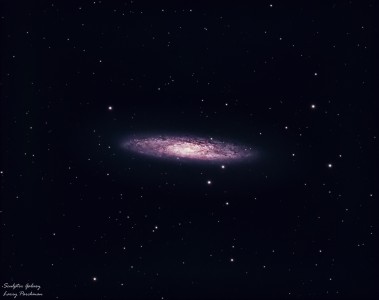
I am new to the thought of CCD imaging. I am new to even using a telescope!! I just got a used 12inch Meade Lx200 classic. I have found every Messier on my starry night program in one great night of viewing. M42 was the most beautiful thing I ever seen. The rest of the galaxies (except for m82 I think) were definite faint fuzzies. I did realize this getting into the hobby. The pictures seen in mags and cheap telescope boxes are time lapse, altered, or Hubble shots. The ccd idea really intrigues me. I am impressed with what can be pulled out of a faint fuzzy. I don’t have a wedge, but she tracks well for extended periods. After research, I want to get a SAC 7 air-cooled (live up north) It seems the best bang for the buck, which I am a little short of !!! I have scope + NGF JMI focus+ meade 2” diag + Sac 7 (I hope).I do realise the swing limit with fork arms. I watched it all night and didn't come too close. Saturn slew 'bout gave me a heart attack lol. The scope is f10 and I understand the Sac7 would give an apparent image like an 8mm eyepiece. I think I will need a focal reducer to get a whole galaxy, for example, on the chip. FINALLY THE QUESTION, sorry!! Should I get the Meade/Celestron 6.3 (130$) screwed in right at the entrance to scope or go for the SAC (95$)version that is both 6.3 and 3.3 with another adapter/tube.It is used at the camera end. SAC claims reducer can be threaded onto eyepieces, 1.25, for use visually. SAC would be cheaper plus I get 3.3, but I am too uneducated to know what I would need. DSO would be primary target with some planet and of course the moon to learn on.
SAC 7,focal reducer,questions on CCD
Started by Dale Ro, 03/04/2004 10:55PM
Posted 03/04/2004 10:55PM
Opening Post
Posted 03/05/2004 01:49AM
#1

Just like everything else in the world, you get what you pay for. The reducer from Meade is 130 dollars because its 2 inches. Sac is 1 1/4 thus only 95 bucks. You should get the same results with whatever you choose. If you start imaging the planets and moon you dont need a reducer. You would use a good barlow lense, increacing the image scale. If imaging the moon you wouldn't even need a barlow to get nice crater images. What you will find out when trying to image dso is you MUST guide somehow. I know your scope tracks nicely visually, but the camera is hundreds of times more sensitive to the slightest movement. In a ALT/AZ mount, which you have, 10 seconds is about all you can do for exposure times before stars will start to be elongated or arches in your images. A lot of dso images need at least a 30 second exposure before you can even see it in your image. My advice, if you care to hear it, would be like you said, image the moon. Image it over and over. Get good at it. Get great at it. You'll only be able to image small sections, so you will have to learn to do mosaics to image to whole moon. Then move on to the planets. Your 12 inch should give you great planet images with lots of practice. Then you can decide if you are ready for DSO. That's when it gets more complicated and more expensive. Remember,baby steps. Good luck!
Funding Member
