

I usually frequent the *other* CCD forum (DSOs), but I did have a chance to observe the impact and I thought I would share my results here....
Like Stefan I also found the calibration challenging even from frame to frame the same evening.
There is a rather large animated Gif of an 18 image sequence. Beware, it is about 6 Megabytes. It can be accessed here:
http://jthommes.com/MiscAstro/Archives/images/DImpact-Tempel1WF-C_JThommes_03_Jul_2005.gif
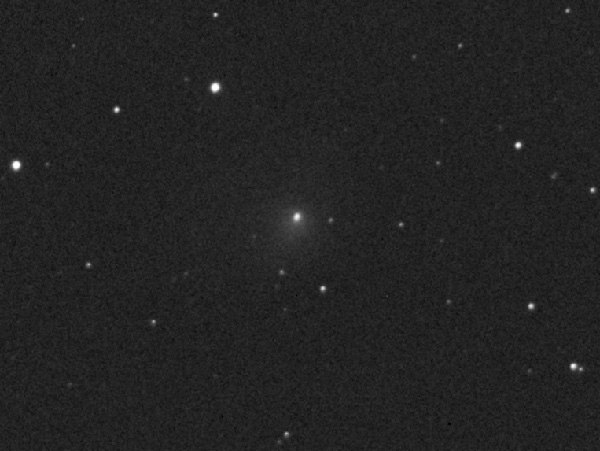
These images were taken in 3 minute intervals (3x50 second stacks) between 5:46UT 4 Jul and 6:44UT 4 Jul. During this time I had observed the peak reading for the comet starting at about 980 and peaking at about 2800 on the Artemis285 camera (Used the focus aid to get these readings). These images are of course stretched a bit for visual purposes, but I did try to calibrate all the frames to a constant peak for the star GSC 5546:1406 (the star between the two brighter stars upper left of the comet). This calibration was the best I could do to keep the visualization constant. Part of the difficulty is that at the end of the sequence, I was shooting very low to the horizon and that tended to interfere with some haze and star bloating.
I think the images tend to show brightening of the comet peaking in the 4th or 5th frame and then holding
This data was captured with my C8 SCT on a GEM mount. The camera was the Artemis285. Filters were for broadband visual light.
Like Stefan I also found the calibration challenging even from frame to frame the same evening.
There is a rather large animated Gif of an 18 image sequence. Beware, it is about 6 Megabytes. It can be accessed here:
http://jthommes.com/MiscAstro/Archives/images/DImpact-Tempel1WF-C_JThommes_03_Jul_2005.gif
These images were taken in 3 minute intervals (3x50 second stacks) between 5:46UT 4 Jul and 6:44UT 4 Jul. During this time I had observed the peak reading for the comet starting at about 980 and peaking at about 2800 on the Artemis285 camera (Used the focus aid to get these readings). These images are of course stretched a bit for visual purposes, but I did try to calibrate all the frames to a constant peak for the star GSC 5546:1406 (the star between the two brighter stars upper left of the comet). This calibration was the best I could do to keep the visualization constant. Part of the difficulty is that at the end of the sequence, I was shooting very low to the horizon and that tended to interfere with some haze and star bloating.
I think the images tend to show brightening of the comet peaking in the 4th or 5th frame and then holding
This data was captured with my C8 SCT on a GEM mount. The camera was the Artemis285. Filters were for broadband visual light.
Attached Image:
Jim Thommes
Mak-Newt 152 mm
C8
Megrez II APO
Zenithstar 66 mm APO
G11/Gemini
ST8300M
Artemis285 Camera
Canon 350D DSLR
http://jthommes.com/Astro/

