Image of the day

Captured by
Byron Davies

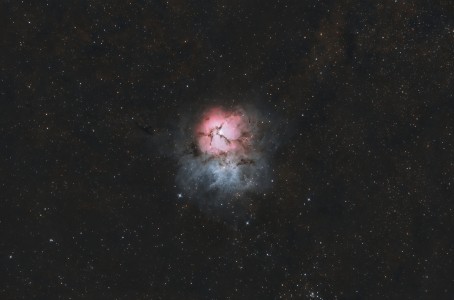
M-20 Trifid Nebula

My Account

New to Astromart?

Register an account...

Need Help?

Well beyond diffraction limit?

Started by jpcannavo, 12/22/2005 02:29PM
Posted 12/22/2005 02:29PM | Edited 12/22/2005 02:29PM Opening Post
Hi all.
As a visual observer who greatly enjoys watching the incredible strides you guys are making, I ask for reactions to the following image:
http://www.buytelescopes.com/gallery/view_photo.asp?pid=7570
It seems that the theoretical resolution limit is being significantly exceeded.
As someone who knows nothing about CCD imaging, I pose what is perhaps a silly question:
Is it possible for the expectations of the imager (based on what they know about the actual details of the target) to somehow be inadvertantly "processed" into the final image.
Joe
Please note, I am in no way challenging integrity here. My question only addresses methodology.

16" F5 "Front Collimating" mirror cell
Posted 12/22/2005 07:36PM | Edited 12/22/2005 07:41PM #1
Hi Joseph,

If not for your exuberance for an image that is so obliviously over processed I would normally not comment on an image like this.
With no disrespect meant for you or the person who took the image this IMO is one of the most over processed images of Mars I have seen in a long time, I think most people that frequent here know that I very seldom say anything negitive about an image and I at first hesitated to say anything about this image.

Thanks,

Wes Higgins

joseph cannavo said:

Hi all.
As a visual observer who greatly enjoys watching the incredible strides you guys are making, I ask for reactions to the following image:
http://www.buytelescopes.com/gallery/view_photo.asp?pid=7570
It seems that the theoretical resolution limit is being significantly exceeded.
As someone who knows nothing about CCD imaging, I pose what is perhaps a silly question:
Is it possible for the expectations of the imager (based on what they know about the actual details of the target) to somehow be inadvertantly "processed" into the final image.
Joe
Please note, I am in no way challenging integrity here. My question only addresses methodology.
Posted 12/22/2005 09:33PM #2
Joseph,

Several interesting topics are raised by your question.

Should there be a distinction between the highest achievable 'visual' image resolution (retina recording/brain filtering) and the highest achievable 'instrument' image resolution (camera recording/digital filtering)? Based on some of the best images posted to this forum, I would say that the question has merit.

Can an imager's prior knowledge of the detail on a planetary disk cause him to "steer" the processing of an image without regard to whether the convolutions are enhancing real detail or just noise and artifacts of previous filters? We all know the answer to this one. A corollary to the issue is: given that we are applying a mixed bag of mathematical convolutions on the same matrix of pixels, shouldn't there be a mathematically correct sequence of filter application in order to maximize resolution? Has anyone worked this out?

Thanks for posting.

Bob

Bob Schnitzer
Grenville Base Observatory - Haymarket, VA
http://www.grenville-observatory.com
16" f18 Royce Conical Dall-Kirkham
10" f16 Parks/Coulter/Novak/Cave Classical Cassegrain
127mm Orion Starmax Mak-Cas
80mm f15 Meade refractor
40mm Tasco variable power tabletop refractor
DMK 31AF03.AS
DBK 21AF04.AS
Posted 12/23/2005 01:25AM | Edited 12/23/2005 01:27AM #3
In my opinion the image is way overprocessed and not comparable even from a distance with many images posted here (except maybe for mine sad )

As far as the very interesting topic of resolution, I'd like to thank Roland for bringing science into the discussion: the only real way of answering this sort of question wink

Ciao all

Luca

PS Merry X-mas to all from Italy. May you spend it well and in the company of the people you really care for.

www.amun-ra.org
Solar Imaging Website
