Image of the day

Captured by
Lawrence Parchman

Sculptor Galaxy (NGC 253)

My Account

New to Astromart?

Register an account...

Need Help?

Which one do you like better? or neither?

Started by gy60356, 08/24/2003 11:02PM
Posted 08/24/2003 11:02PM Opening Post
Forum Member

Join Date: Apr 2002

Location: Morgantown WV, US

Posts: 129

Hi my friends,

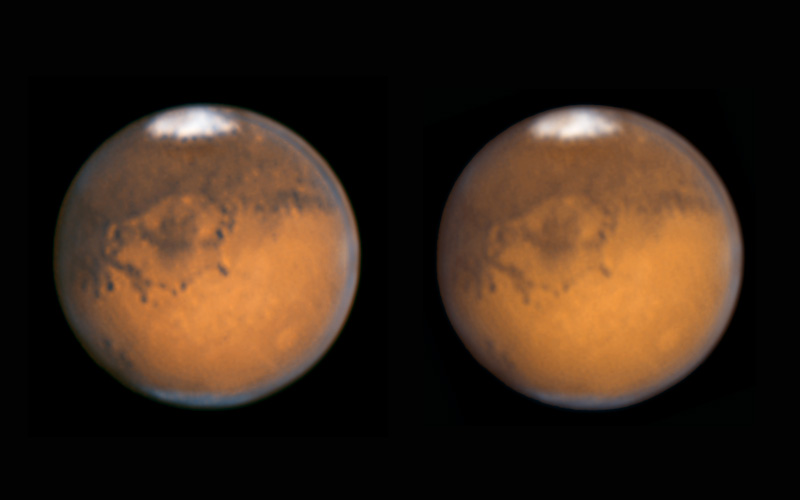
Since the seeing was continuesly bad I spent most of my time on processing the mars. Unlike jupiter or saturn I have big touble to get a nature processing for the red planet. Here are two samples of processing please kindly let me know what do you think.

Clear skies,
GY
http://planets.lamost.org/
Attached Image:

gy60356's attachment for post 8653
Posted 08/24/2003 11:16PM #1
Forum Member

Join Date: Apr 2002

Location: Morgantown WV, US

Posts: 129

To fight against the bad seeing condtion and atomsphere dispersion (From my location mars only reachs 33 degrees above horizon) I was using color filters to get different channels.

My setup is C9.25 + 3X barlow + homemade filter changer + Astronomik filters(Thanks Mr.Sean Walkersmile + ToUcam

Normally I only use Red and Blue filters. The green channel is the average of Red and Blue(according to the S&T article). I found the seeing is always more stable for blue light than the red light (can anybody explane this?) But mars won't give enough blue light to get a good signal noise ratio.

I align all the frames in Registax 2.0 but stack and process them with registax 1.1(which I feel is better for some reason). The finally RGB assembling and adjustment was done in Photoshop.

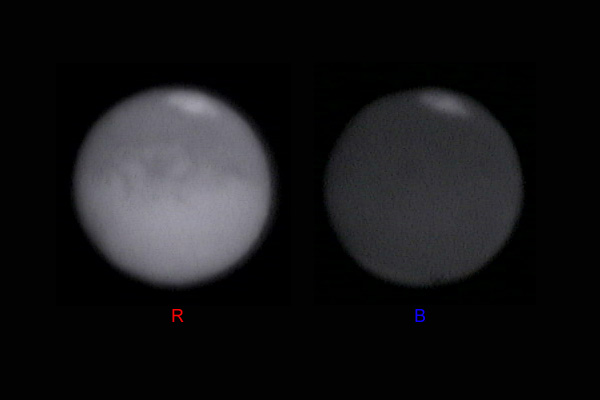
Attached are the typical selected Red and Blue channel raw frames.

clear skies,
GY
http://planets.lamost.org/


Attached Image:

gy60356's attachment for post 70471
Posted 08/25/2003 01:25AM #2
Hi Yu Gu,

I am a rank beginner at this imaging thing and think both of your processed images are great, but the one on the left shows a lot more more detail - but also a stronger halo. Registax2 allows for stacking of both RGB and grayscale (luminace) images. In my limited knowledge from reading current articles, LRGB images seem to produce the most detail without the blue, red or yellow halos you see in a lot of images. The processing call for taking selected images and first making a grayscale image which is then aligned with all of the RGB images, including green. This I think minimizes halos on the right side of the planet. Green images in my limited experience hold quite a bit of information too. Once you add the grayscale image with the RGB, the blue portion of the image gathers a lot of detail as well by pushing the curves in PhotoShop. This LRGB thing is of course not my idea. Ed Grafton mentions it in a current Sky and Telescope issue and he produces consistently excellent images of Mars.

Your images are excellent nevertheless and I wish I could make mine as good.

Take Care,

Jose Suro
Tierra Verde, Florida

Posted 08/25/2003 01:51AM #3
Yu Gu,

For the pure beauty of the image I prefer the
one on the right but the trend seems to be this,
get as much detail as one can by going right up to
the over processed line but not crossing over it and
of course what is over processed to one person may not
be to the next , the image on the left has sharper
details and is not over processed IMO .
They are both excellent! images IMO

Thanks,

Wes Higgins
Posted 08/26/2003 12:07AM #4
Forum Member

Join Date: Apr 2002

Location: Morgantown WV, US

Posts: 129

Hi,

Thanks everybody for the comments. Seems most people think the first one is better because it shows more detail. Actually I like the second one better personally. And I even think the second one is a little overprocessed for my taste. But the problem is the contrast. If I don't process harder the contrast would be too low so the detail won't pop up too well. I think it possibly have something to do with my C9.25's CO and the atomsphere's diturbance. Because throgh my TV102 mars is always contrasty.

But in the other hand if you compare the two image closely the detail in the right one is always "smaller" than the left one which shown the right one actually might have better resolution. This is because the right one lack of high radius sharpening which could wash out the fine detail. It's really a headache to balace the contrast and detail.

Clear skies,
GY
http://planets.lamost.org