im just starting out in astronmy . i have a digital camera that i wanna use to capture shots of the moon. which scope is better for photography ? a 6in. sct or a 8in. newt.also which would be better for a ccd imager .and i dont have a lot of money,but is the celestron neximage ccd a good starter camera?will it work for any deep space objects?
which scope is better for use
Started by bigdaddy692, 11/19/2009 06:04PM
Posted 11/19/2009 06:04PM
Opening Post
Posted 11/24/2009 02:43PM
#1

Don,
Either scope will work...ultimately the mount is going to be the bigger factor in choosing which to use. The 8" newt may yield better resolution, however, if it is on a non-motorized dob mount it may be difficult to track and photograph objects.
The Celestron Neximage is primarily geared for Lunar and Planetary imaging. You will want to use it in conjunction with a good barlow to provide the magnification necessary to bring out Lunar and Planetary detail. You will also find that a motorized focuser is a good investment for achieving fine-focus.
-Gary
There is only one constant in our infinite universe; it is change.
D&G 8” f/15, AP178 f/9, C11, C8, ED80, TV-85, TV101&102, SW120ED, 6"Cave f/8, Solarmax 40, ES127MC,
DM-6, Losmandy Titan 50 GEQ, G11, AP800, ES Twilight-1, UA Unistar Deluxe, WO EZ-Touch,
Denk BVs, 7x50 Fujinons, 10x50 Nikons, 15x70 Astrophysics, 16x70 Fujinons, 22x100 Oberwerks,
Sim Picheloup CPT, Canon 40D, 60Da, Vixen Polarie, SXV-H9, DMK 41AU02, DBK 21AU618,
Shelyak Lhires Lite Spectroscope, Rainbow Optics Spectroscope, Field Tested Systems RSPEC,
Chairman, Southwest Region of the Astronomical League (SWRAL)
President Emeritus, Historian, AL Awards Coordinator, Texas Astronomical Society of Dallas (TAS)
Member/Volunteer, 3RR Comanche Springs Astronomy Campus (CSAC)
ALCOR, Advisor to the Board, Texas Star Party (TSP)
NASA-JPL Solar System Ambassador Volunteer (SSA)
Posted 11/26/2009 05:20AM
| Edited 11/26/2009 06:03AM
#2

Which SCT and newtonian can be significant factors too. Each has it's own peculiarities.
With some SCT's you can have issues with not cooling the scope quickly, rapid dewing on the plate glass holding the secondary, mirror flop or eratic focusing, poor mirror figure, field curvature or floppy hard-to-collimate secondary optics.
An 8" newtonian should give you a higher resolution image than a 6" SCT, but if the focal ratio is fast on the 8" (many 8" newts are lower than f/6 these days) you will probably have to use a strong barlow lens to get decent image scale that would compare with an SCT with a higher f/ratio.
I also agree about the mount, try to get a good mount first (it's really the highest priority), that way you can jack up the magnification and still keep the planet in the field of view long enough to shoot a video clip for stacking. A bad mount makes it difficult to impossible to do planet imaging with good planet size/scale. Get an equatorial mount that can handle the weight of your scope, if you get a 6" SCT, it either comes with a goto mount or is often light enough for a CG-5 class mount, however, if you get an 8" newt, watch the capacity of the mount carefully, some can't handle a steel tube 8" newt satisfactorily.
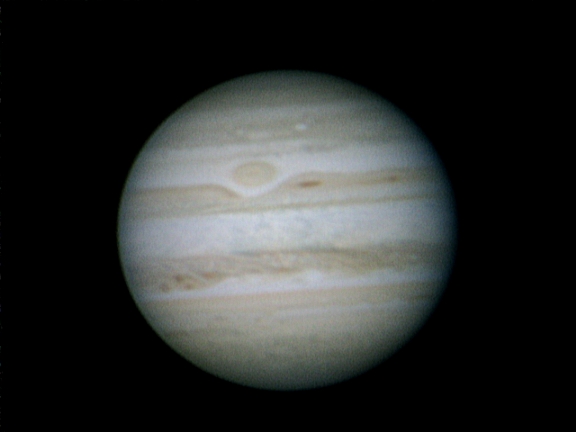
Regarding that camera, if you haven't bought it already, I'd also consider other ones too like a DBK, or use a webcam, or use a point-n-shoot camera if you already have one. Below is my best Jupiter from September this year using a Canon Powershot SX-100 point-n-shoot camera with 10x optical zoom and an old f/7 8" newtonian scope and a TMB 7mm EP.
http://setisociety.org/jupiterMVI_0013sept22amUTdiff.jpg
and below is one of my better Saturn shots from Spring '09 using a Canon Powershot A590 with 4x optical zoom with a 10mm EP and a 2x barlow
http://setisociety.org/Saturn-28-April09-M-1290-r5-s1pt7-reddwn.jpg
And regarding deep space objects, the point-n-shoots can do only a few (but perhaps more than the Neximage Solar System Imager?), here's a link to a gallery of mine done using exclusively point-n-shoot cameras and various (or no) telescopes.
http://www.cfas.org/mediagallery/album.php?aid=20&page=1
The afocal point-n-shoot method is probably the hardest way to go? But it's a way to consider if you don't have money to burn and already have a point-n-shoot camera, and you don't need to have a laptop nearby during shooting!
Regards, Jason Higley.
With some SCT's you can have issues with not cooling the scope quickly, rapid dewing on the plate glass holding the secondary, mirror flop or eratic focusing, poor mirror figure, field curvature or floppy hard-to-collimate secondary optics.
An 8" newtonian should give you a higher resolution image than a 6" SCT, but if the focal ratio is fast on the 8" (many 8" newts are lower than f/6 these days) you will probably have to use a strong barlow lens to get decent image scale that would compare with an SCT with a higher f/ratio.
I also agree about the mount, try to get a good mount first (it's really the highest priority), that way you can jack up the magnification and still keep the planet in the field of view long enough to shoot a video clip for stacking. A bad mount makes it difficult to impossible to do planet imaging with good planet size/scale. Get an equatorial mount that can handle the weight of your scope, if you get a 6" SCT, it either comes with a goto mount or is often light enough for a CG-5 class mount, however, if you get an 8" newt, watch the capacity of the mount carefully, some can't handle a steel tube 8" newt satisfactorily.
Regarding that camera, if you haven't bought it already, I'd also consider other ones too like a DBK, or use a webcam, or use a point-n-shoot camera if you already have one. Below is my best Jupiter from September this year using a Canon Powershot SX-100 point-n-shoot camera with 10x optical zoom and an old f/7 8" newtonian scope and a TMB 7mm EP.
http://setisociety.org/jupiterMVI_0013sept22amUTdiff.jpg
and below is one of my better Saturn shots from Spring '09 using a Canon Powershot A590 with 4x optical zoom with a 10mm EP and a 2x barlow
http://setisociety.org/Saturn-28-April09-M-1290-r5-s1pt7-reddwn.jpg
And regarding deep space objects, the point-n-shoots can do only a few (but perhaps more than the Neximage Solar System Imager?), here's a link to a gallery of mine done using exclusively point-n-shoot cameras and various (or no) telescopes.
http://www.cfas.org/mediagallery/album.php?aid=20&page=1
The afocal point-n-shoot method is probably the hardest way to go? But it's a way to consider if you don't have money to burn and already have a point-n-shoot camera, and you don't need to have a laptop nearby during shooting!
Regards, Jason Higley.
Attached Image:
Funding Member
