I just got a used modified camera (Nikon D50), and am happy to finally be able to capture more H-alpha. So I'm wondering, would it make sense at all to use an H-alpha filter for some of the frames, and "RGB" for others? I know the CCD'ers do it...would it do any good on a DSLR?
H-alpha filter on a DSLR
Started by Steve OK, 02/14/2009 03:54PM
Posted 02/14/2009 03:54PM
Opening Post
Posted 02/19/2009 08:30PM
| Edited 02/19/2009 09:08PM
#1
Hi Steve,
I think that make sense if you can take care of some details.
1. With an H-alpha filter, only 1/4 of the pixels are active. To maintain resolution in the H-alpha channel, you may want to try drizzle when you stack the images. The Bayer Drizzle function in DeepSkyStacker is especially effective for this purpose.
2. With an H-alpha filter, you get good S/N on red nebulars, but relatively poor S/N on every other part of the image. To use such images to enhance the nebulas in your final RGB image without degrading the image quality (S/N), the H-alpha exposure should be sufficiently long. I would say, the H-alpha total exposure time should be comparable to the RGB total exposure time, at least 50% of the RGB.
3. You probably need to be careful when you merge the H-alpha image and the R image. By giving different weights to the images, one can choose to optimize the S/N or to optimize the red nebula enhancement, or something in between.
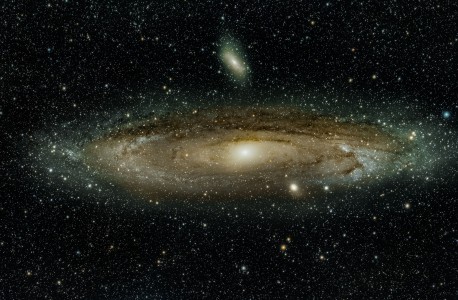
This is an image I took with normal RGB plus H-alpha:
http://www.aoc.nrao.edu/~whwang/gallery/picutres/M31-2008.html
The H-alpha here is not really an H-alpha filter, but a deep red filter cut off at 6400A. It does enhance the red part of the image. However, the H-alpha exposure in this image is too short. It should be at least 2x longer.
Cheers,
Wei-Hao
Wei-Hao Wang
http://www.aoc.nrao.edu/~whwang
Posted 02/20/2009 04:24AM
#2

Steve,
I have a modified Canon 350D. You may know that Astronomik makes an EOS clip with H-Alpha 13nm bandpass. here are some images:
http://www.jthommes.com/Astro/DSLR/NGC1499.htm
http://www.jthommes.com/Astro/DSLR/M42-NGC1977.htm
http://www.jthommes.com/Astro/DSLR/IC1318.htm
In general, I have to say I am more successful in narrowband imaging with my CCD camera (dedicated astro camera). It seems that the big challenge is noise and dynamic range. Seems that the finer details suffer with a DSLR than with a CCD, yet some reasonable results can still be achieved.
Jim Thommes
Mak-Newt 152 mm
C8
Megrez II APO
Zenithstar 66 mm APO
G11/Gemini
ST8300M
Artemis285 Camera
Canon 350D DSLR
http://jthommes.com/Astro/
Funding Member
