Even though I have an Olympus E-1 DSLR (which I bought mostly for daytime use), I still rely on my Olympus OM-1N and OM-4T 35 mm cameras for astrophotos. Usually, I set one on a tripod for star trails and use the other for wide-field piggyback shots.
However, during a recent trip to Courtright Reservoir (8200' elev. in the central Sierra Nevada Mountains in CA), one of my cable releases decided to not lock tight. So, I put one of the 35 mm cameras away and put the E-1 on the piggyback mount.
The attached photo is my first non-Moon astrophoto with the E-1. This was shot at ISO 400 through a 14-54 mm zoom (angle of view equivalent to 28-108 mm in 35 mm) at 14 mm and f/2.8. Length of exposure was 4.4 minutes. There is some noise in the image that I haven't cleaned up yet. The red sensitivity is better than I expected (Lagoon Nebula, not the red flashlights!), though it's nowhere as strong as the modified N and C cameras.
Fred
However, during a recent trip to Courtright Reservoir (8200' elev. in the central Sierra Nevada Mountains in CA), one of my cable releases decided to not lock tight. So, I put one of the 35 mm cameras away and put the E-1 on the piggyback mount.
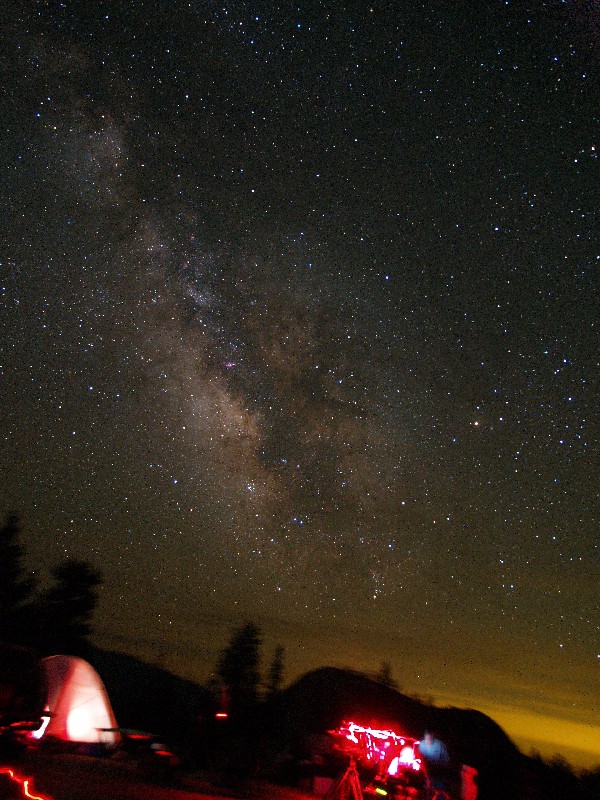
The attached photo is my first non-Moon astrophoto with the E-1. This was shot at ISO 400 through a 14-54 mm zoom (angle of view equivalent to 28-108 mm in 35 mm) at 14 mm and f/2.8. Length of exposure was 4.4 minutes. There is some noise in the image that I haven't cleaned up yet. The red sensitivity is better than I expected (Lagoon Nebula, not the red flashlights!), though it's nowhere as strong as the modified N and C cameras.
Fred
Attached Image:

