
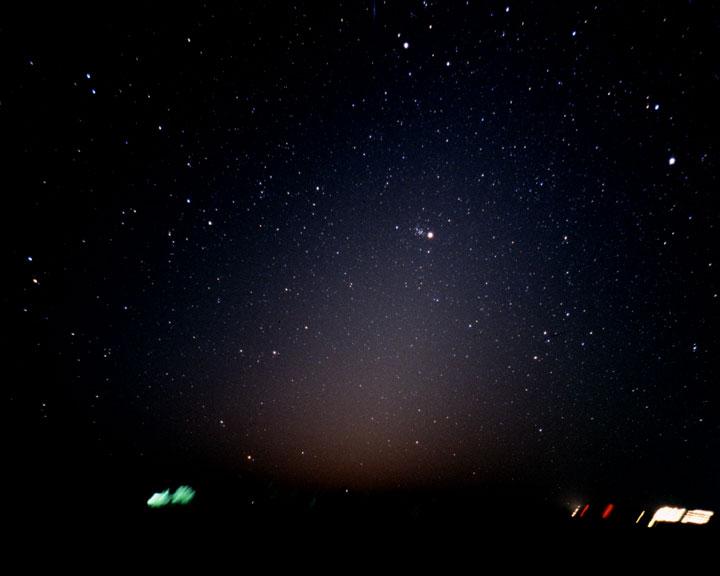
Here's the nasty light that was messing up my Eastern Horizon photros this month! This is the Zodiacal light, which occurs in the early morning hours before dawn. This is NOT an early sunrise, nor anything in our atmosphere.
The Zodiacal Light is actually dust in our solar system! The dust released into our solar system by comets and asteroids undergoes a complex evolution. Initially distributed in the trails that cause meteor showers, the dust eventually disperses into the ecliptic plain (the ecliptic plain, is the plain in which the planets move around the sun). The smallest dustparticles are blown out of the solar system by the sun’s radiation. The larger dustparticles gradually spiral inwards towards the sun, and together form a flattened disc in the ecliptic plain in the inner part of the solar system. This disc of dust is composed of dustparticles with sizes between 0.1 and 100 micrometer.
You need a dark sky to see this, as it is very faint - but can obliterate astrophotos!
September 7th, 2005. 25 minute exposure with a 28mm F/5 lens. Fujichrome 400F Provia.
Photographed in central New Mexico at an altitude of 6500 feet.
CF
The Zodiacal Light is actually dust in our solar system! The dust released into our solar system by comets and asteroids undergoes a complex evolution. Initially distributed in the trails that cause meteor showers, the dust eventually disperses into the ecliptic plain (the ecliptic plain, is the plain in which the planets move around the sun). The smallest dustparticles are blown out of the solar system by the sun’s radiation. The larger dustparticles gradually spiral inwards towards the sun, and together form a flattened disc in the ecliptic plain in the inner part of the solar system. This disc of dust is composed of dustparticles with sizes between 0.1 and 100 micrometer.
You need a dark sky to see this, as it is very faint - but can obliterate astrophotos!
September 7th, 2005. 25 minute exposure with a 28mm F/5 lens. Fujichrome 400F Provia.
Photographed in central New Mexico at an altitude of 6500 feet.
CF
Attached Image:


