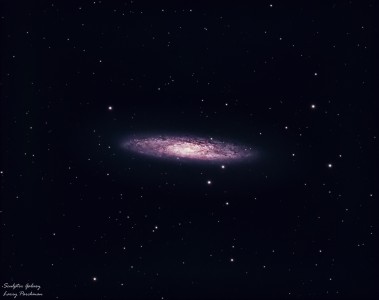
Image of the day

Captured by
Lawrence Parchman

Sculptor Galaxy (NGC 253)

My Account

New to Astromart?

Register an account...

Need Help?

Posts Made By: Dennis Persyk

May 1, 2005 08:23 PM Forum: CCD Imaging and Processing/Solar System

64 Days to Deep Impact … and Counting

Posted By Dennis Persyk

Many of you have read the articles in Sky and Telescope and Astronomy magazines highlighting the upcoming Deep Impact NASA experiment. I imaged the comet on May 1st. Images and accompanying data at
http://home.att.net/~dpersyk/new.htm

Tak E160 with SXV-H9 guided by NP101 with MX-716.

The image comprises 3 x 3 minutes and 15 x 3 with the E160 and SXV-H9 camera, binned 2x2. I have added isophote and color intensity contours and some additional supporting data to my New Images page. I was surprised that the additional 36 minutes, a factor of 4 longer, did little to improve the SNR. Somehow this comet does not seem obey statistics!

My sincere thanks to Jeff Terry for loan of the H9 camera.

Thank you for visiting my site.

Clear skies,

Dennis Persyk
Igloo Observatory Home Page http://dpersyk.home.att.net
Hampshire, IL

New Images http://home.att.net/~dpersyk/new.htm

May 8, 2005 02:58 PM Forum: CCD Imaging and Processing/Solar System

NGC 3628

Posted By Dennis Persyk

Here is my LRGB image of NGC 3628:
http://home.att.net/~dpersyk/new.htm

50 minute lum and 20 minute each RGB; True Technology Filters; SXV-H9 and Takahashi E160 guided by MX716 on NP-101.

It is actually a crop from my previous Leo Trio image. I discovered that there was a lot of detail lurking beneath the unprocessed region of the dust lane which I deftly coaxed out with the new (Beta 11) version of ImagesPlus. It has an Adaptive Richardson-Lucy deconvolution algorithm. One simply defines an intensity window encompassing the region of interest and/or color layer. This is much easier to use and affords more control than PhotoShop’s lasso and layers – at least with my limited understanding of PS.

I’ve never had an image before with this much detail in the dust lane so I’m unsure of what it should look like. I may have over processed it a bit – if so, it is not the fault of ImagesPlus, but rather my judgment. Comments on the image and processing are most welcome.

Thank you for visiting my site.

Clear skies,

Dennis Persyk
Igloo Observatory Home Page http://dpersyk.home.att.net
Hampshire, IL


May 12, 2005 06:40 PM Forum: CCD Imaging and Processing/Solar System

9P/Tempel 1 Rendezvous with NGC 4779

Posted By Dennis Persyk

On July 4, the NASA Deep Impact probe will crash into periodic comet 9P/Tempel 1. Hopefully the impact will cause a dramatic increase in brightness. Meanwhile, I have been imaging 9P as it slowly wends its way through Virgo. On May 10th it was close to NGC 4779, providing a nice photo op. Images and accompanying data at
http://home.att.net/~dpersyk/new.htm

NOAA weather radio reported an “upper level disturbance” over the region. It sure disturbed the seeing! I had great difficulty focusing and guiding in what seemed to be Pickering 1 skies. My image scale of 5 arc seconds per pixel (2x2 binning at 530 mm focal length) seemed to overcome the terrible seeing.

Thank you for visiting my site.

Clear skies,

Dennis Persyk
Igloo Observatory Home Page http://dpersyk.home.att.net
Hampshire, IL

New Images http://home.att.net/~dpersyk/new.htm

May 17, 2005 06:20 PM Forum: CCD Imaging and Processing/Solar System

New R-L Deconvolution Operator in ImagesPlus

Posted By Dennis Persyk

Here is my LRGB image of M66 using the new operator:
http://home.att.net/~dpersyk/new.htm

50 minute lum and 20 minute each RGB; True Technology Filters; SXV-H9 and Takahashi E160 guided by MX716 on NP-101.

The latest ImagesPlus 2.5 has an Adaptive Richardson-Lucy deconvolution algorithm. One defines an intensity window encompassing the region of interest and/or color layer. This is much easier to use and affords more control than PhotoShop’s lasso and layers – at least with my limited understanding of PS.

It seemed that I was able to perform selective sharpening of the galaxy arms without increasing the noise in the areas of faint nebulosity or creating ringing on the stars. I defined a luminosity window that excluded the faint luminosity on the low end and the bright stars on the high end. This provided a pleasing sharpening effect without the attendant problems one often sees with R-L deconvolution.

Comments on the image and processing are most welcome.

Thank you for visiting my site.

Clear skies,

Dennis Persyk
Igloo Observatory Home Page http://dpersyk.home.att.net
Hampshire, IL


May 25, 2005 04:52 PM Forum: CCD Imaging and Processing/Solar System

C/2004 Q2 Machholz sprouted a longer tail

Posted By Dennis Persyk

With a full moon I decided to image a couple of comets. I started out with 9P Tempel 1 and then moved on to Q2 Machholz. Inspection of the subframes of Q2 during acquisition indicated a longer tail than I’ve imaged recently, bright moonlight notwithstanding. When I processed 80 minutes of 60 second subframes I was greeted with a 27 arc minute tail. This seems longer than I’ve seen in recent images of Q2. I’d appreciate any inputs as to the significance of my seemingly longer tail observation.

I believe I’ve correctly oriented the image with North up/East to left, but Guide 8 depicts the tail trailing to the Southeast. Comments?

Image comprises 80 minutes of 60 second subframes. Takahashi E-160 f/3.3 astrograph and SXV-H9 camera on AP1200GTO mount,

Image and supporting information at
http://home.att.net/~dpersyk/new.htm

Thank you for visiting my site.

Clear skies,

Dennis Persyk
Igloo Observatory Home Page http://dpersyk.home.att.net
Hampshire, IL


June 2, 2005 04:56 PM Forum: CCD Imaging and Processing/Solar System

M86 et al.

Posted By Dennis Persyk

Here is my LRGB image of M86 and surrounds:
http://home.att.net/~dpersyk/new.htm

120 minute lum and 30 minute each RGB; True Technology Filters; SXV-H9 and Takahashi E160 guided by MX716 on NP-101; AP1200GTO mount.

Comments on the image and processing are most welcome.

Thank you for visiting my site.

Clear skies,

Dennis Persyk
Igloo Observatory Home Page http://dpersyk.home.att.net
Hampshire, IL


June 7, 2005 05:03 PM Forum: CCD Imaging and Processing/Solar System

New Comet C/2005 K2 Movie

Posted By Dennis Persyk

Comet movie (dial-up modem friendly) , images and supporting data at
New Images
http://home.att.net/~dpersyk/new.htm

New comet C/2005 K2 LINEAR was discovered on May 19th and is brightening very rapidly. I imaged it in Ursa Major at magnitude 12.3 . Takahashi E-160 and SXV-H9 camera binned 2x2.

I have included a modem-friendly movie (38 kb) GIF that shows K2 streaking
across 9.3 arc minutes of Ursa Major. That comet is really racing across the FOV!

The comet is moving very fast relative to the star field at 7.0 arc seconds per minute. I tried autoguiding but there were too many stars and the autoguider software (MaximDL 3.20) would get lost when the comet head bumped into a star. I finally settled on 90 second unguided frames for my 5 arc second per pixel image scale.

On my web page I have a color-intensity that illustrates the kind of artifacts that one can generate with our powerful processing software! It looks like there are jets emanating from K2. However, the “jets” are in act nothing more than remnants from the median combine star trails that have been smoothed out. I find that one has to be careful in digging out faint structure in comet images lest one create something that is really not there.

At first I was unable to find K2 in SkyMap Pro using two day old ephemeredes. I obtained fresh ephemeredes and the declination difference was 34 minutes between new and old! The orbital parameters’ accuracy must be improving daily!

Please take a look at my images of this exciting new comet.

Clear skies,

Dennis Persyk
Igloo Observatory Home Page http://dpersyk.home.att.net
Hampshire, IL

New Images http://home.att.net/~dpersyk/new.htm


June 11, 2005 04:30 PM Forum: CCD Imaging and Processing/Solar System

(OT) Heads Up on Comet K2 LINEAR

Posted By Dennis Persyk

Comet C/2005 K2 Linear is brightening at a furious rate and is now the brightest comet in the sky! Seiichi Yoshida
http://www.aerith.net/comet/weekly/current.html
has it at the top of his list of bright comets at magnitude 8.5 .

I have a recent modem-friendly movie and supporting information on it at
http://home.att.net/~dpersyk/new.htm

Be forewarned! K2 is a very fast-moving comet. It is racing along at 7.8 arc seconds per minute relative to the fixed star fields in Ursa Major. It is imperative that you use fresh ephemeredes to locate it. I’d suggest
http://www.cfa.harvard.edu/cfa/ps/Ephemerides/Comets/2005K2_1.html
but even then you only have it located to within a day. You will note that its coordinates are changing considerably from one day to the next.

I use my planetarium programs (SkyMapPro and Guide 8) with fresh ephemeredes to help me locate the comet.

At magnitude 8.5 it should be an easy target for most scopes, but you may have to hunt around for it a bit if you do not have exact coordinates. This comet is quite unusual and may not last much longer, so I urge you to grab it while you can.

Clear skies,

Igloo Observatory Home Page http://dpersyk.home.att.net
Hampshire, IL

New Images http://home.att.net/~dpersyk/new.htm

June 22, 2005 08:21 PM Forum: CCD Imaging and Processing/Solar System

NGC 4631 “The Whale” et al.

Posted By Dennis Persyk

Here is my image of NGC 4631 and surrounding galaxies:
http://home.att.net/~dpersyk/new.htm

80 minute lum and 20 minute each RGB; True Technology Filters; SXV-H9 and Takahashi E160 guided by MX716 on NP-101; AP1200GTO mount.

I also made a composite of NGCs 4631 and 4656 as they are rather spread out in the full-field view.

Comments on the image and processing are most welcome.

Thank you for visiting my site.

Clear skies,

Dennis Persyk
Igloo Observatory Home Page http://dpersyk.home.att.net
Hampshire, IL


June 30, 2005 04:17 PM Forum: CCD Imaging and Processing/Solar System

Green Whale becomes Blue Whale

Posted By Dennis Persyk

Several astute whale-imagers commented that my original NGC 4631 “Whale” was weak in blue. I accordingly increased the blue intensity in Photoshop and have reposted the before and afters in the link below. Comments on proper color and anything else will be appreciated.

http://home.att.net/~dpersyk/new.htm

80 minute lum and 20 minute each RGB; True Technology Filters; SXV-H9 and Takahashi E160 guided by MX716 on NP-101; AP1200GTO mount.

Thank you for visiting my site.

Clear skies,

Dennis Persyk
Igloo Observatory Home Page http://dpersyk.home.att.net
Hampshire, IL