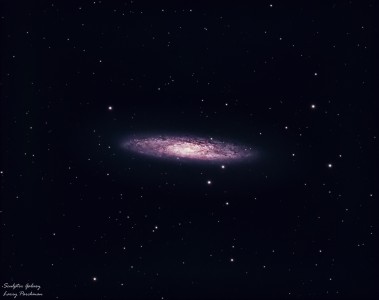
Image of the day

Captured by
Lawrence Parchman

Sculptor Galaxy (NGC 253)

My Account

New to Astromart?

Register an account...

Need Help?

Posts Made By: Jarad Schiffer

March 9, 2005 09:57 PM Forum: Equipment Talk

Focuser travel

Posted By Jarad Schiffer

Floyd -
What is the range of focus positions for your eyepieces? If they are all TV's, you can go to the TV website and see on the eyepiece specifications table. You need enough focus travel to cover the range from the eyepiece with the most in-travel to the one with the most out-travel, plus some extra to allow people with different eyesight to accomodate their eyes (probably add 1/2" to the range of eyepiece focal plane positions).

As far as your adapter plate, if you need a bit more out-travel than you have, you may have the primary too high in the cell. You can adjust the collimation bolts to lower the primary as far as possible, then recollimate. That may gain you 1/4-1/2", and have the additional advantage of gaining you a bit of field illumination from the lower secondary-focal plane distance.

Jarad


March 21, 2005 02:41 PM Forum: Equipment Talk

Curved Spiders

Posted By Jarad Schiffer

Floyd -
Head over to Cloudy Nights - there is a very long thread in the equipment forum that has a lot of info on this:
http://www.cloudynights.com/ubbthreads/showflat.php/Cat/0/Number/360923/page/0/view/collapsed/sb/5/o/all/fpart/1

You might want to do a quick search through the reflector and ATM forums as well - there have been various threads on curved spiders in both over the last year or so. Too much info to repost here.

Jarad


April 5, 2005 06:13 PM Forum: Equipment Talk

14" Tscope big jump from C9.25?

Posted By Jarad Schiffer

Normally I would say that a 14" is a big improvement over a 9.25". But I would also say that it was not a big improvement over a 12.5". So my main comment would actually be that if you want to see a big improvement, get to a darker site.

I have had scopes from 80mm to 18". On DSO's, the number 1 thing is dark skies. The 80mm will literally show you almost as much from a dark site as the 18" will from a heavily light polluted site. A 10" will show far more from a dark site than an 18" in light pollution. If you didn't notice much improvement in the views with the 12.5", then I suspect the culprit is light pollution. If the background is as bright or brighter than the object, no amount of aperture is going to increase the contrast (you have to have some contrast to start with).

So, at a dark site, I would expect the 14" will be significant improvement over the 9.25". But I think taking the 9.25" to a dark site will be better than the 14" in your dirveway, at least for DSO's. If the 14" has good optics, it should also do better on the moon, planets, small glob's, doubles, and with a good filter will probably do better on small nebula's too. Those will all be benefits even under light pollution, but the faint stuff really needs dark skies.

Jarad

April 6, 2005 01:09 PM Forum: Equipment Talk

Wanted: Opinions on an exceptional planetary scop

Posted By Jarad Schiffer

I think any of the premium dobs in the 14.5"-18" size will do what you are looking for. Starmaster is an excellent choice (get the GOTO for planets), or a Portaball with a platform, or an Obsession with Servo-Cat, etc. Make sure you collimate it well, and you'll get great views.

Jarad

April 7, 2005 01:29 PM Forum: Equipment Talk

Apeture and Focal Length

Posted By Jarad Schiffer

Well, it depends on what you want to do with it. The FL is only critical for prime focus photography (in which case you usually want it to be shorter, since you can always make it longer with a barlow or eyepiece projection). Other than that, you can get the same magnification just by using different eyepieces. And a 150mm difference out of 3000+ really isn't going to make much difference. So a scope with a 2000mm FL using a 20mm eyepiece gives the same 100x that a 3000mm FL scope gives with a 30mm eyepiece.

Focal length does not add resolution. APerture does, and adds light gathering as well. I am not sure what you think the FL gains you except about 5% more mag with the same eyepiece (but the Tak will be able to reach both slightly wider max TFOV and noticeably higher max mag than the TEC).

What exactly do you want the scopes for? Are you planning to do photography? Or is it mainly visual use? Portability is an issue with any scope, unless you have an observatory for it, but I am not sure what benefit you will get from the longer FL.

Jarad

April 13, 2005 01:32 PM Forum: Equipment Talk

Very lightweight dobs in the 15 - 20-inch range

Posted By Jarad Schiffer

For compactness, I have 1 recommendation and one "suggestion".

The recommendation is for a Portaball. The Portaball is a very compact scope with excellent optics. I have one, you can read my review of the 14.5" on Cloudy Nights. An 18" version is due to be debuted at NEAF (this weekend, I think).

The "suggestion" is one I have no personal experience with, but it looks very interesting to me. Check the Johnsonian website for info on their "pop up" dob. Again, I can't truly give a recommendation since I have never seen one in person, but it looks like a very interesting concept to me.

Jarad

April 14, 2005 12:56 PM Forum: Equipment Talk

Orion (Synta) 80 ED X William Optics Zentihstar 80

Posted By Jarad Schiffer

The ED-80 will have better optics. The Zenithstar will have better mechanics.

Jarad

April 15, 2005 01:45 PM Forum: Telescope Making

Why No BVC??

Posted By Jarad Schiffer

I asked this on the Zambuto Mirror Yahoo Group. Part of it is, as Herbert said, being conservative. If the current glass is working well, it will take a convincing reason to change. Carl did comment that he had seen one BVC mirror that had problems with primary ripple and astigmatism, and that they seemed to be due to the softness. He thought (although he can't be sure) that the polishing lap squares may have been biting too deep and causing the ripple. He wasn't sure about the astigmatism, but if the softness isn't uniform, that could cause it. Another ATM also reported issues with difficulty polishing due to the softness (he was getting a rougher finish and more scratches than with glass).

You can read the discussion here:
http://groups.yahoo.com/group/zambutomirrorgroup/

Although it wasn't mentioned, I would also think that a softer mirror substrate would require more support points in the mirror cell as well. If you can look up the Poisson, Modulus, and density of BVC, you can enter them into PLOP and try a few runs to see.

Jarad

April 26, 2005 06:47 PM Forum: Eyepieces

please critique my eyepiece collection

Posted By Jarad Schiffer

A few comments:

The 40mm eyepiece is too large of an exit pupil for the 10". Also, if it is a 1.25" plossl, it is giving the same true field as a 32mm plossl would (i.e. narrower TFOV). So I would dump that one for either a 32mm plossl (cheapest option) or a 2" widefield eyepiece in the 30-35 range. If you want to stick to 1.25" eyepieces than maybe swap both the 40mm and 25mm for a 24 pan.

You might find that the 10mm radian is a bit redundant with the 7mm nagler (about the same TFOV), so if you notice that it doesn't get much use, I would consider selling that one. I found this to be the case when I had both a 13 nagler and an 18 radian (same TFOV, 18 didn't get used any more).

The spacings look good at the high end. If you find it hard to track with the 5mm and 3.7mm, you might consider upgrading them to naglers or Pentax XW's someday for the wider FOV. Not urgent, and pricey, so only do it if the narrow FOV bothers you in terms of tracking the dob.

Lastly, I know you said you wanted to avoid barlows, but I find that using a 2.5x powermate with my nagler T6s works very well. I have the 13, 9 and 7, which with the powermate gives 5.2, 3.6, and 2.8. It allows you to get the wider FOV without costing quite as much (3 naglers plus a powermate vs. 6 naglers).

Hope this helps,

Jarad


May 2, 2005 12:31 PM Forum: Equipment Talk

Paracorr and CCD

Posted By Jarad Schiffer

Not exactly. You need to have 55mm + 4mm (actually, are you sure that isn't +/-4mm?) from the paracorr rear lens to the ccd camera. You may or may not need to use some type of tube extender to achieve this, depending on your CCD camera's layout. The paracorr's rear lens will be well down in the focuser tube. To figure out your back-focus, add 9mm to the distance from the top of the focuser to your CCD chip for your camera. That should let you get the CCD chip to the focal plane with the paracorr in place. Actually, I would add 5mm or so more for slop. And don't forget that you mirror collimation bolts can also move the mirror up and down in the OTA a bit.

Jarad