Image of the day

Captured by
Yue Ma

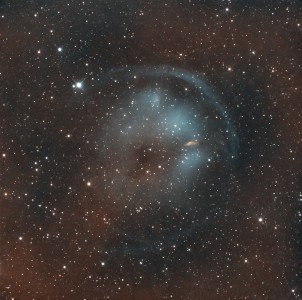
HFG-1

My Account

New to Astromart?

Register an account...

Need Help?

Posts Made By: Inge Skauvik

November 11, 2005 06:20 AM Forum: Deep Sky Observing

IC1396

Posted By Inge Skauvik

IC1396 is a large, scattered open cluster with some nebulosity involved located near the "Garnet star", Mu Cephei. The diameter of the nebula is about 3 degrees, and it is quite faint, but it is a popular target for people doing imaging since it has an interesting appearance with several dark lanes.
It is claimed to be visible in binoculars and small telescopes at low power. With bigger scopes and higher magnification it is very difficult, but narrowband filters are said to enhance the nebula. However, I have read some contradictory statements about O-III vs. UHC. In spite of repeated attempts I have never been able to make out IC1396. I have tried with and without O-III with no success.
It would be interesting to hear if any keen-sighted observer has any experience with this nebula.
The cluster itself is a bit too scattered to be really interesting in a big scope, but it contains a nice triple with a wide double nearby and the star field is very rich and beautiful.

Inge S

November 22, 2005 06:36 PM Forum: Astro Binoculars

Question from a novice

Posted By Inge Skauvik

I use mid-size telescopes regularly, and at present my workhorse is a 12.5-inch Portaball. Lately, however, I have been thinking about acquiring a small telescope for observation of extended objects. To begin with I checked the small refractor market. Very interesting, and a lot to choose from. However, I figured out that maybe a pair of binoculars would be an even better choice. The problem is that I know very little about binoculars, having only a very lousy pair of 10x50's at home. What should I look for when selecting binoculars for astronomy? Are there any pitfalls? I see that there is a very wide range of prices for the same aperture. Are the most expensive ones worth the price? Any recommendations as to brand etc? What about the second hand market?

Inge S

November 25, 2005 07:20 AM Forum: Deep Sky Observing

Deep sky objects observed 24th of November 05

Posted By Inge Skauvik

Yesterday night the sky cleared up in spite of bad weather forecasts, and I used the opportunity to make a combined DSO and double star session. At this time of the year, observing conditions very seldom are good enough for observing, therefore I started the session observing some Cetus objects.
The planetary, NGC246, was one of the most fun objects I ever observed. There was some distrubing light from Stavanger, therefore the nearby guide stars could hardly be seen with the naked eye. However, I noticed a group of faint stars that seemed to be embedded in some nebulosity. Applying the O-III filter the nebula popped out, almost like a miracle. I found it large and round with hint of some structure. A part of the edge was very sharply defined. Very good object using the O-III.
I also checked the region near M77, to see if I could spot some of the other galaxies in the group. M77 itself appears extremely bright, but quite small. I hoped to spot four more galaxies, but could make out only two, NGC1087 and 1090. In this part of the sky, the Stavanger light was pretty annoying.
I spent quite some time with M33. Its spiral structure is pretty obvious with the 12.5-inch, particularly the north-western arm with the emission region, NGC604 is prominent. Also NGC592 was very clear, while I found NGC588 and 595 (all emission regions of the Pinwheel galaxy listed with separate NGC numbers) more difficult. I switched between the 24mm Panoptic (63x) and the 9mm Nagler (167x). M33 demonstrates that I need an eyepiece giving a power in between, probably a 13mm Nagler.
The great Andromeda galaxy was a marvellous sight this evening. Two distinct absorbing lanes running parallel on the western side of the galaxy were obvious, and the NGC206 patch was bright.
I also reviewed the companion galaxies, including NGC185 and NGC147. With my aperture none of them are really difficult. It is very interesting to move between 147, 185 and the smaller, more distant NGC278. It is almost hard to believe that they all belong to the same class of objects.
I observed several galaxies, clusters and nebulae in addition to those already mentioned. At 167x it was possible to see hints of the filamentary structure of the Crab nebula. The visual impression in the eyepiece reminds me of the photo in Kepple&Sanner, Vol.1 p.385.
I scrutinised NGC1931 (Auriga) at 375x, to get a really good look at the stars involved. Actually this nebula contains a triple where the stars (not exactly the same magnitude) form an almost equilateral triangle.
I was not able to capture the spiral structure of NGC2403 in Camelopardalis. Somehow I find the foreground stars to be a bit disturbing. Maybe a 13mm Nagler will help.

Inge S

December 4, 2005 09:28 PM Forum: Deep Sky Observing

Observations with 18-inch 24th of November

Posted By Inge Skauvik

My working schedule and a bad cold have prevented me from reporting these observations earlier. It was a very fun session where we observed a wide variety of different objects including some double stars already reported.
As a warm-up of the session we observed the Owl nebula, M97, and nearby galaxy, NGC3556. Averted vision was necessary to see the "eyes" of the owl. The galaxy, on the other hand, showed several absorbing bands. This galaxy reminds me a lot of M82, but has a relatively bright foreground star near the middle. A dark lane unds parallel with the galaxy past this star, and thickens at one side of it.

Next on the list was the galaxy trio, NGC4291, 4319 and 4386 in Draco. Even in the 18-inch these are just fuzzyballs, but we were using 4319 as a guide to the remote quasar, Markarian 205. This is the first quasar I ever observed visually. Appearing like a 14th magnitude star, it was still a great experience to contemplate on the vast distance of 1300 million light years.
Then we paid M81 and M82 a visit. I find the spiral arms of M81 very difficult to detect even with this aperture. It helps to know exactly where they are, but I probably wouldn't see them if I didn't know they were there. M82 was, as always a magnificient object, with a very high surface brightness and many dark gas clouds.
Next we had an open cluster tour in Auriga, starting with great M37. With 18 inches of aperture it is not only the bright central star that shows colour. Several fainter orange stars can be seen and the cluster is a very beautiful sight. M36 in comparison appears loose and scatteres, most stars being bluish white. On the route to M38 we also had a look at the gaseous nebula, NGC1931. Last time I observed this nebula with the 12.5-inch I had to use a lot of magnification to verify the presence of three stars in the nebula. This time all three stars stood clearly out at a power of 97x.
M38 appears large and scattered, but the stars form very nice patterns. Nearby cluster, NGC1907, stood very well out in the rich star field. Actually I find this a very good cluster even with a much smaller scope.
M33 was a magnificient sight in the 18-inch. Even an unexperienced observer would see the spiral pattern at first glance, and the emission regions were very conspicuous. We spent a lot of time just admiring the view. M33 seems to be an object that responds particularly well to aperture.
Of course we didn't miss M31 and its two close companions. When time permits, we hope to locate some of its globulars. Gemini contains some interesting planetaries. This evening we chose NGC2371/72, located not far from Castor. I use to call this one the "Peanut nebula" for obvious reasons.
At this time the constellation of Monoceros had risen high enough for observation. We switched to the 31mm Nagler, and after having adjusted the focus (at a more or less random position) I noticed a small nebula, comet shaped with a star at its apex. First I thought it was Hubble's variable nebula, but I realised that this one was fainter. It turned out to be NGC2245, pretty good object for the aperture. After a short glance at the Christmas tree cluster, we turned to the Rosette complex. Some nebulosity was visible north east of the central cluster without a filter. On this object the O-III works miracles. A lot of detail became visible. Many bok globules vere easily seen, and with this aperture the stars appeared brightly in spite of the filter. Very beautiful object!
We observed M42 as the grand finale of the evening. Five of the trapezium stars were easily seen, the sixth one was more difficult. The seeing was a bit softer this night than during my previous session with the Portaball. It is hard to describe the Orion nebula with words. Much of the delicate structure seen visually becomes over-exposed on photos.
This was an observing session to remember. I didn't mention all objects we observed this night, but in total we observed 6 double stars, 9 galaxies, one supernova remant (M1), 5 diffuse nebulae, two planetary nebulae, 8 open clusters and one quasar.

Inge S
December 7, 2005 11:37 AM Forum: Deep Sky Observing

The crab nebula

Posted By Inge Skauvik

Much has been written and discussed about this object. Although it appears faint and featureless in a small scope it is a popular and frequently observed target. The view of M1 improves a lot when increasing the aperture from 8 to 12.5 inches, and still further up to 18 inches. But even with 18 inces of aperture I can so far not claim to have seen the filaments of this nebula. Possibly it is possible to imagine seeing something with averted vision even in a 12.5-inch.
I observing guides detection of the filaments is claimed to be possible with a scope in the 10 - 12-inch range, but I find this a bit optimistic. Are there anyone out there who have really seen the filaments? What aperture was used? Do filters help?
In fact we observed M1 with the 18-inch during our last session, but for some reason we didn't think about filters (having both UHC and O-III available). The nebula was large, bright and impressive, but if any filaments could be seen, they were very faint and unconspicuous.

Inge S

January 2, 2006 02:50 PM Forum: Deep Sky Observing

Diffuse nebulae

Posted By Inge Skauvik

In spite of unstable weather conditions and disturbing aurorae I have made a few observations the last week. Due to bad seeing I have mainly observed objects at low magnification, and I'm becoming more and more fond of diffuse nebulae. They come in all kinds of shape, size and brightness.

The Rosette complex in Monoceros is a very interesting object for visual observation with a filter. At first glance it may seem faint and featureless, but with some patience it is possible to capture its erratic outline and the dark lanes (bok globules) criss-crossing the bright parts. For observers who are frustrated by the horsehead nebula, the Rosette neubla offers many good (and much easier) alternative dark features against a brighter background.

Monoceros contains many additional nebulae, like NGC2261, Hubble's variable nebula. This one is much smaller and brighter than the Rosette, and should be observed at higher magnification. I'm interested to hear if anyone have been able to detect variable features of this nebula visually. It may be optimistic, but would be really interesting.

The great Orion nebula is, of course a very frequently observed object. As such, maybe we don't pay enough attention to its more subtle details. I have to admit that too often I have zoomed in on the Trapezium and forgotten the delicate structures in the outer parts of M42. Due to its brightness I haven't often used a filter when observing M42. However, it is clear that an O-III filter gives a different view of this object. I find that it makes out more whisps and filaments in the brighter parts.

The nebulosity near Zeta Orionis also contains interesting detail. It is generally a good idea to keep the bright star outside the field of view. It is generally recommended to observe this nebula with a filter. However, I often prefer to observe it without a filter. I have not seen the Horsehead nebula. Orion doesn't get very high in my sky, and I don't have a Hydrogen-beta filter. I suppose that a dark transparent sky and absence of ambient light is more essential than aperture for observation of the Horeshead.

The nebulae mentioned here is just a start for the lover of diffuse nebulae. The reflection nebulosity in the Pleiades can be seen with a small scope (although I didn't see it until I got my 12.5-inch). There are many good emission nebulae in Auriga, Perseus, Cassiopeia, Cepheus and Cygnus. And you lucky guys who have access to Sagittarius and surroundings (not to speak of the southern skies) have still much more to choose from.

Observation reports about such nebulae are very welcome (as well as anything else, of course). Good reports about the brighter nebulae are just as interesting as records of glimpsing the faint fuzzies.

Inge S

January 3, 2006 06:59 AM Forum: Equipment Talk

Any Plettstone owners out there?

Posted By Inge Skauvik

I'm considering (at least playing with the thought of) an upgrade from my 12.5-inch Portaball to a larger aperture. Being spoiled by the Portaball ergonomics the 14.5-inch PB is an interesting option. However, the performance gain by moving from 12.5 to 14.5 inches of aperture is perhaps too small to justify the investment, and therefore I'm aiming at an aperture around 16 inches.
The Plettstone scopes seem to satisfy my demands of quality and portability. They are quite expensive, though. However it would be very interesting to have some comments from persons owning (or having tried) such a scope.
I noticed that dew removing was not mentioned as an option on the Plettstone web site. What about this?

Inge S

January 6, 2006 09:28 PM Forum: Deep Sky Observing

Some planetary nebulae

Posted By Inge Skauvik

Yesterday night I had a nice time with two of my fellow astronomers and my Portaball. We observed quite a few objects, and a full observing report would make a very long post. Therefore I decided to split it up and make several posts spread over a few days.

We started early when the moon still interfered a lot. The seeing was not good enough for double star observing, so we decided to look for some planetaries to begin with. NGC6543 (Cat's eye in Draco), NGC2392 (Eskimo nebula in Gemini) and NGC7662 (Blue snowball in Andromeda) were all well placed for observations. It was interesting to compare these three objects. Although they are quite similar in size and brightness they look quite different. With the 12.5-inch 6543 shows most structure (with O-III). It has a clear green colour, while 2392 is more dull and 7662 is blue. I find the surface of 7662 to be more homogeneous in brightness than the other two which are brighter near the centre.

We also observed M76 in Perseus, and the miniature edition of it, NGC2371/72 in Gemini. They have the peanut or hourglass shape in common, and as such they can be said to have an interesting shape. Their colour, however, appears greyish to me.
At the time when the moon was gone we observed two more challenging planetaries. PK205+14.1 in Gemini is very different from the other two Gemini planetaries. It is very faint and large. Anyhow it can be spotted without a filter. The O-III makes out its unusual crescent shape. I don't know any other planetary looking like this "Medusa Nebula".
The last planetary of the evening was a very good one, NGC1514 in Taurus. This is another planetary where the O-III filter is very useful. It appears as a pretty large, slightly oval disk with hints of structure. The central star is relatively bright, and this would be nearly the perfect example of a planetary nebula for a public demonstration. It is definitely one of my favourites, and it is a pity that it is often neglected.

Inge S

February 4, 2006 10:11 AM Forum: Deep Sky Observing

Abell 779

Posted By Inge Skauvik

Last Wednesday I observed several deep-sky objects and doubles. Some of the time I spent with the galaxy group, Abell 779 near Alpha Lyncis. The central galaxy of this distant group is NGC2832, and that one is quite easy in 8 - 12-inch scopes. However, the other members of this group are very faint and inconspisuous. I was able to identify two of them this evening. NGC2831 actually forms a close pair with 2832 and is located on its western edge. With a magnification of 167x it is a faint smudge. At the northern edge of 2832 a faint star is located. NGC2830 is further to the west, well off the close galaxy pair. There is even a faint double star south of NGC2832. I'll have to return to this group to make out more of its members since they are scattered over a larger area than I expected during the Wednesday observing session.

Those of you interested in observing this group should choose a night with good seeing. If seeing is poor, it is difficult to discriminate between faint stars and Abell 779 members.

Inge S

February 4, 2006 10:17 AM Forum: Deep Sky Observing

NGC2371/72 in Gemini

Posted By Inge Skauvik

The Peanut planetary in Gemini is an interesting looking object in moderately sized scopes. During last Wednesday's observing session I was able to make out the central star of it for the first time. It is located midway between the two lobes, and is pretty hard to make out. However, since I can see it with a 12.5-inch, I'm sure some of you can do with less. Anyone taking the challenge?

Anyhow it is a good object, not requiring a filter. It is quite small, and a magnification giving an exit pupil of about 2mm is recommended.

Inge S
