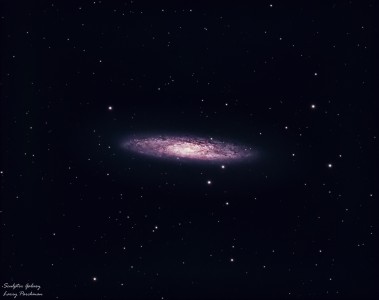
Image of the day

Captured by
Lawrence Parchman

Sculptor Galaxy (NGC 253)

My Account

New to Astromart?

Register an account...

Need Help?

Posts Made By: Dennis Persyk

July 6, 2005 02:02 AM Forum: CCD Imaging and Processing/Solar System

M101

Posted By Dennis Persyk

Every time I get a new scope or camera, I re-image M101. I think this is my best effort. I welcome critical criticism from all viewers. I want to improve my imaging and processing techniques.

http://home.att.net/~dpersyk/new.htm

120 minute lum and 50 minute each RGB on two separate nights; True Technology Filters; SXV-H9 and Takahashi E160 guided by MX716 on NP-101; AP1200GTO mount.

Thank you for visiting my site.

Clear skies,

Dennis Persyk
Igloo Observatory Home Page http://dpersyk.home.att.net
Hampshire, IL


July 6, 2005 03:33 AM Forum: CCD Imaging and Processing/Deep Sky

M101

Posted By Dennis Persyk

Every time I get a new scope or camera, I re-image M101. I think this is my best effort. I welcome critical criticism from all viewers. I want to improve my imaging and processing techniques.

http://home.att.net/~dpersyk/new.htm

120 minute lum and 50 minute each RGB on two separate nights; True Technology Filters; SXV-H9 and Takahashi E160 guided by MX716 on NP-101; AP1200GTO mount.

Thank you for visiting my site.

Clear skies,

Dennis Persyk
Igloo Observatory Home Page http://dpersyk.home.att.net
Hampshire, IL

July 9, 2005 11:29 PM Forum: CCD Imaging and Processing/Solar System

Comet 161P Hartley-IRAS

Posted By Dennis Persyk

Periodic comet 161 P is now among the brightest comets in the northern skies at magnitude 10.1. It is well positioned in Cassiopeia. It has a relative motion of 3.4 arc seconds per minute, making it a good movie candidate.

My mage comprises 30 minutes of 120 second subframes. Takahashi E-160 f/3.3 astrograph and SXV-H9 camera on AP1200GTO mount.

A modem-friendly movie and supporting data are included on my web page below – please take a look.

Image and supporting information at
http://home.att.net/~dpersyk/new.htm

Thank you for visiting my site.

Clear skies,

Dennis Persyk
Igloo Observatory Home Page http://dpersyk.home.att.net
Hampshire, IL


July 14, 2005 08:08 PM Forum: CCD Imaging and Processing/Solar System

C/2004 Q2 Machholz

Posted By Dennis Persyk

Still the finest comet in the sky with a tail extending 40 arc minutes. The magnitude is 11.1. The currently brightest comet is C/2005 K2 LINEAR at magnitude 10.0. But K2 has a stubby little tail – not very comet-like if you ask me. Machholz is still magnificent.

Image comprises 13 x 4 minutes. Takahashi E-160 f/3.3 astrograph and SXV-H9 camera on AP1200GTO mount.

Image and supporting information at
http://home.att.net/~dpersyk/new.htm

Thank you for visiting my site.

Clear skies,

Dennis Persyk
Igloo Observatory Home Page http://dpersyk.home.att.net
Hampshire, IL


July 22, 2005 03:50 AM Forum: CCD Imaging and Processing/Deep Sky

B72 The Snake

Posted By Dennis Persyk

I enjoy imaging the Barnard dark nebulae. This guy is kind of cute:

http://home.att.net/~dpersyk/new.htm

6 x 10 minutes minute luminance; SXV-H9 and Takahashi E160 guided by MX716 on NP-101; AP1200GTO mount.

Thank you for visiting my site and putting my over the 100,000 visitors mark.

Clear skies,

Dennis Persyk
Igloo Observatory Home Page http://dpersyk.home.att.net
Hampshire, IL


July 29, 2005 02:26 AM Forum: CCD Imaging and Processing/Deep Sky

Abell 2151

Posted By Dennis Persyk

Abell 2151 is among the largest galaxy groups. I had previously imaged it in black-and-white and I think it is easier to pick out the galaxies in color.

http://home.att.net/~dpersyk/new.htm

LRGB 60:30:30:30; SXV-H9 and Takahashi E160 guided by MX716 on NP-101; AP1200GTO mount.

Thank you for visiting my site.

Clear skies,

Dennis Persyk
Igloo Observatory Home Page http://dpersyk.home.att.net
Hampshire, IL


August 2, 2005 09:25 PM Forum: CCD Imaging and Processing/Solar System

Comet Movie Starring 161P

Posted By Dennis Persyk

The fast relative motion of 2.9 arc seconds per minute makes for an interesting imaging challenge and a great movie opportunity. Images comprise 52 x 2 minutes unguided (too many stars in the comets’ path to guide!) with the E-160 and SXV-H9 on an AP1200GTO.

Movie and supporting information at
http://home.att.net/~dpersyk/new.htm

Thank you for visiting my site.

Clear skies,

Dennis Persyk
Igloo Observatory Home Page http://dpersyk.home.att.net
Hampshire, IL


August 7, 2005 09:11 PM Forum: CCD Imaging and Processing/Deep Sky

NGC 6960 Veil

Posted By Dennis Persyk


http://home.att.net/~dpersyk/new.htm

NGC 6960 in the Veil is one of my favorite subjects. Although it looks good in color I prefer the ethereal beauty of simple H-alpha filtration. In the past I have had problems with veiling glare (no pun – that’s the terminology) from 52 Cyg who shines brightly at magnitude 4.2. This time my Takahashi Epsilon E-160 handled it with aplomb.

3 x 20 minutes with SXV-H9, E-160, 6 nm H-a filter, AP1200GTO guided by NP-101 with MX-716. I clipped the image a bit to make the sky darker, as seems appropriate for an H-a image. I don’t think I threw away much wispy nebulosity but I’d like to hear what you think. I do have a nasty habit of clipping the histogram!

Thank you for visiting my site.

Clear skies,

Dennis Persyk
Igloo Observatory Home Page http://dpersyk.home.att.net
Hampshire, IL


August 17, 2005 09:31 PM Forum: CCD Imaging and Processing/Deep Sky

Pickering’s Triangular Wisp

Posted By Dennis Persyk

Pickering’s Triangular Wisp in the Veil is one of my favorite subjects. Although it looks good in color I prefer the ethereal beauty of simple H-alpha filtration. The whole region is called the Bridal Veil Nebula, and bridal veils are traditionally white – and thus so are my images of this target.

http://home.att.net/~dpersyk/new.htm

The image was taken with a Takahashi E-160 (f/3.3) astrograph aboard an AP-1200GTO. The camera was an SXV-H9, and the exposure was 2 x 20 minutes via a 6 nm FWHM H-a filter. There was a full moon, but light pollution has no affect whatsoever on a narrow-band H-a filter.

Pickering's Wedge, as it is also called, was discovered in 1904 by Williamina Fleming of Harvard College. Fleming was examining photographic plates of the region around 52 Cygni when she noticed a triangular wispy patch of nebulosity. As was the custom of the day, credit for the discovery went to her supervisor, astronomer E. C. Pickering.

Thank you for visiting my site.

Clear skies,

Dennis Persyk
Igloo Observatory Home Page http://dpersyk.home.att.net
Hampshire, IL


August 27, 2005 02:07 AM Forum: CCD Imaging and Processing/Deep Sky

A Typical Night in the Life of an Imager

Posted By Dennis Persyk

I have chronicled my trials and tribulations of imaging M8. This is typical night for an imager.

The final image is at
http://home.att.net/~dpersyk/new.htm

Please take a look. I’ve included a simulated “eyepiece view” illustrating what M8 looked like through an 8-inch SCT the previous night. M8 is very low for me, so it probably looks better through your scope.

Here is my imaging saga for the night:
9:30 PM
Open dome and boot up guiding and imaging computers and connect cameras.
Goto Vega – Vega is centered on chip – Yea!
Take a bunch of flats and biases now while too light to image
Plug in memory stick to transfer above images – computer hangs – darn!
Reboot computer and transfer images to memory stick – reconnect camera.

10:15 PM
M8 is one and a half hours before transit and 20 degrees elevation in the southeast. I can barely make out the magnitude 2.6 star in Sagitarius. I do a manual meridian flip with the AP1200Gto and cautiously sneak up on M8 so as not to drive the scope into the pier. I am going to start the luminance frames with the mount “upside down” and image continuously through the meridian. I have to exercise caution. I slew while watching the RA/Dec coordinates until I am at M8. The scope clears the pier by a wide margin. Yea!

10:20 PM
I take a 5 second centering image binned 3x3. This doesn’t look like M8! Where are you, M8? I move down in Dec. Take another 5 second shot. Still looks funny. Go still lower in Dec.

10:25
This is ridiculous! I have a fine goto mount and I can’t find M8! I recheck the coordinates. Golly, I am two degrees too low in Dec. Misread my notes. Darn! I slew to the proper Dec. There’s M8! Yea!

10:30 I calibrate the guide camera on a star in M8. MaximDL tells me the guide camera is tipped 42 degrees. This is impossible! Darn! I recalibrate on a different star. Now MaximDL says the guide camera is aligned within a degree. OK. I start guiding with and I have nice little errors – 0.02 pixels or so. I focus imaging camera (SXV-H9) in AstroArt.

10:35
Begin 4 minute lums. I can only go 4 minutes lest I burn out the core of M8. Go in the house and play on the computer.

11:35 Begin blue sequence, ten minutes per frame. Guiding errors seem a tad bigger now. Hmm – why is that?

12:10 AM
My blue subframes have egg-shaped stars! Darn! I see guiding errors of +/- 0.25 pixel now in Dec and RA. My seeing has deteriorated. Darn! Launch 4-minute sequence of green subframes.

12:40 AM
Come out to inspect green subframes. Eggy stars. Darn! Launch red sequence.

1:20 AM
Come out to collect all the images. I look for the red subframes. There are NONE! I forgot to click the Start button. Click start button. Go back in house.

1:55 AM
Come out and inspect red subframes. Stars look like eggs. Fairly round eggs though. Maybe they will be ok. Load images onto memory stick and shut down observatory.

2:15 AM
Make up master bias and flat frames (darks never needed with SXV-H9) in ImagesPlus. Make up master lum and RGB frames in MaximDL. Maxim seems faster at this than ImagesPlus.

2:30 AM
I align the LRGB frames with Auto Star Matching in MaximDL. The result is an ugly mess with red stars next to blue stars and a smeared out M8. Arrrrgh! I try again, this time choosing Auto Correlation. Hey, this looks pretty good! Save as a TIF and open it up in ImagesPlus.

2:45 AM
Adjust histogram stretch in ImagesPlus. Start out with 0.5 log stretch, than Curves. The color looks funny. Sort of lavender. Darn!

2:50 AM
Open image in PhotoShop. Adjust color with slider. M8 looks beautiful now! Yea.

2:55 AM
Open image in ImagesPlus. Apply gentle Addaptive Richardson-Lucy sharpening to just the dark lanes by setting the upper and lower intensity thresholds. Looks a little better. Crop image. Mirror vertically to achieve proper North up/East left. Resize to web page size for no scrolling and save as JPG.
This is amazing! It is one of the best images I have ever taken! I can’t believe it!

3:00 AM
Go to bed. Dream about round stars and nicely colored images.

Clear skies,

Dennis Persyk
Igloo Observatory Home Page http://dpersyk.home.att.net
Hampshire, IL

New Images http://home.att.net/~dpersyk/new.htm