Image of the day

Captured by
Ralph Ford

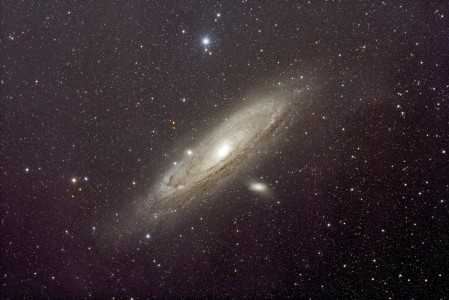
M31 with Redcat 51

My Account

New to Astromart?

Register an account...

Need Help?

Posts Made By: Kim Colter

May 11, 2005 11:04 AM Forum: Deep Sky Observing

3C 273 With A 4" Telescope, 2005/05/08

Posted By Kim Colter

Well done, Dave. I would never have imagined 3C 273 could be seen visually through a 4 inch scope.

May 20, 2005 12:02 PM Forum: Deep Sky Observing

Leo 1

Posted By Kim Colter

Evan
I have seen Leo I on several occasions. I usually start from Regulus and move the scope north until Regulus is just out of the field. I think transparency is critical. I would use an eyepiece/scope combination that gives you an exit pupil equal to your maximum pupil dilation. It is a fairly subtle object. I must admit that I see it better some times than others and can't always explain what it is about the nights when it is seen to best advantage. I saw it at TSP with a 20 inch Starmaster. I have seen it on several occasions with my 40 inch Dob. I have had nights when it was pretty indistinct with the 40 inch when the transparency was poor. Keep trying from dark sites and you'll see it. Maybe try the black cloth over the head technique if there is any stray light.

May 23, 2005 11:55 AM Forum: Pictures of Me and My Telescope and........

My Starmaster 14.5

Posted By Kim Colter

Floyd
I am also a Starmaster fan. I'm curious about the wildlife refuge. It looks rather remote. Where are you located? Thanks
Kim Colter
Washington, MO

May 24, 2005 11:05 PM Forum: Zeiss

Jupiter in Zeiss 150/2250

Posted By Kim Colter

Don
I could see multiple small white whorls in the north equatorial belt, large white bright area fringed with purplish blue in the belt between the NEB and the SEB. The GRS was just rotating out of view during the 45 minutes or so that I observed. I saw small amounts of detail in the GRS. I was quite happy with the overall brightness of the image at 187X in the Zeiss. The first night I had the 20 inch Starmaster set up at the same time--the red equatorial belts were much brighter red in the 20 inch but I don't think I was seeing any major increase in detail in the 20 inch compared with the Zeiss. On a night with steadier seeing where the atmosphere was not the limiting factor I'm sure I could have taken both scopes to higher magnifications and proven the age old axiom that aperture wins. I was comparing Jupiter at 203X in the Starmaster to 187X in the Zeiss. The clear sky clock for my location was light blue at the time I was observing. I would have said the Pickering rating for seeing was 4-5 on the scale of 10 based on the appearance of Airy disc and diffraction rings on bright stars.

August 20, 2005 09:52 PM Forum: After Dark

Back from Oz! :-(

Posted By Kim Colter

Maurice
Condolences on your return to the land of "sky au lait." I am trying to wipe the drool out from between the keys on my computer after reading your report. It sounds like one hardly needs a telescope to do a Messier marathon in the Aussie bush. Can't believe I've been to Perth and Manjimup twice without hornswaggling a trip to Chiro observatory. "Third time's the charm!" Glad to have your expertise back on this side of the pond. You must tell us if Mars is higher in the sky here than there--I suspect it is for this opposition. I had a nice look at Syrtis and Helas this morning through what may be the best seeing I've had in a while.

January 2, 2006 03:37 PM Forum: Deep Sky Observing

Diffuse nebulae

Posted By Kim Colter

Inge
I agree that the diffuse nebulae are targets worthy of study. I feel that I have seen variability in Hubble's variable nebula. However, the variability has been from year to year and therefore my saying that I have seen variability in it is very dependent on my "mind's eye" recollection of it from previous years. I have simply noted that it seems to be brighter and larger some years than others. It is certainly possible that differences in atmospheric transparency could account for some of what I have thought to be variability in the nebula itself.
With some embarassment I will tell the story of my first encounter with Hubble's variable nebula. I was observing with the 30 inch Dob that our club had before I acquired the 40 inch. I was out in the predawn hours on Halloween (October 31) and was cruising around in Monoceros after looking at the Rosette. I stumbled upon Hubble's variable nebula which I had never even heard of before. I was convinced I had a comet. I closed up the observatory and headed back to town. I emailed my observing buddy, Mark Birkmann, and described what I had seen and where. Mark emailed back that I might have seen Hubble's Variable Nebula. I looked up an image on the web and realized that was exactly what I had done. Good thing I didn't email Brian Marsden. I would almost bet that over the years some newbie has done exactly that.
As to the Orion nebula, I agree that it has many layers of complexity. It is amazing to me how much more I see in it some nights compared to others. While transparency is important, I think atmospheric stability (seeing) may be more important. On the most stable of nights with big aperture the nebulosity in the trapezium area is absolutely sprinkled with 14th to 16th magnitude stars. I see many more some nights than others with the seeing seeming to be the deciding factor. I have even found that the choice of eyepieces makes a difference. I most often look at the Orion nebula with a wide field Nagler eyepiece. On one occasion when a club member was out at the scope with me, he put a 32 mm 2 inch Plossl style eyepiece in on a night of good seeing and we saw subtle vertical bands in the nebulosity that I had not been aware of before. That same night these bands were much less evident in a Nagler. Sorry I can't remember which Nagler I tried at the time, it was years ago. Thanks for your stimulating post, Inge.

January 29, 2006 05:57 AM Forum: Reflectors

Dew at WSP

Posted By Kim Colter

David
I think your plans for a dew heater from Astrosystems for your secondary sound like all you will need. I have been to WSP five times. One night during the five weeks I had dew form on the primary of my 20 inch Starmaster. The rest of the time I have been fine with the secondary dew heater being all that was needed. If you have your secondary rigged for dew prevention you will be as well equipped as anybody else there.

February 4, 2006 05:04 PM Forum: Equipment Talk

Fujinon 16x70 vs 4" refractor

Posted By Kim Colter

Dave
If you look up some of the excellent posts by Ed Zarenski on cloudy nights and in the binocular observing forum you will find much information germane to this issue. The claim has been made that using binoculars produces an image that is equivalent to a single aperture about 20% larger than the aperture of the binoculars--this statement would be true if the magnification were the same in the binoculars and the scope. I am quite sure if you perform Ed Zarenski's exercise of counting the number of stars you can see in the Pleiades with your 4 inch refractor at 26X you will count more stars and see stars of fainter magnitude in your 4 inch refractor than in the Fuji 16X70's. You can find the finder charts for this exercise in the files section of the Yahoo group called "binocular astronomy." They may be available on the cloudy nights site as well or by contacting Ed Zarenski. I think Ed's compilation of results of limiting magnitude in the Pleiades and number of stars counted in the field he has outlined for the Fuji 16X70's are also available on the Yahoo group files and at Cloudy Nights. The Fuji's will give you a wider field of view than the 2.6 degrees you get from your 4 inch refractor at 26X.
To equal your 4 inch refractor for limiting magntude or star counts in clusters you would probably have to go to something like 20X100 binoculars which would have a little more "aperture equivalence" and a little less magnification.
I have a Nikon 20X120 binocular that would probably give your "26X102" monocular a run for its money but is undoubtedly more unwieldy to transport, handle, and set up than your refractor.

February 5, 2006 02:56 PM Forum: Deep Sky Observing

NGC2371/72 in Gemini

Posted By Kim Colter

Inge
I like this planetary very much and frequently look at it with the 40 inch Dob. I think it is enhanced by the OIII filter. I have not taken the challenge to try it with a smaller scope than your 12.5 inch. I think it is a planetary with similarity to the ring nebula with respect to the perspective we have on it from our vantage point.

February 11, 2006 03:56 PM Forum: Eyepieces

BIG mirror makers - who are the better people to t

Posted By Kim Colter

Steve
I own two Steve Swayze scopes/mirrors, the 40 inch f5 mentioned by Floyd above, and the 12.5 inch finder for the same scope. I am very happy with both mirrors. I own a 20 inch ZOC mirror and two smaller ZOC mirrors and can't say enough about the quality of ZOC mirrors. If 24" isn't big enough for you, then you will have to consider a source other than ZOC. I read very positive things about the Steve Kennedy mirrors but have no personal experience with them. I cannot tell you about "turnaround times" from these various sources of mirrors--i.e. how long from when you place your order until you are using the mirror. Perhaps others can weigh in on that issue. I would be very surprised if you were disappointed with a mirror from any of these three sources.