Image of the day

Captured by
Erwin Forbragd

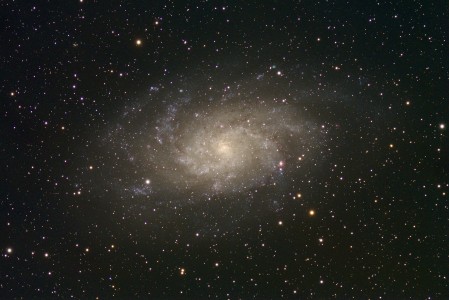
M33 in Triangulum

My Account

New to Astromart?

Register an account...

Need Help?

Posts Made By: Fred Lusk

September 21, 2013 05:42 AM Forum: Sports

Fresno State 41, Boise State 40

Posted By Fred Lusk

Snaps a 7-game losing streak and losing 11 out of the last 12. We have no running game and our defense is suspect, but we have Derek Carr.


January 16, 2014 07:43 PM Forum: My Favorite WIMP.COM or YOUTUBE.COM

"The front fell off…"

Posted By Fred Lusk

http://www.youtube.com/watch?v=LlTZ2lvmHPM

April 17, 2014 04:48 AM Forum: Digital SLR AstroPhotography

Total Lunar Eclipse (2014-04-14/15)

Posted By Fred Lusk

My original plan was to do a time lapse of the eclipse from my backyard, but technical glitches (i.e. operator error) busted part of it. Also, here in Fresno, CA, the eclipse started with thin high clouds which gradually thickened after mid-eclipse. So, at about 1:30 a.m., I shut everything down and started to pack up. That's when I noticed that the clouds had mostly and quickly dissipated. Oh well.

At least the interview I did around 8:30 p.m. with a local TV news reporter turned out fine. (He and the cameraman got quite a kick out of looking at Jupiter and the Moon in the two scopes I had set up.) The reporter I talked with got it right when our segment aired. Too bad the TV station's meteorologist made a repeated mistake by saying that the partially eclipsed Moon (i.e. between U1 and U2 and between U3 and U4) was in the penumbra rather than the umbra. I had even explained this quite clearly to the reporter and gave him a very nice diagram of a lunar eclipse.

Anyway, I was able to salvage some images from my time lapse attempt. Focusing was difficult because the clouds dulled the Moon's features. This first image has a time stamp of 10:57 p.m., which is just about at contact point U1.

Telescope: Celestron C5+ with 0.63x focal reducer (Net FL = 790 mm)
Mount: Celestron Advanced VX
Camera: Olympus E-5 (4:3 format; crop factor = 2)

October 14, 2014 11:48 PM Forum: Beginning Astronomy?

Telescope Visual Limiting Magnitude

Posted By Fred Lusk

Every beginning astronomer should have some idea of the visual limits of his/her telescope. For example, why search for 14th magnitude Pluto if you only have a 70 mm scope (which simply can't go that deep) and/or you are observing under light polluted skies? On the other hand, my Celestron CPC 800 (8" SCT) under Bortle Class 2 skies can go much deeper…my record is magnitude 15.4 stars (see Wikipedia or search Google for "Bortle Scale).

The Telescope Visual Limiting Magnitude (TVLM) is affected by telescope aperture, seeing conditions, the observer, and several other factors. It is not possible to calculate a definitive TVLM, but it is possible to estimate it for your conditions with a simple formula. Actually, there are several formulas floating around out there.

If you would like more information about TVLM, and don't mind some simple math, I refer you to the following resources I recently created and posted online. These resources cover five formulas for estimating TVLM: three that are based only on the telescope aperture and two others that include additional parameters. The first resource is a PTC Mathcad worksheetfor TVLM that I posted at http://communities.ptc.com/docs/DOC-5277 . Mathcad is mathematics software that is targeted primarily at engineers and scientists who need to see the math, not just the results (Excel, for example, shows only a table of data and results; the formulas aren't normally shown and when you flip to formula view, the formulas are formatted more like FORTRAN code than textbook-style equations). Since Mathcad is a niche product and I don't expect very many non-engineers to have a copy, the .zip file I posted there also includes an Adobe Acrobat .pdf file that you can read for information on the various methods used to estimate the TVLM. If your math background extends at least to Algebra I, you should be able to figure it out. But, ask me for help if you can't

Secondly, last Saturday, I gave a presentation on TVLM for my astronomy club. I converted my PowerPoint presentation to .jpgs and posted them as a public album on Facebook. You can access it with or without being a member of Facebook at https://www.facebook.com/media/set/?set=a.10205329095573313.1073741856.1425866703&type=1&l=9730d636f9 . There is also a video version (with no sound) of the presentation at https://www.facebook.com/video.php?v=10205336473997769&set=vb.1425866703&type=3&theater .

October 27, 2014 05:06 AM Forum: Film Astrophotography - Imaging and Processing

Three star trails from this summer

Posted By Fred Lusk

2014 was not a very productive year, astrophoto-wise. We only did two camping trips the summer (one to Courtright and one for Glacier Point), instead of the usual three or four. Scattered night-time clouds during both camping trips further limited the number of shots I could take.

Here are three star trails I took this summer with my OM-1N and OM-4T cameras. I still use 35-mm cameras for star trails and some wide-field piggyback images. Star trails especially are much easier with film than with digital. My film of choice is Fuji Provia 400 slide film because it renders emission nebulas with a nice bright red color. The first image I took at Courtright Reservoir, at 8200 feet in the SIerra Nevada east of Fresno, CA. The last two images I took at Glacier Point (7200' elevation) in Yosemite National Park. The center of both images is the iconic Half Dome. The landscape is dimly illuminated by a nearly first quarter Moon. The bright lights on top of Half Dome are from hikers who are not supposed to be up there after sundown.

May 4, 2015 03:05 AM Forum: Sports

Life isn't fair…

Posted By Fred Lusk

Now that the baseball season is in full swing (pun intended), it is my duty to remind y'all that life is only 25% fair. The remaining 270 degrees is foul territory. smile

November 15, 2015 10:59 PM Forum: Digital SLR AstroPhotography

Basic Orion Nebula

Posted By Fred Lusk

I don't do a lot of astrophotography, but last night we had good skies at Eastman Lake so I did some wide-field piggyback stuff with my 35-mm camera (seriously). When I was done, Orion was high enough to try a few shots with my DSLR.

I used an Olympus E-5 at prime focus of my Celestron C5+ with 0.63x focal reducer (--> 790 mm focal length [1580-mm equivalent] @ f/6.3), ISO 1600, 60 seconds. The only editing was a slight increase in contrast to blacken the background (i.e primitive noise reduction).

This is just one image. A few dozen images stacked would give better results, but I only got a couple more because it was time to come home.

December 19, 2015 11:33 PM Forum: Equipment Talk

Nothing says "love" and "Merry Christmas"...

Posted By Fred Lusk

...quite like an Orion 9x50 Illuminated Right-Angle Correct Image finder scope for my wife for her 10" Orion IntelliScope Dob. She (and her back and neck) are so done with the stock straight-through finder.

Half the battle in life is marrying the right person. :-)

July 1, 2002 03:33 AM Forum: Star Parties

Glacier Point, Yosemit NP

Posted By Fred Lusk

Bad spelling means bad hand-eye coordination.

September 6, 2002 02:31 AM Forum: Film Astrophotography - Imaging and Processing

Neat Photo

Posted By Fred Lusk

Walt…

Jeep has some pretty good ads. Probably why I've got one.

Did you notice that the hill the Jeep is on looks like a human face in profile? Could it be one of the characters on the Simpsons?

Too bad the Pointer Sisters…I mean Stars…don't point to Polaris. I guess that's what happens when you let the artist have at it instead of using a real photo.

Fred