Image of the day

Captured by
Yue Ma

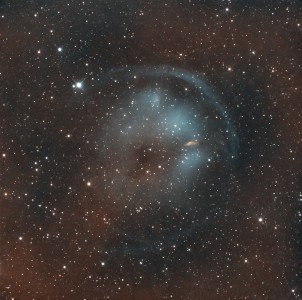
HFG-1

My Account

New to Astromart?

Register an account...

Need Help?

Posts Made By: Inge Skauvik

February 4, 2006 10:23 AM Forum: Deep Sky Observing

NGC1514 in Taurus

Posted By Inge Skauvik

This winter I have returned to this planetary several times, and I become more and more fond of it. Unfortunately it is very difficult to see it without a filter, but the O-III works wonders with it. A 12.5-inch scope and a magnification of 100 - 200x and the filter makes it one of the most delicate planetaries in the sky. The central star is plainly visible and fine condensations can be made out across the nebulous disc. I would rate it as #1 in a Planetary Nebula Beauty Contest (Visual observation, not HST images).

Inge S

February 6, 2006 08:00 AM Forum: Deep Sky Observing

Sagittarius DSO's

Posted By Inge Skauvik

Having decided to go for a one-week astro vacation on Gran Canaria, I'm presently busy learning the constellations that will be visible from that latitude, but never rise above the horizon at home. The last couple of days I have been studying the maps of Sagittarius, and now I think I'll be able to navigate well enough in the constellation to locate all the Messier objects. The only Sagittarius object I have ever seen from Norway is M17 (although M18 is probably also within range). Although I understand that many of the Messier objects in Sagittarius are very interesting, and show much detail, I would like to know which of the non-Messier objects in the constellation are worth looking for. Therefore I ask you specialists who know the constellation well about some advice. Any objects you regularly return to? Are there any interestingly looking planetaries? Any challenges for medium-sized apertures?

Inge S

February 8, 2006 10:00 AM Forum: Deep Sky Observing

DSO's in Vela, Puppis, Pyxis, Antlia

Posted By Inge Skauvik

Looking at my computerised sky map I realise that during my stay in the south the last week of May I should also pay some attention to the south-western part of the sky. Unfortunately only a small corner of Carina will be above the horizon, and way too low to be observable in practice. However, as darkness falls much of Carina will be within reach, and also a part of Puppis that I can't reach from here (M46 and M47 are observable from Norway, M46 indeed stands out as a superb object). But what about objects further south? Planetary nebula NGC3132? M93? Any double stars worth looking for?

I really hope for advice from those of you who know this part of the sky. I'll request information about many more constellations later(Hydra, Scorpius, Centaurus, Lupus) but I want to memorise their major star patterns first.

Inge S

February 10, 2006 07:26 AM Forum: Deep Sky Observing

DSO's (and doubles) in Hydra, Libra and Ophiuchus

Posted By Inge Skauvik

These three constellations all partly rise above the horizon at home, therefore I need no information about the part of Hydra north-west of Alphard or the upper half of Ophiuchus.

I think I know the map well enough to be able to find M83 and NGC3242 (Ghost of Jupiter). I will, in fact, try to see the latter from home if I get a dark, clear night.

Hydra, however, covers a huge area of the sky, and I suppose there are more good DSO's there. I'm also definitely going to challenge the double star, Beta Hydrae.

I have never paid much attention to Libra. I remember having split Alpha with binoculars, and I have put a couple of doubles on the plan. But are there any interesting galaxies or other good DSO's there?

The southern part of Ophiuchus also seems to be very interesting. I'll be very glad to learn about the "must see" objects of that region.

Inge S

February 11, 2006 04:04 PM Forum: Deep Sky Observing

Do anyone know anything about..

Posted By Inge Skauvik

The following planetary is plottet in my atlas, and listed in Burnham's, but not in Kepple and Sanner.

NGC5882 in Lupus, magnitude 10.5, size 7". Have anyone observed it?

The following three objects in Norma seem very interesting to me:

Planetary listed as Sp 1 in Burnham's. Magnitude 8.5, size 72"-

Two rich open clusters: NGC5999 and NGC6067.

I'm very interested in any information about these objects.

Best regards

Inge S

February 15, 2006 07:08 AM Forum: Deep Sky Observing

Hydra Galaxies (and double stars)

Posted By Inge Skauvik

Hydra seems to be a constellation getting less attention than deserved. Since most of it is well off the Milky Way it doesn't contain many star clusters, but is pretty rich in galaxies. It also contains several very good double stars. I'm not a hundred percent sure, but I think that under the Astromart forums I have only seen postings about three Hydra objects, the planetary NGC3242, the great galaxy M83 and the double star Epsilon Hydrae. But I know that there is much more to see. Soon getting the chance of a better view of the constellation I would like you to share some experience with me. Have anyone observed the Hydra-1 galaxy cluster (NGC3311/3312 and more)? Is the galaxy pair, NGC4105/4106 worth the search? And what about NGC3621? And most important of all, am I missing or forgetting any good objects?

The southern parts of Hydra also contains several double stars in the 0.8" - 2" range. Have anyone split Beta Hydrae? Any other interesting doubles? Tips about wider doubles are also welcome.

Inge S

March 1, 2006 06:57 AM Forum: Deep Sky Observing

Re: DSO details with the ETX125 w UHTC

Posted By Inge Skauvik

Hello Mike,

You have a nice period of interesting exploration ahead. I never owned a 5-inch scope myself, but I have some experience with smaller refractors (as well as larger reflectors that I'm currently using). I have never been a person being able to push the telescope to its extreme limits, therefore I think you can consider my statements as realistic for an average person.

Open star clusters (good examples, M37, M11) are easily resolved in your telescope, and will be very beautiful objects. Normally you don't need very high magnification for open clusters.
Globular star clusters (M3, M13, M92 and many more) may appear as hazy spots at first glance, but a closer look you will see that the sky is sprinkled by tiny stellar points. Globular clusters often look best at average magnification, perhaps 100x with the 5-inch.
Gaseous nebulae actually come in several classes.
Reflection nebulae like the Merope nebula in the Pleiades will appear faint and featureless, and is considered to be rather difficult objects.
Emission nebulae (e.g. M42 in Orion and M17 in Sagittarius) vary very much in size and brighness. The Orion nebula will have a lot of beautiful detail even in a small scope. With a larger telescope such nebulae may show even more detail if a filter (O-III or UHC) is applied. I'm not sure how well filters will work with a 5-inch.
Planetary nebulae also come in different shapes and sizes. Some of them are nearly stellar, while others are large and very diffuse. I'm sure you will enjoy observing the ring nebula, M57 and the beautiful M27 in Vulpecula.
You should not be too optimistic about detecting spiral structure in galaxies with 5 inches of aperture. You may see hints of it in M51, but to begin with I recommend to look for the general shape of the brighter ones (face-on vs. edge-on spirals etc.). The Andromeda galaxy is an awesome object, but don't forget the galaxy pair M81/M82, M51, M94, M33). Several hundred galaxies are within range of your telescope.
Finally, don't forget the double stars. Hunting for doubles may be very rewarding, and can give you many nice challenges.

Good luck,

Inge S

March 8, 2006 12:28 PM Forum: Deep Sky Observing

The core of M31

Posted By Inge Skauvik

I have observed M31 on many occasions with different telescopes. With 18-inches of aperture some interesting features come to view that are more difficult to detect with smaller scopes. On one occasion I was particularly thrilled by the core of the galaxy. It stood out like a tailless comet, perfectly round, and a brighness considerably higher than the central disc of the galaxy.
Have anyone else noticed this? In the 18-inch it was pretty conspicuous, but I can't remember to have seen it in the 12.5-inch.

Inge S

March 8, 2006 02:38 PM Forum: Deep Sky Observing

Deep-sky objects in Centaurus

Posted By Inge Skauvik

Which deep-sky objects should I look for in Centautus. Of course I know about Omega Centauri and the great galaxy, NGC5128, and I really look forward to observing them. But I'll appreciate all hints about other good objects in the constellation.

Concerning doubles I have found out that Centaurus contains many good ones(plus a couple of very tough ones). It would rank high on a list of the best double star constellations in the sky. Still I'd like to hear if any of you who know the constellation have any favourites.

Inge S

March 9, 2006 06:49 AM Forum: Equipment Talk

4-inch refractors

Posted By Inge Skauvik

I have always been a one-scope owner, presently having a 12.5-inch Portaball as my personal scope. Lately I have been thinking about getting a small refractor as a supplement, and I regularly browse the Classifields section. Still being at the "just looking" stage I get more and more surprised about the enormous variation in the prices of 4-inch refractors. Actually I'm thinking about an APO, or at least a semi-APO, and I have the impression that a basic OTA start somewhere just below 1000$. Quite a few are, however, offered for amounts in the 2000 - 3000 range. In some cases just the OTA is offered, in other cases the deal also includes a diagonal and/or a finder. But still I find the differences quite enormous. So my question is: What is the motivation for buying a 4-inch for 3000$ if you can get one for 1000$? Is it a matter of differences in colour correction? And if this is the case, is it possible to see these differences visually in other objects than Vega and Sirius?
I'm a visual observer. Maybe there are some secrets of the imagers' community I don't know about.

Inge S
