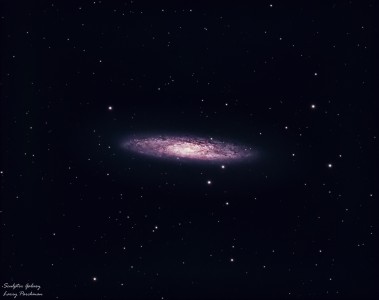
Image of the day

Captured by
Lawrence Parchman

Sculptor Galaxy (NGC 253)

My Account

New to Astromart?

Register an account...

Need Help?

Posts Made By: Ron Wodaski

September 16, 2002 06:37 PM Forum: CCD Imaging and Processing/Solar System

M 17

Posted By Ron Wodaski

Nice image! I note taht you have three images. Have you tried using a median combine? That should eliminate or at least greatly reduce the visibility of that satellite track.

Also, your white point looks to me to be a little bit too low. Or perhaps you added these images? You may have saturated if you added. An average is just as good as a sum, but prevents white saturation. If you did average, then perhaps the 1-minute exposures are a bit too long - more exposures of a shorter duration would give you more detail in the bright areas.

So the cure depends on the methods you used; if you need more informaton on any of these methods, just ask.

Ron Wodaski
author of "The New CCD Astronomy"
http://www.newastro.com

September 16, 2002 06:38 PM Forum: CCD Imaging and Processing/Solar System

NGC 6946

Posted By Ron Wodaski

Nice image; your guiding and your technique is very good. Now take about a half-dozen of these and combinme them, and you'll get some impressive details!

Ron Wodaski
author of "The New CCD Astronomy"
http://www.newastro.com

September 16, 2002 06:46 PM Forum: CCD Imaging and Processing/Solar System

M16 Unfiltered...

Posted By Ron Wodaski

A really nice image! You might have a bit of a light pollution gradient (brighter on the right) that is preventing you from displaying the full nebulosity in your image. There are various ways to remove gradients. Do you use Photoshop? I have some techniques for removing gradients with Photoshop in my book.

I have written a plug-in that will remove gradients using the latest build of CCDSoft v5. It isn't available yet, but if you want it I will send you a beta copy.

MaxIm DL has a gradient removal tool, but it's less effective when there is extensive nebulosity, as here. Mira has a complex but powerful tool that will remove gradients. Astroart has a third-party plug-in that will remove gradients.

Ron Wodaski
author of "The New CCD Astronomy"
http://www.newastro.com

September 16, 2002 07:03 PM Forum: CCD Imaging and Processing/Solar System

Veil Nebula HaRGB Image

Posted By Ron Wodaski

Gorgeous image. Very nicely focused and processed. I can see the HII regions clearly; the OII are dimmer. A longer color exposure would help bring out the blues and greens.

Ron Wodaski
author of "The New CCD Astronomy"
http://www.newastro.com

September 17, 2002 03:25 PM Forum: Equipment Talk

Problem getting Tide calculation software to run.

Posted By Ron Wodaski

I can't tell you how to fix this, but I can tell you how to find out what's wrong. Since this program has to run in a DOS box, open one yourself and run the program there. IF there are any error message, now you will be able to see them - the box won't close when the program ends, it will close when you close it.

In WIndows 2000, the command prompt (DOS box) is on the Accessories list; don't know if it's still there in XP.

Ron Wodaski
author of "The New CCD Astronomy"
http://www.newastro.com

September 17, 2002 03:29 PM Forum: Equipment Talk

focal lengths and light pollution

Posted By Ron Wodaski

You won't be upgrading your optics if you make that switch. You can achieve the same effect by using a slightly shorter focal length eyepiece on the Newtonian.

if you want to see more, you need more aperture, not simply a slower focal ratio.

Ron Wodaski
author of "The New CCD Astronomy"
http://www.newastro.com

September 17, 2002 03:31 PM Forum: Equipment Talk

Best scope for terrestial viewing

Posted By Ron Wodaski

My vote would be the Takahashi Sky90. It's small and light, yet a large enough aperture for high powers and bright viewing. And the optical quality is superb; it's as sharp and contrasty as any refractor I've ever used.

Ron Wodaski
author of "The New CCD Astronomy"
http://www.newastro.com

September 21, 2002 04:29 PM Forum: CCD Imaging and Processing/Solar System

A shot of the pillars

Posted By Ron Wodaski

Very nice detail!

Ron Wodaski
author of "The New CCD Astronomy"
http://www.newastro.com

September 21, 2002 04:30 PM Forum: CCD Imaging and Processing/Solar System

st-2000xm first light.

Posted By Ron Wodaski

Quite a project you took on there. That's a very nice image, too. How much sharpening did you do on this image?

Ron Wodaski
author of "The New CCD Astronomy"
http://www.newastro.com

September 21, 2002 06:08 PM Forum: CCD Imaging and Processing/Solar System

Best entry level scope for CCD Imaging??

Posted By Ron Wodaski

This is a big question.

In one sense, you already have a superb scope for getting started - a small refractor. The only thing that would make it idea is a shorter focal length (shorter focal lengths are less demanding of mount and operator). I believe there's a .8 reducer/flattener for the TV-102, and that would solve that. So by that criterion, you are set!

In terms of a mount, what you are looking for is low periodic error and smooth periodic error. No sudden jumps or errors. The newer G-11s have better worms and gears, and should be fine. All of the Tak mounts are great for imaging; it's a matter of picking one to match your chosen scope. AP mounts are great, too. The CI-700 is so-so, but it's a good choice for someone who doesn't mind tinkering with the mount - maybe changing out some bearings, re-lubing it, etc.

If you can specify what you'd like to do in imaging, I could be more specific about what might constitute and ideal scope and mount for _you_.

Ron Wodaski
author of "The New CCD Astronomy"
http://www.newastro.com