Image of the day

Captured by
Yue Ma

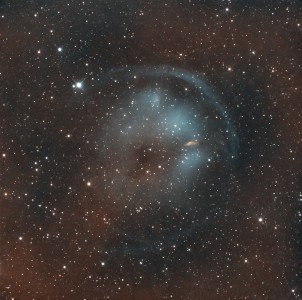
HFG-1

My Account

New to Astromart?

Register an account...

Need Help?

Posts Made By: Inge Skauvik

March 24, 2006 07:19 AM Forum: Deep Sky Observing

The Ghost of Jupiter - and other goodies

Posted By Inge Skauvik

Yesterday night gave us a clear sky in spite of a rather bad weather forecast. After a period with interfering moon and cold winds from the north, I therefore went to my nearest dark site for an observing session. Conditions were fra from optimal with lots of scattered light from Stavanger, and transparency and seeing below average. I just acquired a 13mm Nagler and spent some time comparing galaxy images with the new eyepeice (115x) and my old 9mm (167x).

M81 and M82 near zenith were awesome. I found that for M81 115x magnification was a better choice than 167x. At 115x the thin, faint spiral arms could be glimpsed, at least with averted vision. M82 was better with 167x. To view both galaxies at the same time, however, I had to use the 24mm Panoptic.

For M101 115x was the best choice. This evening the contrast made it difficult to make out the spiral pattern, and 167x was too much for this galaxy.

M51 revealed its spiral pattern even in the Panoptic, but was better at higher power, slightly better at 167x than 115x.

The large herring/whale galaxy, NGC4631 was best at 115x. It was a really great sight this evening with its small neighbour, NGC4627 easily visible. With the Panoptic the hockeystick, NGC4656 could be seen togehter with the other two. To make out the hook, however, 115x was necessary.

M99 was a positive surprise. The 13mm eyepiece was an excellent choice both for this one and for M98. The spiral pattern of M99 was pretty obvious, and it will probably be even better when located higher in the sky and under better seeing conditions.

In addition to those mentioned I observed several other galaxies, mostly old friends. However, I located a nice galaxy pair in Leo Minor which I never have observed before. NGC3395/3396 are moderately faint, and look like a miniature edition of NGC4485/4490 near Beta Canum Venaticorum.

Before finishing the session, I checked the sky just above the horizon in the south to see if I could find NGC3242, the "Ghost of Jupiter". Last time I tried was a failure. However, this time it was near the meridian. After one minute's search I found it. Indeed, this is a magnificient object. Although low in the sky I found it very bright and much larger than e.g. NGC7662. Most of all I was struck by its colour. I found it very blue, without any hints of green. I really look forward to observing it from the Canaries two months from now.

Inge S

March 31, 2006 05:40 AM Forum: Deep Sky Observing

Deep-sky objects in Scorpius -advice needed

Posted By Inge Skauvik

At last I have reached Scorpius in my preparations for my astro-trip in May. I have studied my materials and identified the show objects, but I'm still interested in knowing about the less known objects in Scorpius and also som hints to what I should look for in the brighter objects.

Inge S

April 1, 2006 10:34 AM Forum: Deep Sky Observing

Re: DSI/Focal Reducer/W.O. Microfocuser Connection

Posted By Inge Skauvik

Please, keep equipment discussions under the "equipment" forums! People interested in the subject will perhaps not see your post when you put it here.

Inge Skauvik
(Moderator)

April 2, 2006 05:43 PM Forum: Deep Sky Observing

Galaxy observing session 31.03

Posted By Inge Skauvik

Friday night I experienced clear skies and good seeing, and spend a couple of hours observing galaxies and double stars. Totally I logged 61 galaxies, but I didn't look closely at all of them. I spent some time galaxy hopping in the Virgo cluster, and then the number of spotted object easily becomes high. I'll mention some of the highlights here.

I always enjoy observing the Coma cluster of galaxies. The two brighter ones, NGC4889 and 4874 can definitely be seen with a much smaller scope than my 12.5-inch. A nearby 7th magnitude star disturbs a little, however, particularly if you also try to see some of the fainter galaxies of the cluster. I could see several faint light pathces in the field, but I haven't identified any individual galaxies so far. An exception is NGC4921 which lies some distant from the two giant ellipticals. It is moderately faint, but it is impressive to think about the grandeur of these objects being visible at 400 million light years' distance.
A bit south of the Coma cluster lies a bright galaxy, NGC4725. This is another of Messier's omissions, looking quite similar to NGC2907 in Leo. At 167x power it gave a clear impression of being a barred spiral.
One fun target is the galaxy pair, NGC3226/3227 near Gamma Leonis. One of the galaxies is elongated, the other one small and round, and the pair always reminds me of a celestial exclamation mark.
M61, in the southern part of the Virgo cluster is one of the galaxies where the spiral pattern can be detected in my scope. The galaxy is rather small, but bears magnification well. I used 167x, but probably 200 - 250x would bring out still more detail.
I also observed M49, slightly further to the north. N49 is an elliptical, and as such not extremely interesting. It lies very close to a 12.5 mag star which ould give the impression of a supernova in the galaxy. The main reason for spotting this galaxy was to make a galaxy hop via NGC4526 to the double star, Struve 1658. In this case it is easier to use galaxies to navigate for a double star, than using stars to navigate for a DSO. The galaxy 4526 is a good object in itself. To me it is always "the galaxy between the two stars".
M101 was great this evening, and so was M51.
I also observed several doubles this evening. Some of them are mentioned in a post under the double star forum.

Inge S

April 5, 2006 01:22 PM Forum: Deep Sky Observing

A conspiracy?

Posted By Inge Skauvik

Yesterday evening I spent an hour jogging under the starry sky and the waxing moon. I left home about 10 p.m. and suddenly noticed that it was still not dark in the north-west. Even at 10:30 it was still possible to see the glow in that direction. When the moon has passed its full phase, the period of nocturnal darkness will have shrunk still further, and if I want to observe under dark skies I'll have to start well after midnight.

I think I'm the victim of a vicious conspiracy. Just consider the following:

At +59 degrees, nocturnal darkness will vanish completely in early May. In april, however, there is still a period with darkness, and at this time of the year temperatures start getting more pleasant than in winter. It would therefore be very nice to use the evenings of April to observe. But some secret brotherhood has invented something called "DAYLIGHT SAVING". This shifts the dark period of the night one hour, and for a person in full job has to get some sleep at that time. I also think that the same secret organisation have put the zero meridian through Greenwhich. Therefore I'm located almost at the western edge of my time zone. I'm more than 5 degrees west of Dmitri and nearly 10 degrees west of Thomas who both are in the Central European time zone. Therefore they get nocturnal darkness considerably earlier than me. IT IS NOT FAIR.

I'm soon going to start my own secret fellowship. Our ultimate goal will be to move the zero meridian to Dublin and eliminate the use of daylight saving. It is is possible, we'll also move the north pole to Mexico. I'm afraid, however, that this will represent some technical difficulties. But who knows...

Inge S

May 2, 2006 05:43 AM Forum: Deep Sky Observing

H-beta objects in the summer sky?

Posted By Inge Skauvik

Now there are just three weeks to go before our planned astro-trip to the Canary Islands. Last weekend we had a meeting to discuss practical issues. During the meeting my friend informed me that he had bought a H-beta filter, and asked me if he should take it with him.

Of course, the filter is small, and doesn't represent any extra weight worth mentioning. However, I have to admit that I don't know about any objects in the summer sky where this filter is of any use. Any suggestions in the milky way from Sagittarius to Cygnus?

We have both O-III and UHC filters, and look forward to using them along with all our Naglers, Panoptics and Radians. But the H-beta is new to me, and the only objects I know about where this filter is of any use, are the Horsehead and California nebulae.

Inge S

May 19, 2006 07:03 AM Forum: Deep Sky Observing

Leaving cloudy skies and bright nights behind

Posted By Inge Skauvik

Tomorrow I leave the cloudy skies and bright Nordic nights behind for a week. According to the weather forecast the Canary Islands have clear skies and +24 degrees during daytime.
My friends and I are going to live in Casa Rosabel, which is an astro tourism accomodation site run by retired Swedish astronomer Göran Hosinsky. I expect to spend more time observing during this week than the total of the last couple of years at home.

I'm very grateful to all of you who have contributed with tips about interesting objects in the zone where I have never made telescopic observation before. I promise to give comprehensive feedback when I return home.

In addition to my Portaball equipped with a great collection of TeleVue eyepeices and narrowband filters, we bring along a pair of mounted 20x80 binoculars. Casa Rosabel also has two telescopes to our disposal, one Meade Schmidt-Newtonian and a 3-inch Unitron refractor.

I'm pretty confident that the trip will be a great success. I'm a bit worried, though, that I'm going to be completely spoiled when I return home.

Inge S

May 29, 2006 06:17 AM Forum: Deep Sky Observing

Home again!

Posted By Inge Skauvik

Yesterday I returned from La Palma with my travel mates after a great week. I've got stuff for many postings and discussions, and will not give a full report here and now. To begin with, just some general impressions:

Casa Rosabel, our accomodation site, is located at the western side of the island about 600m above sea level. The place offers free sight towards the south and west, but high mountains block the view of the eastern sky. The sky is dark - it was no problem to hold 15.3 mag stars 100% of the time in the 12.5-inch. Seeing, however, is generally poor, only occasionally it is possible to get below 2" there. Steady seeing would have improved the limiting magnitude still further. Five of our six nights down there were clear. The sky above the horizon (ocean) was, however, generally hazy. It vas possible to get a glimpse of Beta, Gamma and Delta Crucis as well as Alpha and Beta Centauri with the naked eye. Some 5 degrees above the horizon, however, transparency improved considerably.

Two of the nights we went up to the observatory camp at Roque de los Muchachos at some 2100 metres above sea level. We were not admitted to the highest peaks where the domes are located, but observed from a helicopter landing pad. From there the sight directly to the south was blocked, but we had free sights to all other directions. It was quite cold up there and the wind was annoying. Seeing generally becomes better as wind increases. The second night we had 15 metres/sec (more than 30 mph), and had to find a place just below the landing pad to get some shelter from the wind. We didn't measure the limiting magnitude from the summit, but it must have been at least half a magnitude better than from Casa Rosabel.The windy night also offered good seeing (It varied somewhat, but occasionally it was excellent).

In spite of some difficulties our trip was a great experience. The most impressive deep-sky objects observed during our stay were the following:

#1: The Milky way of Sagittarius, Scorpius, Scutum etc viewed by the naked eye.
#2: Omega Centauri
#3: M8 viewed with 13mm Nagler and O-III
#4: Veil nebula (13mm Nagler, O-III)
#5: M17
#6: M20 (Unfiltered)

The three gaseous nebulae all showed an incredible amount of detail, and were very beautiful. In addition to the ones listed, there are several runners-up, e.g. M51, M83, NGC5128, M101, M22, M13, M11... And then comes a long list of other goodies. Postings about them will follow later.

Inge S


May 30, 2006 06:02 AM Forum: Deep Sky Observing

The great diffuse nebulae of Sagittarius/Serpens

Posted By Inge Skauvik

At last I had the chance to observe all the great nebulae in the direction of Sagittarius (M8, M16, M17 and M20). Among these only M16 and M17 can be observed from home, and only for a very limited time of the year. From La Palma there was time to really enjoy the objects and play around with magnification and filters.

All the four nebulae are easily visible without filters, M17 being the most striking one. With O-III (which is the most versatile of the narrowband filters for these nebulae from my experience) M8 gains so much that I would put it as Number One. M8 is a beauty unfiltered, but with O-III it is gorgeous. With the 13mm Nagler eyepiece (115x) it shows a tremendous amount of bright and dark detail, and appears like a gigantic vortex in space.

The visible extent of M17 also increases a lot when using the filter, and lots of fine structure becomes visible. Neither M17 nor M8 are much inferior to the great Orion nebula when observed through a filter.

M16 is very nice both without and with a filter. The filter is necessary to make out the dark "fingers", and it is not a bad idea to use some magnification (115x rather than 63x) to study these details.

After trying both O-III and H-beta on M20, my conclusion was that it looked best without a filter. Both filters enhance the nebula a little, but they are not needed to see the dark lanes clearly. And the beautiful quadruple in the centre of the "trifid" is definitely best unfiltered.

Several other diffuse nebulae were also observed from La Palma. I'll comment on them on a later occasion.

Inge S

May 31, 2006 07:07 AM Forum: Deep Sky Observing

Not all globular clusters look the same

Posted By Inge Skauvik

Globular clusters are impressive in any telescope big enough to show their individual stars. I have to admit, however, that I haven't paid too much attention to them, considering them to have more or less the same appearance in the telescope (except for some variation in size and brightness). So why not just observe M13 and skip M2, M3, M5, M15, M53...?
During my visit to the south, however, I found many globulars with pretty unusual appearance. The first one we observed from La Palma was M4. It is a very beautiful cluster, many of its individual stars being very bright. The cluster was nearly split in two by a conspicuous chain of bright stars, and an orange pair south of this chain immediately caught my attention.

Three clusters were easily seen with the naked eye from La Palma, M13, M22 and Omega Centauri. M22 also containes quite a few bright individual stars, and is a very appealing cluster.

From photos I had the impression that Omega Centauri was just another globular, only brighter than e.g. M13. Observing it though the telescope, however, gives a completely different impression. It is awesome. The number of stars visible is enormous, and although it lacks outstanding individual stars, it is beautiful beyond words. To get all the outliers within the field of view, I had to use the lowest magnification (63x), but it looked even more glorious at 115x in the wide field of the Nagler eyepiece.

In addition to those very bright globulars, we observed quite a few other interesting ones. M62 appeared clearly un-symmetrical, giving an impression of the cluster moving at high speed with some of its members tending to lag behind. This was most obvious at low magnification. Some clusters were larger and brighter than I expected. NGC5897 in Libra is a very good object, which seems to be neglected. In Sagittarius, M55 was a positive surprise. I liked it more than slightly brighter M28. Even NGC6723 near the Corona Australis border turned out to be a very fine globular, better than many Messier clusters.

NGC6397 in Ara is large, bright with many bright individual stars. This excellent object made a pretty good view from La Palma, but it was quite close to the horizon, and a few degrees of extra elevation would have made it even more impressive.

The last object I'd like to mention here is the "third" globular of Hercules. Everybody are familiar with M13, and M92. Even further north in the constellation, there is another globular, NGC6229. I observed it for the first time from La Palma. It forms a nice equilateral triangle with two 8th magnitude stars, and although I couldn't resolve it (possibly due to poor seeing) it had a very delicate appearance.

Inge s