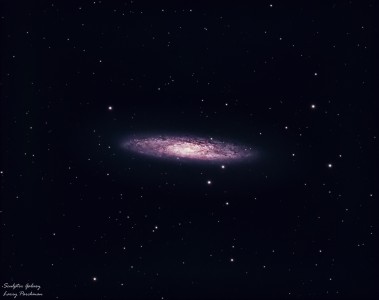
Image of the day

Captured by
Lawrence Parchman

Sculptor Galaxy (NGC 253)

My Account

New to Astromart?

Register an account...

Need Help?

Posts Made By: Dennis Persyk

November 13, 2005 11:06 PM Forum: CCD Imaging and Processing/Deep Sky

Sh2-150 Faint Emission Nebula

Posted By Dennis Persyk

This is the faintest emission nebula I’ve imaged so far in H-a. I usually can see a hint of the nebula with a five second centering shot at f/3.2 binned 6x6. Sh2-150 required a full 120 seconds to get even a glimpse of it. That puts it about 3.5 magnitudes dimmer than your common emission nebula. I mainly trusted the goto mount to point me to the right place in the sky.

I think Stewart Sharpless did the us imagers based in light-polluted skies a tremendous favor by cataloging his 234 H-II targets. I am starting to work my way through them and am finding some of the fainter ones to be quite challenging.

18 x 15 minutes = 4.5 hours via a 6 nm H-a filter and SXV-H9 binned 2x2 with 3/4 moon; Takahashi E-160 @f/3.2; guided with NP-101 and MX-716; AP1200GTO mount; acquisition AstroArt; processing ImagesPlus.

I started out with the mount “upside down” about 1.5 hours pre-meridian and acquired continuously for another 3 hours post-meridian without a meridian flip. The temperature was quite stable and I only had to refocus once during the period – that is most unusual for my f/3.2 astrograph.

http://home.att.net/~dpersyk/new.htm

Comments and suggestions to improve my New Images page format most welcome.

Thank you for visiting my site.

Clear skies,

Dennis Persyk
Igloo Observatory Home Page http://dpersyk.home.att.net
Hampshire, IL

November 22, 2005 04:29 PM Forum: CCD Imaging and Processing/Deep Sky

NGC 6995 Ha vs Ha-RGB

Posted By Dennis Persyk

I tried adding 2x2 binned color to my Ha image and I’m disappointed in the results. Both images at

http://home.att.net/~dpersyk/new.htm

Ha: 7 x 10 minutes via a 6 nm H-a filter and SXV-H9; RGB 10 minutes each binned 2x2; Takahashi E-160 @f/3.2; guided with NP-101 and MX-716; AP1200GTO mount; acquisition AstroArt; processing ImagesPlus.

What did I do wrong?

Thank you for visiting my site.

Clear skies,

Dennis Persyk
Igloo Observatory Home Page http://dpersyk.home.att.net
Hampshire, IL

December 1, 2005 10:18 PM Forum: CCD Imaging and Processing/Deep Sky

Cedarblad 214 in H-a

Posted By Dennis Persyk

1 hour 45 minutes in 15-minute subframes; E160 and SXV-H9; guided with NP-101 and MX-716. AP1200GTO mount. Acquired with AA 3.0 and processed with ImagesPlus.

http://home.att.net/~dpersyk/new.htm

I think I have found my calling in imaging! Emission nebulae. Image them with a narrowband H-a filter and all the moonlight and local light pollution have no effect. It is as if my VLM 3.0 site were on the Carnary Islands or somewhere equally dark.

I hope there will be some bright comets to image during the spring months when there are no emission nebulae to image. Comets are my other favorite, but there aren’t any bright ones at present and the ones I can image are tail-less, which I find sort of un-comet like.

Please visit my site and provide feed back so I can improve it.

Clear skies,

Dennis Persyk
Igloo Observatory Home Page http://dpersyk.home.att.net
Hampshire, IL

December 12, 2005 07:51 PM Forum: CCD Imaging and Processing/Deep Sky

NGC 281 and Effects of Bad Seeing

Posted By Dennis Persyk

I have been concentrating on imaging in H-a because I don’t have to worry at all about light pollution or full-moon pollution. And I like the nice tiny stars I get via the 6 nm H-a filter. I also image at 530 mm to help mitigate bad seeing, which I have most nights at my Northern Illinois site. But some nights are so bad I should really throw in the towel and go watch TV or something . That’s what my mentor taught me to do, and I should follow his advice.

I don’t have an eyepiece on any of the scopes but I get a very quantitative measure of my seeing by observing the focus parameters in MaximDL ( the one-half flux diameter value) used on the guide scope and AstroArt ( the width of the focus spot) used on the imaging camera. I normally focus on a fairly bright star so that I am not saturated but still have good statistics. With good seeing, these parameters are steady from one focus frame to the next. With bad seeing, they wander about considerably. The greater the wander, the worse the seeing.

The poor seeing image is at:
http://home.att.net/~dpersyk/new.htm
while the good seeing image is at
http://home.att.net/~dpersyk/Ced214_7x15m_crp_mh_900x_R6.jpg

Both images taken with the same equipment and processed the same – only the seeing was different. I’d estimate roughly P3 on the “good” night and P2 on the “bad” night.

Thank you for visiting my site.

Clear skies,

Dennis Persyk
Igloo Observatory Home Page http://dpersyk.home.att.net
Hampshire, IL

December 20, 2005 06:57 PM Forum: CCD Imaging and Processing/Deep Sky

NGC 7635 The “Bubble” Nebula

Posted By Dennis Persyk

Kepple and Sanner (The Night Sky Observer’s Guide) give this one a meager one star visual rating in 8-10 inch scopes. But for the imager, I give it a solid five-star rating .

I took a rather wide field image (58 arc minutes) to capture the surrounding faint nebulosity which reminds me of steam rising.
The image is at:
http://home.att.net/~dpersyk/new.htm

As I take longer and longer H-a images, I keep bringing out more and more nebulosity – it seems to never end! At first I thought it was light pollution gradients, but I am beginning to believe there is no area of the sky that is totally dark save for inside of Barnard Dark Nebulae .

Thank you for visiting my site.

Clear skies,

Dennis Persyk
Igloo Observatory Home Page http://dpersyk.home.att.net
Hampshire, IL

January 9, 2006 06:15 PM Forum: CCD Imaging and Processing/Deep Sky

IC 5068

Posted By Dennis Persyk

This amorphous blob of luminosity with just a few seconds of centering acquisiton appears rather uninspiring. After 9, fifteen-minute subframes ( two hours, fifteen minutes) with H-a, a number of interesting dust lanes and surrounding structures become evident.

Takahashi E-160 f/3.3; SXV-H9; 6 nm H-a; AP1200GTO; 135 minutes; ImagesPlus processed; AstroArt 3.0 acquired

The image is at:
http://home.att.net/~dpersyk/new.htm

Thank you for visiting my site.

Clear skies,

Dennis Persyk
Igloo Observatory Home Page http://dpersyk.home.att.net
Hampshire, IL

January 19, 2006 03:28 PM Forum: CCD Imaging and Processing/Deep Sky

NGC 896 Today and Two Years Ago

Posted By Dennis Persyk

I asked my mentor if he hadn’t imaged everything worth imaging after many years and he replied that each year you re-image your subjects and do a little better.

I imaged NGC 896 two years ago with the LX-90 taking 30 second unguided images. The link below shows my images, then and now. I also reprocessed the two-year old image and improved it a bit. Perhaps I am making progress .

Latest image: Takahashi E-160 f/3.3; SXV-H9; 6 nm H-a; AP1200GTO; 135 minutes; ImagesPlus processed; AstroArt 3.0 acquired

The images are at:
http://home.att.net/~dpersyk/new.htm

Thank you for visiting my site.

Clear skies,

Dennis Persyk
Igloo Observatory Home Page http://dpersyk.home.att.net
Hampshire, IL

January 27, 2006 05:36 PM Forum: CCD Imaging and Processing/Deep Sky

Phantom of the Opera Nebula Sh2-173

Posted By Dennis Persyk

Stewart Sharpless, of the U.S. Naval Observatory, published his catalog of 313 HII regions north of declination -27 degrees in 1959. Many of these emission nebulae are quite faint and seldom imaged, much less observed visually. I have begun imaging them because they present an interesting challenge. But because I am imaging in H-a, my light polluted site is far less of a handicap than when I do luminance imaging. The H-a filter is a great leveler of the imaging playing field.

I recently imaged the most striking Sh2-173 which I have named The Phantom of the Opera Nebula due to its eerie appearance and semblance to the Phantom.

Takahashi E-160 astrograph @ f/3.3
4 hours in 15 minuted guided subframes via an Astrodon 6 nm H-a filter
AP1200GTO mount
SXV-H9 camera
Acquired in AA3; Processed in ImagesPlus

My image and accompanying finder frames are at
http://home.att.net/~dpersyk/new.htm

Please take a look at this most unusual emission nebula.

Clear skies,

Dennis Persyk
Igloo Observatory Home Page http://dpersyk.home.att.net
Hampshire, IL

New Images http://home.att.net/~dpersyk/new.htm


February 6, 2006 09:56 PM Forum: CCD Imaging and Processing/Deep Sky

IC’s 59, 63 and ?

Posted By Dennis Persyk

My three-hour H-a image of IC’s 59 and 63 contains two other nebulae that are not cataloged in any of my planetarium programs. Perhaps a group member could identify them for me.

Takahashi E-160 astrograph @ f/3.3
3 hours in 15 minuted guided subframes via an Astrodon 6 nm H-a filter
AP1200GTO mount
SXV-H9 camera
Acquired in AA3; Processed in ImagesPlus

My image and accompanying finder frames are at
http://home.att.net/~dpersyk/new.htm

Clear skies,

Dennis Persyk
Igloo Observatory Home Page http://dpersyk.home.att.net
Hampshire, IL

New Images http://home.att.net/~dpersyk/new.htm


February 15, 2006 05:41 PM Forum: CCD Imaging and Processing/Deep Sky

Sharpless 2-240

Posted By Dennis Persyk

Sh2-240 is a three-degree wide emission nebula in Taurus. It reminds me of the Veil with its beautiful filamentary structure. I captured a small chunk of it in a four-hour H-a exposure.

Takahashi E-160 astrograph @ f/3.3
4 hours in 15 minuted guided subframes via an Astrodon 6 nm H-a filter
AP1200GTO mount
SXV-H9 camera
Acquired in AA3; Processed in ImagesPlus

My image and accompanying finder frames are at
http://home.att.net/~dpersyk/new.htm

Clear skies,

Dennis Persyk
Igloo Observatory Home Page http://dpersyk.home.att.net
Hampshire, IL

New Images http://home.att.net/~dpersyk/new.htm