Image of the day

Captured by
Ralph Ford

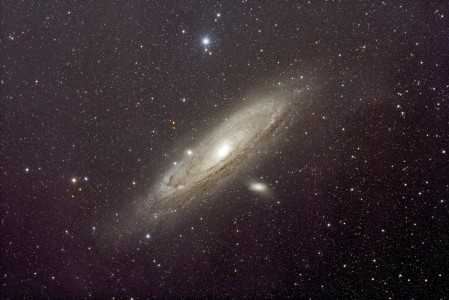
M31 with Redcat 51

My Account

New to Astromart?

Register an account...

Need Help?

Posts Made By: Joplin Motisher-Chittenden

February 28, 2003 10:42 PM Forum: Equipment Talk

A question on finders

Posted By Joplin Motisher-Chittenden

David, the most accurate method is to allow a star on the celestial equator to drift across the field of view of your finder. It will take a while (a 6 x finder with a wide field of view could take nearly 1/2 hour). The best star to use right now is probably Mintaka, Orion's western-most belt star (it's less than 1/5 deg. away from the celestial equator, will give an accurate result). The star will appear to move about 15 degrees every hour, so long as it is well above the horizon. It is important that the star drifts through the center of the crosshairs to get an accurate reading. This will be more difficult to accomplish with a dob mount, so I'm adding a simple chart you could use to get a close estimate of your finder's field of view. The Telrad Circle are 4 degrees, 2 degrees, and the Telrad Bullseye is 1/2 degree across.

Joplin

March 2, 2003 01:13 PM Forum: Film Astrophotography - Imaging and Processing

Cleaning the pictures

Posted By Joplin Motisher-Chittenden

Michael,

The items that appear to be like meteor trails are probably either scanning artifacts or scratches on your negatives / prints. The easiest way to tell if it is a scanning artifact would be to rotate the prints 90 degrees and scan them again; if it is a scanner artifact, the lines won't rotate with the image.
I have found from my experience working in photolabs that Pec-12 photographic emulsion cleaner produced by Photographic Solutions works the best for cleaning prints and color negatives. I generally use it with Pec pads, a special lint free non-abrasive disposable cleaning clothes. The Pec products are not widely available for resale but can be found at many of the larger photo supply mail order houses ( Adorama, for instance).

Joplin

March 11, 2003 02:19 AM Forum: Equipment Talk

Mount for Coronado MaxScope 40mm?

Posted By Joplin Motisher-Chittenden

You could try the Borg fork mount distributed by Hutech. It is very light weight and even has slow motion controls. It is also available as a package with a lightweight tripod. There is a review on Cloudynights in conjuction with a couple Borg scopes. Here is the link to the Hutech product page:
http://www.sciencecenter.net/hutech/borg/parts/html/3101.htm

Joplin

March 19, 2003 03:52 AM Forum: Equipment Talk

EZ Telescope

Posted By Joplin Motisher-Chittenden

Here is a link to their website which appears to be functioning:

http://www.sunflower.com/~clafever/ezt/index.html

Joplin

April 7, 2003 12:30 AM Forum: Equipment Talk

Dob Focusers

Posted By Joplin Motisher-Chittenden

Peter,

I recently replaced the stock R&P focuser on my Parks Newtonian with a used Moonlite focuser (a slightly older model with 3:1 belt drive reduction purchased on Astromart). I have been quite impressed with the smoothness and precision of it. I was also impressed with the service I got when I ordered a curved base adapter and extension tube for it from moonlite, they were very helpful. I used it last night and also used the club's dob with a JMI DX2 and it seemed to me that the Moonlite was much smoother (the DX2 was installed new just a couple months ago). One thing I have heard but I have not checked myself is that the JMI requires a large hole for the drawtube, which can make it difficult to change focusers later. I have also used a club member's Kineoptics helical crayford which was very nice, a good option if you want a really low profile focuser.

Joplin

April 22, 2003 12:45 AM Forum: Film Astrophotography - Imaging and Processing

Full moon pics on a 8" celestron Dob? How?

Posted By Joplin Motisher-Chittenden

Erik, taking pictures of the moon is fairly simple, you will just need a T-ring for your camera and an adapter that connects the T-ring to your 1.25" focuser. The only issues that I can think of are making sure your focuser has enough in - travel to accomodate the camera and probably rigging up a temporary weight on the back of the scope to keep it from falling down from the weight of the camera.
The slowest shutter speed you will be able to use should be around 1/15 or 1/30 of a second. If you shoot the full moon w/ 100 speed film, the exposure should be about 1/250. Quarter moon will be around 1/60 or 1/30; Crescent around 1/15.
Just be sure to use the mirror lockup feature on the camera and a cable release to trigger the shutter to minimize vibration.

Clear Skies,

Joplin

April 25, 2003 05:12 PM Forum: Equipment Talk

Parks 12.5" primary,,,,,quality ?

Posted By Joplin Motisher-Chittenden

I'm very happy with the quality of the optics on my 10" Parks Newtonian.

Joplin

April 27, 2003 07:15 PM Forum: Equipment Talk

Eyepiece Question

Posted By Joplin Motisher-Chittenden

David,

I've used some Panoptics and borrowed a few Naglers and similar eyepieces at star parties. One thing I have noticed is that all of them are effected to some degree by the focal ratio of the telescope. If your telescope is a 120mm F8.3 model, you have quite a few options whereas if you have an F5 model, only a few of the most premium eyepieces will give you a sharp image across the entire field. Here's a short list of ones to consider in order of decreasing ability to compensate for a fast (like F5) telescope: Naglers, UWA, Panoptics, SWA, Widescans, Erfles, Konigs. The last three seem to vary a lot but can probably be lumped together as ones that won't do well with scopes faster than about F6 or 7. I'm sure there will be much disagreement over the exact pecking order since every scope/ eyepiece combination is different. I personally prefer the view through Panoptics and Pentax XL's over Naglers most of the time. Naglers seem a bit "soft" to me although the newest type 6 ones seem better in this regard.

Joplin

April 28, 2003 04:50 AM Forum: Eyepieces

Pentex E.P.s

Posted By Joplin Motisher-Chittenden

I recently purchased a 7mm Pentax XL here on Astromart. I already had a Pentax SMC ortho 7mm and I wanted to see just how well the two compare. I've used both quite a bit in my 10" F6 Newtonian and 80mm F8 refractor. In the 10" on Jupiter the image in the ortho is almost imperceptibly brighter than the XL but the two are tied in terms of low contrast detail on Jupiter. I find myself using the XL much more because it's easier to view through and gives a much wider field which works great for globular clusters, small gallaxies, etc. It has also become my favorite eyepiece for solar observing since it yields a large image of the Sun that still fits well in the f.o.v. of the refractor.

Joplin

April 28, 2003 06:30 PM Forum: Birding Optics and Photos

posting great pictures

Posted By Joplin Motisher-Chittenden

Vincent,

I have a Mac too; posting images with one really isn't any different than posting images with a PC. The only practical difference is that macs use a higher monitor gamma setting (lighter) most of the time so images posted from a mac will usually look darker when displayed on a PC monitor. If you have a shot that is dark to begin with, you may want to lighten it up just a bit before you post it here. As far as image size goes, I usually try to stay between 640 x 480 pixels and 800 x 600 pixels so the image will fit on most screens (or at least not require much scrolling). The file should be a JPEG, I try to keep mine around 100k or less so they won't take too long to display. You will need to compress the image to some degree; artifacts won't be noticeable on screen unless you compress it too much. Any basic image editing program will handle these adjustments. I use Photoshop myself - here is a link to a "Mac only" site with links to a number of different graphics software programs:
http://www.pure-mac.com/graph.html
If you have a scanner it may have come with a light version of photoshop or something similar that will let you make the adjustments.

Joplin
