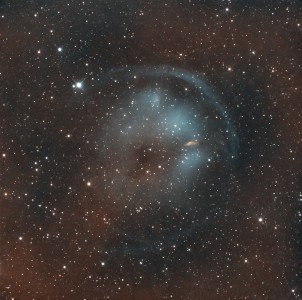
Image of the day

Captured by
Yue Ma

HFG-1

My Account

New to Astromart?

Register an account...

Need Help?

Posts Made By: Inge Skauvik

June 1, 2006 06:18 AM Forum: Deep Sky Observing

Galaxy observation from La Palma

Posted By Inge Skauvik

Galaxy observation from La Palma was very rewarding. During my stay there the Virgo/Coma galaxy cluster was high in the sky together with all the fine objects of Canes Venatici and Ursa Major. In addition several objects in Centaurus and Hydra were within range.

The most notable of the soutern galaxies were M83 and NGC5128. Both of them had a very interesting apperance in the telescope. Of course, I knew beforehand about the peculiar shape of NGC5128, and it didn't disappoint me, although it wasn't very high above the horizon. It must be one of the most unique objects in the sky. M83 turned out to be a very beautiful spiral galaxy, slightly tilted from the face-on position. The spiral arms were not difficult to make out, although not as marked as those of M51.

Even closer to the horizon than 5128 was the large edge-on galaxy, NGC4945. Although it didn't show much detail, it was a very impressive object.

The Hydra 1 galaxy group is also too far south to be observed from Norway. I observed it twice from the Canaries. The first time I noticed four galaxies within the field of view. The second time I applied the 13mm Nagler, and found six. They were all moderately faint fuzzyballs, but it is always facinating to observe tight galaxy clusters and just contemplate on the true nature of the objects.

Slightly further east in Hydra I observed NGC3621. I couldn't make out any detail in it, but it is large and bright and looks very nice together with several foreground stars.

M104, the Sombrero galaxy can be observed from home, but it is very low in the sky, and in a 12.5-inch scope it is difficult to see light at both sides of the dust band. From La Palma it was an awesome object. Being rather small, it stands magnification well, and I found it best with a 9mm Nagler giving me 167x power. I saw photos of this galaxy when I was a kid, and they really trigged my imagination. Therefore it was a very nice experience for me to observe the galaxy at its full splendour through the eyepiece.

All galaxies of the northern sky appeared brighter and better from La Palma. Moving from a place with sub-arctic to one with tropical skyglow probably explains a lot. M101 and M51 were superb objects, and so were M81 and M82. NGC4564 was very long and bright - it sometimes disappoints me when I see it from home.

I still couldn't confirm the spiral pattern of M100, but the spiral structure of M99 and M61 was obvious. We invented a new name for M61 - the "Food processor galaxy", since they had an appearance similar to the knives of a food processor.

In the distant Coma galaxy cluster at least 15 - 20 faint galaxies could be glimpsed in addition to the large ellipticals. It was even possible to see that some of them were edge-on galaxies with different orientation.

I often get the impression of seeing dust clouds in the large, edge-on galaxy, NGC4631 in Canes Venatici. From La Palma this was even more conspicuous. I'm still not 100% sure if my imagination plays tricks with me. Anyhow this galaxy is a very fine object. Nearby NGC4627 makes it even more interesting, and it is even possible to get NGC4656 within the same field of view. Its irregular hook shape was very obvious under the dark skies of La Palma.

Seeing is often considered to be less important for observation of deep-sky objects. My experience, however, is that structural details in galaxies tend to be washed out by poor seeing. Observing from the mountain under excellent seeing was significantly better than from the lower altitude site where seeing was blurry (but the sky still dark).

Inge S

June 5, 2006 01:32 PM Forum: Deep Sky Observing

La Palma trip - some general information

Posted By Inge Skauvik

I got a message from Herbert Highstone containing some questions that probably may be of some interest. Readers of our blog may already know most of it, but I give a brief summary here.

I brought a 12.5-inch telescope along as airline baggage. How, and what kind of scope?

This is a 12.5-inch Portaball (www.Mag1instruments.com). To bring it along I used the original packing material. I took out the primary mirror, and carried it as hand luggage (all the time pretending that the 15 kilograms were sooo easy to carry and leaving no suspicion that this was about twice as much as the maximum of the airline regulations for hand luggage). I usually had to open the mirror box whan passing security, and on one occasion I was stopped at the gate because the pilot wanted to know what was inside that large drum shaped box. Obviously the x-ray had revealed the round bomb-shaped ball inside. Mostly fun, a lot of contact with nice people and no problems really. (When I purchased the Portaball, I also travelled to the US to pick it up. This turned out to be cheaper than having it shipped).

We had a rental car to our disposal th whole week at La Palma. Since we were three persons splitting the cost, this was no big deal.

The observatory zone was restricted area. We were admitted access to the helicopter landing pads some distance from the domes. It is always possible for people staying at Casa Rosabel to get access to the area, since the host is a former worker at one of the observatories. I think that our landing pads were about 200m lower than the highest peak.

The caldera of Roque de los Muchachos is large, and the observatories are located on its northern edge. There are high peaks also at its eastern and southern side, but the region is dangerous, and we decided to stick to the landing pads although it was very windy there and the view towards the south was partly blocked.

People interested in visiting the Canary Islands for astro tourism may also consider Tenerife. There are also some observatories located at Tenerife island, and near the high peak, Teide, there is a hotel specialising in astro tourism. I don't think it is recommended to make observations from the summit of Teide, though.

Inge S

June 6, 2006 01:27 PM Forum: Deep Sky Observing

Planetary nebulae from La Palma

Posted By Inge Skauvik

Observing planetary nebulae is fun, because they come in all kinds of sizes and shapes. I observed several nice ones from La Palma. The well known ones from the northern sky (M27, M57) were awesome, of course. Among the brighter ones in the "new" part of the sky, were the Ghost of Jupiter (which I was able to observe from home with some difficulty) and NGC3132, the "Eight Burst Nebula". Another nice, pretty bright one was NGC6818 in Sagittarius, an object that shouldn't be forgotten by anyone who has observed Barnards galaxy - it is located just slightly north-west of the galaxy.
The oddest of all planetaries must be the Bug nebula near Lambda Scorpii. It really resembles a bug.
A couple of the southern nebulae were clearly annular. The "Little Ghost Nebula", NGC6369 in Ophiuchus was almost like a miniature edition of M57. Also Shapley-1 in Norma was annular. It appeared a bit larger than 6369, not extremely bright, but would probably have been a very good object at a higher altitude above the horizon.
I really enjoyed the sight of the open cluster/planetary nebula, NGC2818 in Pyxis. I had to catch it just after nightfall, and it was low above the western horizon. Although this cluster/nebula combo is fainter than M46/NGC2438 in Puppis, it is very nice in a 12-inch, and I find it strange that it isn't more famous.
The most difficult of the planetaries I observed during my trip was the box nebula, NGC6309 just north of Eta Ophiuchi. When I first pointed the scope at the position where I expected to find the nebula I noticed two double stars in the field, but couldn't find the nebula. Blinking with the O-III, however, made me suspect the fainter of the two double stars, and after increasing the magnification to 167x, I saw that one of the components of this "double", indeed, was the nebula. Its brightness wasn't impressive, and it was quite small with a pecuoiar shape. The "Box nebula" is probably an appropriate name for it.

I didn't observe the Helix nebula. The horizon in the east was blocked by mountains. The good thing about this, of course, is that there are still some great objects on the to-do list, together with all the great galaxies of the autumn sky and the wonders of Southern Canis Major, Lepus, Puppis and Eridanus.

Inge S

June 16, 2006 01:24 PM Forum: Deep Sky Observing

Astronomy season 2005/2006. Looking back

Posted By Inge Skauvik

For sub-arctic residents it is natural to speak about the "astronomy season" starting in August and ending in April the year after. I was so lucky, however, that I got that extra week in May. Looking back on the 2005/2006 season I realise that it has been one of the most exiting seasons ever. of course, this is partly because I'm reaching the age where I can affort to spend more money on astronomy than earlier. Kids and wife also grant me more free time than some years ago.

The "top ten astronomical events" for the last season were the following (Not ranked):

1: Splitting Gamma Andromedae BC under excellent seeing conditions with 18-inch Dob.

2: Observing M101 under dark sky conditions with the 18-inch. The visual impression of this great spiral is priceless.

3: The Veil Nebula from the Canary Islands with the 12.5-inch and O-III filter.

4: The Lagoon nebula, M8 with the 12.5-inch and O-III filter. I'm so impressed by this nebula. It is just sooo beautiful and bright.

5: Showing Omega Centauri to visitors at Roque de los Muchachos with the 12.5-inch and a 13mm Nagler. Just before I had shown them Saturn. When the first guy had a look at the cluster he exclaimed to his friends: "Forget Saturn - come and have a look at Eisblume (Ice flower)!"

6: Admiring the Sagittarius/Scorpius Milky Way with the naked eye from the Canaries.

7: The Coma Galaxy cluster with the 12.5-inch from the Canaries. Although all except the giant ellipsiodals were just faint smudges, it was possible to recognise them as galaxies - some edge on systems with different orientation. An awesome reminder of the vastness of the universe.

8: The Sombrero galaxy with the 12.5-inch from the Canaries at 167x magnification. A superb galaxy.

9: The Trifid nebula. I liked the unfiltered view the most. A much more delicate sight than most photographs where the nebula tends to be over-exposed.

10: The planetary nebula, NGC1514 at the Perseus/Taurus border observed from home with the 12.5-inch and the 18-inch. Maybe the experience was more memorable just because it turned out to be much better than my expectations. However, I recommend this object to anyone who has sufficient aperture and an O-III filter.

There are many runners-up. M33, M51 and M31 with the 18-inch, M17, the Ghost of Jupiter and the Eight-Burst planetary, good views of the Rosette nebula, an enormous number of good double stars, Mars near opposition under excellent conditions with the 18-inch.... Just to mention a few.

Inge S

August 15, 2006 06:37 AM Forum: Deep Sky Observing

Is seeing important for the deep-sky observer?

Posted By Inge Skauvik

What is your experience and opinion?
Of course, seeing is important for resolution of distant globular clusters, but what about galaxies and extended nebulae?
Personally, I consider good seeing to be a great advantage, almost regardless of object. If the seeing is VERY bad the stars look like 2 - 3" fuzzyballs, and even low magnification images suffer. I assume that this doesn't affect objects like the North America Nebula very much, but the nice impression of the faint nebulosity embedded in the rich field of pinpoint stars is lost.
I can't say for sure how small features I can make out visually in a galaxy like M51. Anyhow I always have a feeling that it looks unsharp at higher magnification (150 - 200x is often a good choice for this galaxy). And I'm never satisfied with an observation of M81 if I can't split the two small double stars in the field.
I also believe that poor seeing reduces the ability to detect very faint diffuse objects. Reduced resolution means reduced contrast. Thus a very faint object, otherwise possible to see, can disappear when seeing is bad.
What do you think?

Inge S

August 23, 2006 06:17 AM Forum: Deep Sky Observing

Something to think about...

Posted By Inge Skauvik

Occasionally observers report a feeling of seeing DSO's, particularly globular clusters, in three dimensions. This feeling, however, can not have anything with reality to do. The image with any instrument at such distances will be flat. The 3-D feeling is probably a result of differences in brightness of the stars. When a globular like M13 is viewed through a big scope at a magnification of 200 - 300x, the cluster fills nearly the whole field of view, and the observer gets the feeling of being located not far from the edge of the cluster.

If you were located just outside a globular cluster where all the stars had the same absolute magnitude (hypothetical) the nearer stars would appear much brighter than the stars at the opposite side of the cluster. Assuming the centre of the cluster to be 100 light years away, the nearest stars 40 and the most distant ones 160 light years away, the nearest stars would be 2 magnitudes brighter than the stars near the centre and 3 magnitudes brighter than the most distant stars of the cluster.

If this hypothetical globular was observed with a telescope from a distance of 40.000 light years all members of the cluster would appear equally bright (far all practical purposes) regardless of aperture and magnification. I assume that such a globular would appear flat in the telescope.

Any real globular cluster contains a number (several hundreds or even thousands) giant stars in addition to myriads of fainter main sequence stars. The brightest giants will appear brightest through the telescope regardless of their position in the cluster, many of them being located at the far side. Observing the real cluster through the telescope at high magnification may give the illusion of a 3-D view with the brighter stars being the nearest. The truth is that the members of a globular cluster appearing brightest in the telescope are the ones with the highest true luminosity. (This facilitates the process of constructing the HR-diagram of a globular cluster.)

Something to think about...

Inge S

September 4, 2006 12:57 PM Forum: Deep Sky Observing

Dark skies - at last

Posted By Inge Skauvik

At last darkness is returning to the sub-arctic zone. Unfortunately we had a very good summer here with high temperature and clear skies every day. Now, as it is possible to make astronomical observations, we obviously have used up the good weather quota.

My friend has acquired a device for measuring the sky darkness. I think the measured value is "apparent magnitude for one square minute of sky". Of course we will measure the value for our observation sites and make them available at this forum. In particular, it will be interesting to see if the sky darkness varies with the solar cycle.

My special project for the first few months is to become more familiar with the region Cygnus - Cepheus - Lacerta. Although this part of the sky is circumpolar here, it is one of the regions I know the least. As far as I know it doesn't contain any famous show objects, but several DSOs and double stars should be quite good in the 12.5-inch.

Inge S

September 15, 2006 06:27 AM Forum: Deep Sky Observing

Observing again - at last

Posted By Inge Skauvik

After a period with heavy rain yesterday evening brought clear skies. Because of a steady wind from the east and some haze I decided not to bring my scope along to one of my dark observing sites, but set up the scope on my balcony just to do some maintenance of it and collimate the optics.
Winds from the east normally means poor seeing at my site. However, a quick check on Epsilon Lyrae and Pi Aquilae showed that conditions were much better than I expected. When seeing conditions are poor, images appear soft even at 63x magnification, but this time the 9mm Nagler (167x) gave sharp stellar points. Therefore I decided to spend an hour or so observing.
My balcony is directly exposed to light from several high-pressure sodium lamps. There is, however, still leaves on the birch trees in my garden blocking away much of it. There were other disturbing light sources too (including the moon rising in the north-east), therefore conditions were not perfect for deep sky observation. Limiting magnitude near zenith was around 5.

Still I decided to look for some nebulae in the Cygnus - Cepheus region.
I never observed planetary NGC40 before. It forms an (almost) isosceles triangle with Gamma and Pi Cephei, and it turned out that it was pretty easy to find it using these stars as a reference. It was moderately bright, and was not much enhanced by the O-III filter.
Using Alpha and Beta Cephei I located an interesting reflection nebula, NGC7129-33. This nebula is illuminated by four moderately bright stars, and it was obvious at first glance. This is a rather small nebula, and I found it beneficial to increase the magnification from 63 to 115x.
Just to get acquainted with the region I pointed the scope at the position of the Cocoon nebula. I messed around a bit with and without the O-III filter, but saw nothing. I guess it requiers darker and more transparent skies.
Then I tried to find the planetary, NGC7048. I was pretty sure of its position, but couldn't see it before applying the O-III. Removing the filter again, it was barely visible. With the filter it was a very nice, round nebula with a star on its edge.
NGC7027 a bit further to the south-west was much brighter. It is, however, possible to miss this object too because it is so small. At 63x it looks like a blue star, just slightly out of focus. Its true nature becomes more obvious at higher magnification, but I have never seen any structure in this planetary.
As a "grande finale" of the planetary session I reviewed the three great objects, NGC6826 (Blinking planetary), M57 and M27. After spending the time with faint and small nebulae, observing the show objects was almost an overwhelming experience.

For people wanting to investigate the effects of the O-III filter, M27 may be an interesting object. The nebula appears quite differently when the filter is applied.

Of course I also observed the Veil. The segment north of 52 Cygni could just be made out without a filter, while nothing could be seen south of it. With the filter much more detail appears, even under mediocre conditions like yesterday evening.

Inge S

October 5, 2006 06:08 AM Forum: Deep Sky Observing

Cepheus spiral, NGC6946

Posted By Inge Skauvik

When I observed this galaxy from the Canary Islands, its spiral structure was pretty obvious in the 12.5-inch. Observing it from home I still see hints of the spiral arms. What is your experience?

Inge S

October 19, 2006 05:51 AM Forum: Deep Sky Observing

A few DSO's observed last Saturday evening

Posted By Inge Skauvik

During my observing session last Saturday evening I spent most of the time on double stars, but I also observed some nebulae.

NGC7331 in Pegasus was well placed for observation. I always apply a 24mm Panoptic eyepiece (63x) when aiming my telescope. With this magnification I always find this galaxy a bit disappointing. However, it bears magnification well, and at 115x and 167x it becomes a very appealing object. I can not see the dark lane visible in photographs, but a sharp brightness cutoff is obvious at the side where the lane goes. Two of its faint companion galaxies were quite obvious, and NGC7335 really looked like a small galaxy, not just a smudge.
Further south in Pegasus I viewed the pair of edge-on galaxies, NGC7332/7339. These galaxies also require a magnification above 100x to be seen well. They are about the same size, but differ in orientation and surface brightness. No particular features could be made out in these objects.
Still further south (3 degrees south of Alpha Pegasi) the barred sprial, NGC7479 is located. This galaxy appeared in a photo in one of the first astronomy books I owned, and therefore it has a special status among the "items in my collection of astronomical objects". Actually it is rather faint, and so far I have not been able to detect its spiral arms. This object is on my to-do list for my next trip to La Palma on the Canary Islands (September, next year). There I expect to capture some detail in NGC7479.
In addition to galaxies in Pegasus, I observed a few nebulae and clusters in Cepheus and Cassiopeia. I'd just like to mention one quite weird object in Cepheus. NGC7380 is a rather loose open cluster with faint stars located not very far from Delta Cephei. There is some nebulosity in this cluster that can be made out without a filter. The O-III filter enhances the nebula quite a lot. Photos show that the nebula has an irregular appearance, but through the eyepiece the cluster/nebula combo appears almost like an equilateral triangle. I quite often experience that my eyes/brain tend to simplify the shape of faint objects and straighten out irregularities. In this case three of the brighter stars of the cluster arranged as a triangle contributes to the illusion. NGC7380 can hardly be characterised as a show object, but it should be detectable with considerably smaller aperture than 12.5 inches.

Inge S