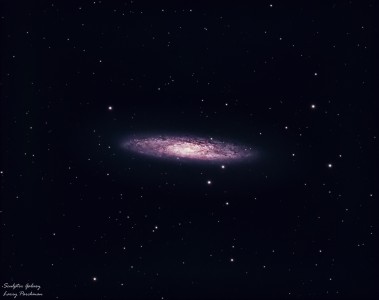
Image of the day

Captured by
Lawrence Parchman

Sculptor Galaxy (NGC 253)

My Account

New to Astromart?

Register an account...

Need Help?

Posts Made By: Doug Scobel

November 14, 2003 07:48 PM Forum: Telescope Making

testing a fine old coulter

Posted By Doug Scobel

Phil,

After my previous post, I discovered that my Genmir program is making assumptions regarding the mask opening widths, and bases the wavefront and transverse aberration errors on those assumptions. The assumption is not that the mask openings are 12mm wide - rather, it is assuming that each opening picks up where the other left off. So the results I posted assume that the opening widths (going from the center out) are 12mm, 30.45mm, 20.3mm, and 13.3mm. Note that this affects the error calculations only - the mean radii of .3, .6, .8, and .95 were still used as the mean radius of each zone, for purposes of the slope calculation. The slope errors are extrapolated out to the edges of the mask openings, and so if the widths I listed above are larger than what they actually are on your mask, then they could be in error.

Please post the actual zone widths as they exist on your mask, and in the meantime I'll modify my program to let me input them directly. You should also carefully measure what the "active" diameter of the mirror is (i.e., omitting the bevel). I can then see if the numbers come out any different.

Regards,
Doug

November 18, 2003 08:25 PM Forum: Equipment Talk

New subject to ponder!

Posted By Doug Scobel

I think the next time your observing and standing on your ladder, you'd better watch your back!

grinoug

November 25, 2003 05:22 PM Forum: Equipment Talk

What type of finish?

Posted By Doug Scobel

Polyurethane. Without good moisture resistance, that "good looking" finish won't look good for long. And a well-applied polyurethane finish looks quite good.

IMHO of course.

Doug Scobel

November 25, 2003 09:13 PM Forum: Deep Sky Observing

Best power for DSO's

Posted By Doug Scobel

In my 13.1" f/4.5:

M31 - 53x (28mm UO Pretoria) - use as low power as exit pupil will allow. But use higher power on the companions, especially M32 which has a nearly stellar core.
M33 - 53x - look for HII regions in arms
M42 - 53x for full extent, 117x (14mm Radian) or higher for examining the Trapezium and other intermingled stars. UHC filter brings out more nebulosity.
Veil nebula - 53x + OIII + dark sky - spectacular!
M57 - 117x and up. Hard to go too high it has such a high surface brightness
M13 - 213x (7mm Nagler) - fully resolved across the entire thing
NGC4236 (Large, faint galaxy in Draco) - 53x - 117x
NGC3190 (Member of group of small galaxies in Leo) - 117x lets you see all four at once
NGC6210 (Small planetary in Hercules) - 117x and up - also high surface brightness
NGC7662 (Moderately small planetary in Andromeda) - 117x and up. Over 200x can see "overlapping" ellipses. AKA the "Blue Snowball"

My personal rule of thumb is to increase the magnification until the object starts looking no better or worse (too faint, too fuzzy, less detail seen, etc.), then go back to the next previous EP.

Doug Scobel

December 1, 2003 01:49 PM Forum: Equipment Talk

Dark or Altitude?

Posted By Doug Scobel

Floyd -

The whole point of higher altitude is darker skies and better seeing. If your high altitude site is inferior in both respects, then I think you've answered your own question, no?

Best regards,
Doug Scobel

December 3, 2003 03:16 PM Forum: Deep Sky Observing

WHY???????

Posted By Doug Scobel

My wife tells me that it is the light pressure from the full moon that blows the clouds away. I find it hard to argue with her.

Doug Scobel

December 4, 2003 02:58 PM Forum: Telescope Making

How about this one?

Posted By Doug Scobel

Jerry, the sides of the rocker box on my 13" are made from single thickness 3/4" plywood, and it has virtually no flexure. The OTA weighs considerably more than 30 pounds. I think the secret is to have adequate triangulation/cross-bracing - on mine there's another panel about 16" high running across the front of the rocker box joining the two sides. You can see a picture of it here: http://www.astromart.com/messages.asp?message_id=140099&page=

I think that 3/4" will be fine.

Regards,
Doug Scobel

December 4, 2003 09:09 PM Forum: Telescope Making

How about this one?

Posted By Doug Scobel

Jerry, another place where flexure may be creeping in is in the piece(s) joining the two sides of the rocker box. If there is a large opening in it, or if you have separate pieces, top and bottom, or if it is too short, then you may get some flexure side to side. Simply adding corner braces won't help much - you need triangulation. Can you post a picture from the front?

The key in making the structure stiff is not necessarily thickness, but rather triangulation. And the bigger the triangles, the better.

Doug

December 8, 2003 01:51 PM Forum: Telescope Making

Painting over Polyurethane

Posted By Doug Scobel

Walter, Krylon makes an oil-based polyurethane brush-on enamel. I use it on my sonotube newts and it's near impervious to moisture, and very durable. (I've always put it directly on the tube exterior without sealing first.) It's getting hard to find, but it's still on the Krylon web site so I assume they still make it. If you can't find any at your local stores (I found some at Wal-Mart of all places), then you should be able to order some through a paint store.

Good luck,
Doug Scobel

December 8, 2003 05:36 PM Forum: Solar System Observing

A Tail of LINEAR, 2003/12/3 UT

Posted By Doug Scobel

FYI, here's a sketch I made of C/2002 T7 (LINEAR) on the night of November 27, which was 6 days prior to your observation.

Best regards,
Doug Scobel
