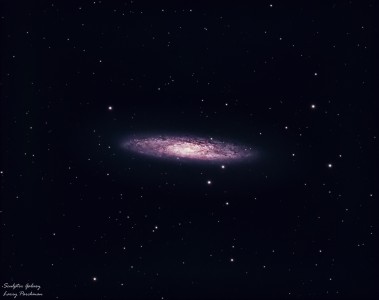
Image of the day

Captured by
Lawrence Parchman

Sculptor Galaxy (NGC 253)

My Account

New to Astromart?

Register an account...

Need Help?

Posts Made By: Paul Hyndman

November 4, 2002 01:38 AM Forum: Coronado-Lunt-DayStar Solar Filters

Questar 3.5

Posted By Paul Hyndman

If you already own the scope or anticipate using it in other applications, I imagine it would not present any major problems, assuming the blocking filter is large enough to accomodate full disk views at the specified focal length.

H-a itself is a very narrow, monochromatic slice of the spectrum... 656.28nm, and typically less than 0.7angstroms wide, so not much more than an achromatic that is reasonably well corrected (for Red) is needed to enjoy the show.

Cheers,

Paul

Info on this image:
http://www.astro-nut.com/sun-ha-21oct02.html

November 5, 2002 11:23 PM Forum: Equipment Talk

powermate vs televue 2x barlow

Posted By Paul Hyndman

Hi Matt,

Those here with far more optical expertise than I will likely be able to give you better input, but FWIW I already own a 2X TV Big Barlow, but recently picked up some Powermates as well.

I'm fortunate to have a well-rounded selection of eyepieces and seldom found the need to use the barlow, but was seeking the best solutions for using an SLR with with my scopes... something that would not only to give me the image scales I wanted but would also preserve the image quality my scopes deliver.

After discussing the situation with "Uncle Al", I ordered a 2X and 4X Powermate (to replace my 2x Big Barlow) and T-adapters for each. The Powermates, as you are probably aware, are not simple barlows but telecentric* devices that provide a virtually distortion-free wide potential image scale when used alone or combined together.

Al ingeniously designed these with extenders that are removable from the chromed optics barrels, and (optional)customized T-adapters that can be screwed on in their place. This allows close placement of a camera or CCD (using a T-ring), to reduce or eliminate vignetting.

Lest you think the Powermates are only beneficial for persnickity imagers and such, let me state that they are also a great addition for visual use as well. They now sport captive brass clenching rings (ala AP style) to hold the EPs in place, and yes, I'd buy them again in a heartbeat!


*Before seeing the term in the TeleVue Powermate ads and speaking with Al, I had no idea at all what telecentricity was or how the lack of it could affect the image. This is an interesting essay on the subject and may help explain what the telecentric Powermates can do (that a normal barlow doesn't):

http://makeashorterlink.com/?L25562512

Paul

PS: The below image was taken using only a 2X Powermate (no eyepiece) via a Canon D60LSR and FS128 Tak' (processed with Images Plus and final finishing with Adobe PhotoShop).

November 6, 2002 10:07 PM Forum: CCD Imaging and Processing/Solar System

GANYMEDE

Posted By Paul Hyndman

WOW!!!

Nice animation on your site, too... thanks for sharing!

Paul

November 8, 2002 02:02 PM Forum: Film Astrophotography - Imaging and Processing

Using Generic Digital Camera w/telescope?.

Posted By Paul Hyndman

With a non-removable camera lens, you must shoot afocal... through the eyepiece. Usually best results are achieved when the camera is set to infinity and focus is accomplished with the telescope's own focuser.

Youi should visit the Digital Astro egroup for more complete information:

http://groups.yahoo.com/group/digital_astro/

or digicam astro-imaging FAQs:

http://users.erols.com/szykman/Astro/AstroDigiCamFAQ.html

The below image was gathered by my Nikon CoolPix 995 and 8" scope:

Paul

November 9, 2002 02:42 PM Forum: Film Astrophotography - Imaging and Processing

Attention: Paul Hyndman & Jim Mills

Posted By Paul Hyndman

Thanks for the kind words Larry, and I'm sure you'll soon be producing some really nice images of your own! Being able to see immediately what the results are (or will be), helps loads, as we can correct for the foibles that would othewrwise make it much more difficult to capture good images.

That image was taken through my 8" Mak-Newt, but the 5" refractor is no slouch either... here's one of yesterday's solar Ha images, taken with the smaller scope and a Coronado Solarmax90 filter using a 2X Televue Powermate and Canon D60 digital camera.

Other digicam images (most taken with a Nikon CoolPix995) can be seen on my site at:

http://www.astro-nut.com/


Cheers,

Paul

November 14, 2002 07:47 PM Forum: Film Astrophotography - Imaging and Processing

First Moon Shot

Posted By Paul Hyndman

Great shot, Christopher!!!

Paul

November 16, 2002 11:30 PM Forum: Off Topic Discussions

Why is astronomy seemingly so male-dominated?

Posted By Paul Hyndman

Interesting... I'll ask the club President (ASNH/Yale) when I see her at next week's meeting! shocked)


Paul

--- http://www.astro-nut.com/ ---

November 18, 2002 11:16 AM Forum: Film Astrophotography - Imaging and Processing

Pre-photos w/mask at target sets up scope focus.

Posted By Paul Hyndman

You might want to try using a nearby star in lieu of an extended object. Perhaps you are already aware of the following, but if not, here's how these masks work...

Each opening acts as an individual off-axis telescope, with its own unique image. As an eyepiece (or camera, etc.) is moved closer or further from focus, the OA image will move across the field of view. This is most apparent when the OA image source is a point source of light (a star). Using extended objects is more difficult, although a two-hole mask can be used for well-defined line-features (such as Rupes Recta on the Moon), rotating the mask so that the two images form lines that diverge/converge laterally (=) and are NOT overlapped inline (--) to determine Critical Focus.

Focusing a single image can be ambiguous, as there is often some latitude or "sweet" spot where small changes seem to have little or no effect. When multiple OA images are used (ie; from a multi-holed focusing mask), the center of each focused "sweet-spot" (even if it is difficult to tell where each individual one might be) intersect at one unique point, (drum roll please...) "Critical Focus"!

So... here's the scenario: However many holes you have, you'll have separate images when out of focus. As you approach focus, those images converge. When you have a single image, Voilá, you have attained Critical Focus. More holes or larger size is not always better though, nor is using a star so bright as to become a giant fuzz-ball when approaching Critical Focus.

The farther apart the openings, the more dramatic their effect (and hence making it easier to determine Critical Focus). Openings nearer the center will have little movement even with large changes in focus, while those nearer the edge will show greater movement even with small changes in focus. Generally, you want the bulk of the opening area as close to the edges of the aperture as possible.

Bigger openings = brighter targets, but to be bigger means that the bulk of their areas is moved closer to each other, diminishing the off-axis effects.

Soooo.... it is a balance of enough total (and individual) area to be bright enough to work with, but not so large as to minimize their off-axis effect. Too small = not bright enough; too big = hard to detect any changes.

The use of "Zoom" to enlarge the image scale also helps. When using a Nikon CoolPix, I would zoom to the max of 8X to aid in scrutinizing the masked images. With the Canon D60 SLR I don't have the luxury of pre-screen zoom, but use a 2.5X optical finder instead.

Ron W. has an excellent chapter on focusing with masks that is available as a *free* sample of his "The New CCD Astronomy" book:

http://www.newastro.com/newastro/samples.asp

He also illustrates an interesting triangular cut-out, which adds diffraction spikes to the help find Critical Focus.

The below image illustrates the level of focus that may be attained when a mask is used in conjunction with zoom.

Paul

November 18, 2002 11:50 PM Forum: Film Astrophotography - Imaging and Processing

Thankyou Paul! was only aware of 20% of that!.

Posted By Paul Hyndman

One more tidbit if I may...

Attach a "remove before flight" banner to the masks!!! A 2" wide x 2' long (or so) strip from an old white window shade secured with a dollop of glop from a hot-glue gun works well.

I *can't* even begin to count how often I shot myself in the foot by NOT remembering to remove the mask when taking the actual shots. Granted, it's far easier to muck up during film-based shots (where you have no immediate feedback) than digital images, but still a pain in the arse never-the-less!

Since attaching a streamer to each mask, I've not shot myself once (ouch... I shouldn't jinx myself like that!), as it's hard to miss, even in the dark!

Hope this saves you a little of the angst I've gone through!

Paul

November 19, 2002 06:17 PM Forum: CCD Imaging and Processing/Solar System

M27 - D60

Posted By Paul Hyndman

Superb Mike... I'm champing at the bit to try out some of the new features you've put into in Images Plus v1.69!

I'm going to try a 0.8X reducer to recapture some of the punch lost in my Mak-Newt images (to the 2x Powermate used as a relay lens), but here's my best stab it it so far (14 three-minute images @ISO800 taken with a D60 through an 8" Mak-Newt w/2X TeleVue Powermate. Aligned and adaptively added with Images Plus 1.68 and tweaked with PhotoShop. Here's to hoping for crisper images with the new set up!):

Paul

PS: Thanks Mike and Johannes for the help!
