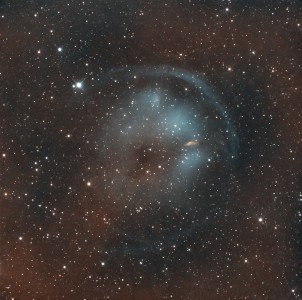
Image of the day

Captured by
Yue Ma

HFG-1

My Account

New to Astromart?

Register an account...

Need Help?

Posts Made By: Inge Skauvik

October 19, 2006 07:17 AM Forum: Eyepieces

Zoom eyepieces for high power - TeleVue?

Posted By Inge Skauvik

I have a 12.5-inch scope with good optics equipped with a series of TeleVue eyepieces, including a 4mm Radian giving 375x power. In most cases I don't need to go higher, since atmospheric seeing normally sets the limit of resolution. However, under the rare occasions when seeing is excellent, I'd really like to have the possibility to use even higher magnification. Using a barlow is one option, but with my present series of eyepieces a 2x Barlow would give a magnification gap between 375x and 750x, and 750x is definitely too high for an undriven telescope.
What about the TeleVue zoom eyepieces, for instance the 3-6mm zoom? Does it perform well over the entire magnification range? Is it worth the money?

Inge S

October 27, 2006 05:46 AM Forum: Deep Sky Observing

Observation reoprts needed , NGC253, NGC55...

Posted By Inge Skauvik

For those of you who are lucky enough to live so far south that you can observe galaxies in the Sculptor region - I would like to know what you are able to see in your telescopes (small or big). All contributions are welcome. Also galaxies in Eridanus and other constellations in this part of the sky are of interest.

Inge S

November 15, 2006 07:33 AM Forum: Deep Sky Observing

Can you see these galactic details?

Posted By Inge Skauvik

I want to make a list where galactic features are ranked by difficulty. For this I need the input of all of you. At the end of this post is a list of different features, and I want you to make a statement about which of them you have actually seen through your telescope. If you have several telescopes it is interesting to know the results for each of them individually.

Use the following "scale" to express what you see:

A: The feature is seen with direct vision.
B: The feature is seen with averted vision.
C: The feature is suspected with averted vision.
D: The feature can not be seen
E: Have never tried to observe the object (or can't remember).

Additional comments can be given.
Please, give information about telescope aperture and observing conditions (dark, suburban, lousy...).

THIS IS NOT A COMPETITION! Please be honest and realistic! In this case "D" and "E" scores are just as interesting as "A" and "B". Some of the features are moderately easy to see while others are more difficult.

Here's the list (in random order):

1: Dust bands in M82
2: Spiral arms of M61
3: Equatorial dust band of NGC891
4: Spiral arms of M33
5: The obscuring cloud of M64 ("Black eye")
6: Spiral arms of M51
7: Emission nebula, NGC604 in M33
8: Dust bands in NGC3556
9: Spiral arms of M99
10: One dust band in the Andromeda galaxy
11: Spiral arms of M101
12: Equatorial dust band of NGC3628 (The one near M65/66)
13: Two dust bands in the Andromeda galaxy
14: Emission nebulae in the spiral arms of M101
15: Spiral arms of M100
16: Equatorial dust band of NGC4565 (Coma Berenices)
17: "Bend" of galaxy NGC4656 (Canes Venatici)
18: Spiral arms of NGC2403
19: Spiral arms of NGC2903
20: Bridge between M51 and companion galaxy

All contributions are welcome.

Inge S

January 17, 2007 06:58 AM Forum: Deep Sky Observing

Burn-out?

Posted By Inge Skauvik

The posting frequency under this forum is low at present. Are users of this forum experiencing a burn-out?
I have a good excuse for myself for not contributing much. We had rain here for the last 82 days, and observation has been practically impossible. Therefore it has not been possible to contribute with observation reports. In fact I have been observing only twice since last May, the reason being the long summer season followed by this awfully long period of unsettled weather.
However, there may also be other reasons for unfrequent posting. Maybe the level has become too high, making observers with modest equipment or little experience refrain from posting.
It is ok, of course, to discuss observation of difficult objects like the Horsehead nebula. However, this is an example of an object that is out of range for most of us, and there's a huge number of targets around the sky that are visually far more interesting, that never get any attention. Maybe observation of e.g. M37 or M42 is an everyday matter for many of us, but I would welcome postings about any object, and also encourage experienced observers to contribute in such discussions.
Discussion about observing tecniques are also becoming rare. Although this is not an "equipment" forum it must be allowed to talk about the importance of aperture, field of view, magnification, filters and even telescope type. Lengthy discussions about telescope brands, however, should be placed under another forum.
Come on, guys! Let us get some new posts here. Personally I want to see posts about objects in Sculptor, Fornax, Eridanus and Canis Major. And when did we last see a post about M67, M50, M41, M35 etc.....

Inge S

January 22, 2007 08:39 AM Forum: Deep Sky Observing

Back again!

Posted By Inge Skauvik

Returning from my short trip I find several good posts both under the deep-sky and double star forum. In fact the quality of the observation reports is so high that I really find it worth while to print them out and keep them as supplement to my observation guides.
Please, keep up with your good work!

Inge S

January 30, 2007 06:34 AM Forum: Deep Sky Observing

NGC1275 in Perseus

Posted By Inge Skauvik

Hello, everybody!

Is there anybody out there who has observed the peculiar galaxy NGC1275 in Perseus?
I have messed around for it on a couple of occasions, but always got lost among the myriad of stars in this part of the sky.
I assume that it appears as a faint fuzzyball in most amateur telescopes. Even on photographs I find NGC1275 to be among the less appealing galaxies - just a slightly elliptical patch with some irregular mottling near the edges.
Physically, however, NGC1275 is highly interesting, and it is an enormous object located at a vast distance. Therefore it belongs to the group of objects I really would like to view directly through the eyepiece.
NGC1275 is actually the brightest member of a galaxy group, and I suppose that big scope owners also may have observed some of the fainter galaxies in this region.

Inge S

February 3, 2007 08:38 AM Forum: Deep Sky Observing

Puppis cluster, NGC2477

Posted By Inge Skauvik

From my observation guides I see that NGC2477 is an awesome open cluster. It doesn't reach the horizon up here, but I hope to be able to observe it from La Palma in September.
Is there anybody who observe this cluster regularly? Any observation reports?

Inge S

February 12, 2007 03:02 PM Forum: Deep Sky Observing

Features in some selected diffuse nebulae

Posted By Inge Skauvik

Diffuse nebulae are interesting to observe, because their appearance, size and brightness varies a lot from case to case. My impression is that the brightest ones (like M42) and the most difficult ones (Zeta Orionis nebula with Horsehead) get most attention in forums like this. However, there are many moderately easy nebulae out there, and I would like to sharpen your appetite by giving you a small task.

Here comes a list of diffuse nebulae, nebular features and I want you to check them out and give scores according to how difficult/easy they are to see visually. This list is by no means exhaustive, but contains some objects that are well placed in the evening sky at this time of the year. Those of you who have not tried to observe many of these objects may have a surprise or two, even pleasant ones.

Well, here is the list.

1: NGC2024 (Flaming star nebula near Zeta Orionis)
2: NGC1579 in Perseus
3: IC410 in Auriga
4: Dark lane in NGC2024
5: Dark channels (bok globules) in Rosette nebula
6: NGC2174 in Orion (near Eta Geminorum).
7: Obscuring cloud in western part of NGC2174.
8: IC443 (Supernova remant near Eta Geminorum)
9: NGC1788 (In Orion, north of Beta Eridani)
10: NGC2245 in Ophiuchus (west of Christmas tree cluster)

Use the following codes for your scores:

1: Obvious without filter
2: Difficult without filter(maybe averted vistion)
3: Obvious with narrowband filter (O-III, UHC)
4: Difficult with filter
5: Not seen (location verified)
6: Never tried/didn't find object

Good luck!

Inge S

February 15, 2007 07:33 PM Forum: Deep Sky Observing

Another small project - galaxies near M106

Posted By Inge Skauvik

Detecting an object where the exact position is known is much easier than detecting an object by chance. In order to check your abilities, try the following:
Point your scope at the large, bright galaxy M106 (NGC4258) in Canes Venatici. Then examine the region up to about 2 degrees away from M106 and check how many faint galaxies you can see. Don't use a map when doing this - just notice approximately where you find galaxies (rough distance from M106 and approximate direction), and give a short description of each of them to post under this forum.

How many do you find? Any result is of interest - also if you don't find a single one. None of the neighbouring galaxies of M106 are bright. Still I hope you will enjoy this small exercise. Good luck!

Inge S

February 16, 2007 07:09 AM Forum: Deep Sky Observing

Two very different planetary nebulae

Posted By Inge Skauvik

During one of my observing sessions last week I observed some planetary nebulae. One of them, IC2003 in the southern part of Perseus, was new to me. I have been looking for it on several occasions before, but missed it even though it is bright enough for a much smaller telescope than mine. The problem is that it is very small and looks almost like a star at low magnification. Under poor seeing conditions it is impossible to recognise it as a nebula at 63x. This evening seeing was very good and I had a suspicion of its position already before I applied the blinking technique with my O-III filter. At 167x it appeared as a neat, round greyish evenly illuminated disc. Not a show object, but well worth the search.

Over the border to Taurus is another planetary which has become one of my favourites in the sky. NGC1514 is a much neglected object, perhaps because it requires a filter for a good view. Without a filter it looks like an ordinary star surrounded by some faint haze, very much like the impression you get of any star with some dew on the eyepiece. The O-III filter works wonders with this nebula. It reduces the brightness of the central star a bit while the nebula is greatly enhanced. To me this is a textbook example of a planetary. The nebula is round with well defined edges. The nebulous disc is not even in brightness, but contains several dark spots. The central star is clearly visible.

I have observed this nebula several times, and I find it quite sensitive to observing conditions. The sky background must be dark and seeing should also be good. With my 12.5-inch a magnification of 115x is near perfect.

Inge S