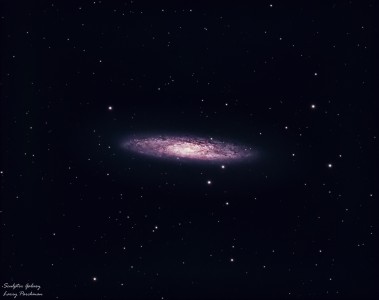
Image of the day

Captured by
Lawrence Parchman

Sculptor Galaxy (NGC 253)

My Account

New to Astromart?

Register an account...

Need Help?

Posts Made By: Dennis Persyk

May 26, 2006 01:08 AM Forum: CCD Imaging and Processing/Deep Sky

Comet 41P

Posted By Dennis Persyk

Comet 41P Tuttle-Giacobini-Kresak has a history of rapid brightening pre-perihelion. It was rather bright at its last two apparitions, and at its 1973 apparition underwent two large outbursts of 9-10 magnitudes peaking at magnitude 4-5. Comet 41P is expected to reach magnitude 10 around perihelion on June 11, but in light of above may well be brighter. It passes from Cancer into Leo in early June and spends the rest of the month in this constellation.

The comet was moving at a relative rate of 2.2 arc seconds per minute on May 23rd. I imaged it at 5.0 arc seconds per pixel, binned 2x2, which allowed two minute exposures without blurring the comet. Actually, with the comet fairly low in the west against the setting sun, I started with 60 second exposures to avoid saturation.

My sky conditions were 20.30 mags/sq arc second at zenith ~ Bortle 4.5 ~ 5.6-5.9 VLM as measured with the Sky Quality Meter; seeing ~ Pickering 3.

Images and supporting data at
http://home.att.net/~dpersyk/new.htm

Thank you for visiting my site.

Clear skies,

Dennis Persyk
Igloo Observatory Home Page http://dpersyk.home.att.net
Hampshire, IL



June 12, 2006 04:47 PM Forum: CCD Imaging and Processing/Deep Sky

Comet 41P Movie

Posted By Dennis Persyk

I’ve added a short movie illustrating 41P’s rapid motion across 2.1 arc minutes of star field.

Movie and supporting data at
http://home.att.net/~dpersyk/new.htm

Thank you for visiting my site.

Clear skies,

Dennis Persyk
Igloo Observatory Home Page http://dpersyk.home.att.net
Hampshire, IL

July 7, 2006 01:28 AM Forum: CCD Imaging and Processing/Deep Sky

Sharpless 2-86

Posted By Dennis Persyk

I planned to image this emission nebula in H-a for three hours. Clouds conspired to limit me to 4 x 15 minutes. I software average-binned the images 2x2 in ImagesPlus. This produced an under-sampled image at 5.0 arc seconds per pixel but improved the SNR. Note that on-chip binning is normally better than post-acquisition software binning, but in the case of the low readout noise of SXV-H9 (~ 7 RMS electrons), the result was nonetheless satisfactory.

I usually bin 4x4 to take my initial centering shots. There is nothing like a factor of 16x in sensitivity to bring out faint nebulosity fast! I’ve put an example on my New Images page link below.

Image and matching SkyMap Pro 10 screen shot at
http://home.att.net/~dpersyk/new.htm


Clear skies,

Dennis Persyk
Igloo Observatory Home Page http://dpersyk.home.att.net
Hampshire, IL

New Images http://home.att.net/~dpersyk/new.htm

July 18, 2006 10:02 PM Forum: CCD Imaging and Processing/Deep Sky

Sharpless 2-155 has a face in it!

Posted By Dennis Persyk

I acquired 3 hours 15 minutes of H-a signal before the clouds rolled in this time – a near-term record for me of late.

In my haste to process the nice subframes – all keepers w/o satellite tracks – I almost cropped out a perfectly circular area that I assumed was an artifact. I explain my error on my web page.

This emission nebula has an interesting face in it. See if you can spot it.

Image and matching SkyMap Pro 10 screen shot at
http://home.att.net/~dpersyk/new.htm

Clear skies,

Dennis Persyk
Igloo Observatory Home Page http://dpersyk.home.att.net
Hampshire, IL

New Images http://home.att.net/~dpersyk/new.htm

July 29, 2006 11:29 PM Forum: CCD Imaging and Processing/Deep Sky

177P – I imaged it so why couldn’t I see it?

Posted By Dennis Persyk

Comet 177P Barnard is currently magnitude 8.4. I imaged it last night and thought I’d visually observe it and post an “eyepiece view” image beside the camera image. But as carefully as I searched the sky with my 14-inch SCT I could not see it!

Now I can assuredly see magnitude 8.4 stars with my 14-inch scope from my VLM 5.6 site, so why couldn’t I see the comet? The camera of course saw it with ease on the six-inch astrograph.

Images and simulated eyepiece view of the invisible comet at
http://home.att.net/~dpersyk/new.htm

I’d appreciate comments on the why I can’t see a magnitude 8.4 comet with my scope! Help! Please check out my site for details – they are all there – and let me know what went wrong.

Thank you for visiting my site.

Clear skies,

Dennis Persyk
Igloo Observatory Home Page http://dpersyk.home.att.net
Hampshire, IL

August 3, 2006 08:51 PM Forum: CCD Imaging and Processing/Deep Sky

Comet 177P Barnard Movie

Posted By Dennis Persyk

Comet 177P is moving at a relative speed of 3.6 arc seconds per minute against the star field in Hercules. This makes it difficult to image as one must take short exposures so the comet is not blurred – and autoguiding on a comet is very difficult.

But the good news is that the fast-moving comets make for nice movies. I’ve put a short, modem-friendly 432 kb movie that shows seven arc minutes of travel from 59 minutes of subframes.

Images, movie and accompanying data at
http://home.att.net/~dpersyk/new.htm

Thank you for visiting my site.

Clear skies,

Dennis Persyk
Igloo Observatory Home Page http://dpersyk.home.att.net
Hampshire, IL

August 20, 2006 12:55 AM Forum: CCD Imaging and Processing/Deep Sky

Comet 177P Barnard – Easy to image – hard to obser

Posted By Dennis Persyk

Comet 177P Barnard is currently magnitude 8.5. Your planetarium program probably says its 13.8, but that’s wrong. The comet is presently much brighter than the standard light curve predicts.

But it is a very diffuse blob, and pretty difficult to observe visually. Observers and imagers in North America will find it positioned nicely in Hercules. It transits in the early hours of astronomical darkness. It is an excellent imaging target with a ten arc minute coma. Alas, it has no tail.

Images sky finder maps and other info at
http://home.att.net/~dpersyk/new.htm

Thank you for visiting my site.

Clear skies,

Dennis Persyk
Igloo Observatory Home Page http://dpersyk.home.att.net
Hampshire, IL


August 23, 2006 05:19 PM Forum: CCD Imaging and Processing/Deep Sky

Comet 177P – Movie and Seeing Comments

Posted By Dennis Persyk

I made a small (243 kB) movie of 177P Barnard traversing 5 arc minutes of sky. In all of my movies I usually see a bit of jitter from frame-to-frame. I finally think I know the source of the jitter– I think it’s seeing. My seeing for the movie was poor, about Pickering 3 or 4 arc seconds or so FWHM. This is typical for the Midwest USA.

If you look at the movie you will see the PSF of stars changing from one frame to the next. It is easiest to see on the faintest stars. The image scale is 2.5 arc seconds per pixel, re-sampled from 5.0 arc seconds per pixel in the original 2x2 binning.

Each frame is a four minute exposure, and I’d have though that seeing effects would average out during this long a period, but I still think seeing is the predominant effect. I’d appreciate comments from others on the root cause.

Movie and other info at
http://home.att.net/~dpersyk/new.htm

Thank you for visiting my site.

Clear skies,

Dennis Persyk
Igloo Observatory Home Page http://dpersyk.home.att.net
Hampshire, IL


August 26, 2006 07:02 PM Forum: CCD Imaging and Processing/Deep Sky

Wandering Hot Pixel looks like new Asteroid!

Posted By Dennis Persyk

I have received dozens of emails from sharp-eyed observers of my latest comet movie commenting on the new, mysterious “asteroid” that appears in my movie:
http://home.att.net/~dpersyk/new.htm

The “asteroid” – actually there are a couple of them – is in fact an errant warm pixel. The movement in the movie is a bit perplexing, so I thought I’d explain it to the group.

My movie spans a time period of 1 hour and 28 minutes, compressed into a mere 7 seconds and 23 frames. During that time, the star field has drifted in declination a few arc minutes due to imprecise polar alignment -- this is simple field rotation. And this is important! Because now the warm pixel appears to be moving with respect to the star field. This motion is apparent when I run the video sequence. The solution is to apply a 3x3 median filter to each frame before assembling them into an animation.

I first encountered this wandering warm pixel phenomenon in hour-long stacks of H-a subframes. The sky background as imaged via a 6 nm FWHM filter is essentially pure black, and the warm pixels leave their little footprints across the stacked image due to field rotation. The 3x3 median filter fixes the problem.

Many thanks to the visitors to my site for pointing out the “asteroid”. Alas, I didn’t discover anything new.

Clear skies,

Dennis Persyk
Igloo Observatory Home Page http://dpersyk.home.att.net
Hampshire, IL

New Images http://home.att.net/~dpersyk/new.htm

September 3, 2006 10:45 PM Forum: CCD Imaging and Processing/Deep Sky

P/2006 HR30 Siding Spring Uncomet-like Comet

Posted By Dennis Persyk

I keep thinking the name is Sliding Spring, but the observatory in Australia is in fact Siding Spring.

This 13.4 magnitude comet(?),was formerly designated an asteroid. In my 45 minute image it sure looks more like an asteroid than a comet. See what you think.

Images, sky finder maps and other info at
http://home.att.net/~dpersyk/new.htm

Thank you for visiting my site.

Clear skies,

Dennis Persyk
Igloo Observatory Home Page http://dpersyk.home.att.net
Hampshire, IL