Image of the day

Captured by
Ralph Ford

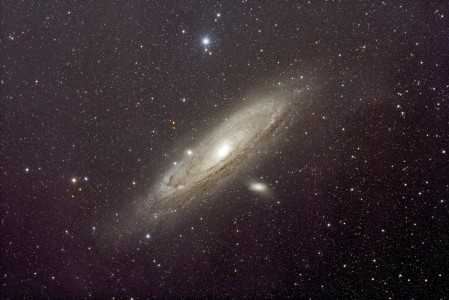
M31 with Redcat 51

My Account

New to Astromart?

Register an account...

Need Help?

Posts Made By: Charles Hakes

November 23, 2008 06:13 AM Forum: CCD Imaging and Processing/Deep Sky

M41

Posted By Charles Hakes

You can barely make out those Van Gogh "ears" in the background, but I thought I rescued most of it OK. This one was at .71"/pixel.

Charlie


November 23, 2008 11:38 PM Forum: CCD Imaging and Processing/Deep Sky

Saturn

Posted By Charles Hakes

Or NGC 7009. This was a target of opportunity when I had the focal reducer off, so the image scale is ~.71"/pixel. The seeing was somewhere between medium-poor and why bother. (Mix of conditions and object elevation.)

LRGB - 51x1min, then 24,20,16minutes in 2min subs. This is really bright near the middle, so I couldn't take any longer L subs. And you can see by the weird mix of times that many had to be thrown out. FWHM > ~4"!

I don't know what to say about the color. Usually I like to do a "calculated" rather than "auto" color scaling in AstroArt, but this time it turned out WAY blue. So I cut down on blue and then ended up increasing the red while post processing. It still looks blue to me. And I did increase the intensity on all colors a tiny bit before sending it to photoshop.

I wonder how many of the faint stars are really galaxies, as most don't show up in TheSky. And I can't use the seeing to tell this time. Maybe this is a target to try next summer?

Suggestions for improvement? Thanks for looking.

Charlie


November 25, 2008 01:41 PM Forum: CCD Imaging and Processing/Deep Sky

24 minutes of M82

Posted By Charles Hakes

So conditions can make a difference. (Compare to 7009 from last week.) Needs lots more data to get the streamers to show up, but I was happy with the result for the amount of time spent. This was in 1 minute subs to try to keep any star colors, but I might try again with longer and let the stars blow out.

This is at the "shifted" scaling of ~1.05"/pixel, which I think may be the new "default" for us. Better flats sure make a difference, and this one looks like I might need to re-take/tweak the flat to get things really even out to the edge. I also got some color (6x3min each RGB) that I need to process, but one step at a time here.

Processing on this one was a log(log) import to photoshop, a "local contrast enhance", "deep space noise reduction", and a little unsharp mask. Might need to re-do some of this more selectively, as I think some dust details could be made to stand out more and the background could be made smoother.

I would like to add more time soon, but it will have to be next week, as I am traveling to the beautiful panhandle of Texas today.

Thanks for looking. Suggestions always welcome.

Charlie


November 25, 2008 06:41 PM Forum: CCD Imaging and Processing/Deep Sky

82 color v1

Posted By Charles Hakes

Until at least next week this is where it will end up. LRGB 24:18:18:18. Hope to add more time, Ha, IR, etc.

Charlie


December 8, 2008 04:16 PM Forum: CCD Imaging and Processing/Deep Sky

A "weighty" subject.

Posted By Charles Hakes

Just re-did the counterweight system on the 16" Meade. Got some brackets welded that "stand off" the regular Meade sliding weights. The result is better balance and less mass. Note the "extra" weights near the middle. They are WAY cheaper than the Meade weights.

Charlie


December 10, 2008 03:20 PM Forum: CCD Imaging and Processing/Deep Sky

45 seconds gone

Posted By Charles Hakes

I was previously getting glitches like this intermittently. Not all the time, but if they did happen, there seemed to be a periodicity (~5min). You can see where the scope misses tracking for a bit (looks much faster than sidereal when it happens, but it may not be). Anyway the autoguider puts it back on track in a couple of steps. Still very annoying.

But now it is fixed, as far as I can tell. At least I haven't seen it. I think it is ~20% from the upgraded balance and ~80%+ from tightening the RA belt. I could see on the teeth of the belt gear attached to the motor what looked like a screwdriver ding. I think the belt was ridding up and then would pop into the next slot. Tightening definitely fixed that, since I no longer hear a little click as the scope slews east. I had thought the "click" was normal. Must have been a manufacturing defect?

One more tiny step...

Charlie


December 11, 2008 07:06 PM Forum: CCD Imaging and Processing/Deep Sky

More Van Gogh ears

Posted By Charles Hakes

So it was not just the really short exposures that are giving me the "ears". This is a combine of a bunch of 5 minute exposures with an H-alpha filter. Camera temperature was -40C. Dark subtract was with a sigma-combined set of bias frames and 3 minute darks at -40. Flat field was another sigma combine of about 10 frames with the Ha filter done at dusk. Looks like both flats and darks could be a bit better, however, still have those one-sided ears showing up. I have an idea as to what this is and how I can fix it, but wanted to hear other thoughts before I dive into uncertain waters. Thanks to anyone who can confirm (or deny) my suspicions.

Charlie

December 17, 2008 06:49 PM Forum: CCD Imaging and Processing/Deep Sky

One more fix

Posted By Charles Hakes

I had suspected some scaling differences with the SCT from night to night and now I have verified this. These are all luminance shots, but one night I defined as red, one green, and the third night blue. I aligned everything with CCDSoft. You can easily see the scale difference. Ouch! Things may eventually settle down with the mirror, but different elevation angles, temperature, etc...

Anyway, now I have CCDStack and it cleans up the messes. But I must come up with a different (for me) processing work flow. And I may need a computer upgrade, since the fancier alignment takes WAY longer on the vintage 2001 system.

At least I will have time to try a few things now, since I can't tell if we will ever get another clear night. And an irrigation system (very large rolling kind) got blown across the access road and then 2 feet of snow got dumped on it. So things may be inaccessible for a while.... @#$%&^%$

Charlie


December 18, 2008 07:19 PM Forum: CCD Imaging and Processing/Deep Sky

Newer 82

Posted By Charles Hakes

This is the version aligned with CCDStack. I still "stacked" it with Sigma Beta, just to be consistent for my comparison.

I am not totally happy with the processing yet. I smoothed the background and "unsharped" the bright parts, but I got a mix of dark and bright halos. I would like to increase the contrast, but I think it always looks funny afterwards. The seeing was ~2+", not great, but not terrible (for here). Looks like I caught a dim meteor?

I haven't gotten any more color data, so haven't tried to update that part, but I may try to mix in some Ha and IR... (?)

Any processing hints would be most welcome. I am slowly working my way through learning new processing techniques, (I just need more time in the week). In the mean time, the snow keeps falling.

Charlie


February 24, 2009 12:13 PM Forum: CCD Imaging and Processing/Deep Sky

First light/last light

Posted By Charles Hakes

First light - The FLC observatory was unaccessible for a few weeks in January, but I did hike out to "rescue" the camera and tried a few shots with a Canon 50mm lens on the ST-10XE. This is a short series of 30 second, unguided, unfiltered exposures, just to check out possibilities. The camera was just stuck out the back door, which really limited my target options, but Orion was conveniently right there. Interestingly, the tree "looked" much darker than the sky from there, but I guess I don't see IR as well as the camera. I tried a few shots at different f-stops, starting at f1.4, and maybe shouldn't have been surprised at how "bad" things looked with the lens that wide. I think this was ~f4. I stretched as much as I could and sharpened a tiny bit and was surprised at how easy I could see the horse head and other stuff.

Last light - I originally thought I would get a chance to re-do this "right" with a clearer view, pay better attention to focus, get some good flats, try color, etc., but right now the camera is having some mechanical difficulties (shutter error) and I am afraid I will need to send it for repair. Maybe that is just to give me a chance to set up a more portable autoguiding system that could be ready when it gets back... But by then I will be able to get back to the observatory and start in again on my M82 color data.

Charlie
