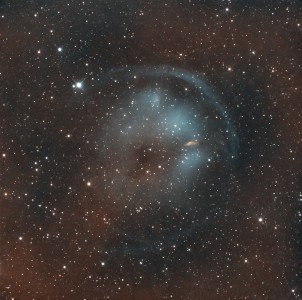
Image of the day

Captured by
Yue Ma

HFG-1

My Account

New to Astromart?

Register an account...

Need Help?

Posts Made By: Inge Skauvik

March 28, 2007 07:59 PM Forum: Equipment Talk

Pete Smitka closes up after 15 years

Posted By Inge Skauvik

I opened the Portaball (Mag1instruments.com) web site today, just to be informed that Pete Smitka has decided to stop production of the Portaball telescopes. sad sad sad sad Even though I don't have immediate plans to purchase another Portaball for myself, these were very bad news for me. I have been dreaming about the 14.5-inch version for years, and even been thinking about getting a 10-inch as a light travel scope.
As a Portaball user I'm completely spoiled by the freedom of moving around in the sky without straining the neck. The Portaball does not have difficult zones near the zenith (like an ordinary dob) or near the pole (like an equatorially mounted scope).
Moreover it is very easily collapsed to a small volume for transportation, and both optically and mechanically the Portaballs are very good telescopes. I realise that I'll have to handle my present 12.5-inch with the greatest care hoping that it will serve me for lifetime. I just wonder what I shall be looking for next time I get hit by purchasing or aperture fewer.

Inge S

April 10, 2007 09:18 AM Forum: Reflectors

High performance visual viewing machine

Posted By Inge Skauvik

Sometimes I get the feeling that visual observers belong to the group of species risking extinction in the near future. The discontinuation of the manufacturing of Portaball telescopes was a hard blow to me, because I belong to this group, and even though I possess one of these scopes I foresee the need to acquire a new telescope, and the use of the Portaball over a few years has seriously spoiled me.
JUST IN CASE of a serious attack of something (aperture fewer and other related diseases) I'm interested in alternatives to the Portaball, but this can not be just any scope.

Any telescope desercint the designation "Astronomical telescope" should have superb optics and be sufficiently stable to allow CONVENIENT observation at powers in the 200 - 500x range. Telescopes not fulfilling these requirements are not really interesting to me. In addition to the basic requirements I shall be looking for the following qualities

- Portability
- Ergonomics
- Ease of collimation and any other maintenance operations
- Superior craftsmanship
- Dew removal and cooling fans for the optics.

I'm interested in hearing about your opinions about different brands of high-end dobs, for example:

- Starmaster
- Obsession
- Plettstone
- Johnsonian
- Teleport
- Others (Do t-scopes, Starsplitter or others play in the same league?)

My size range of interest is 13 - 18 inches of aperture (possibly also looking for a highly portable 10-inch).

Inge S

April 16, 2007 07:04 AM Forum: Deep Sky Observing

M106 and its negihbours

Posted By Inge Skauvik

Last Friday we had excellent conditions for deep-sky observation. I'll not give a complete observation report from the observing session right away, but as a start tell about my observation of M106 (NGC4258) and nearby galaxies with my 12.5-inch.

M106 itself is one of the greates galaxies in Canes Venatici, comparable in brightness to M51, but not so interesting visually. Within a radius of 2 degrees several fainter galaxies can be found - most of them are faint fuzzyballs, but I still find the region interesting to explore.
Very near the large galaxy lies NGC4248. This galaxy is small and faint, but since it is highly elongated it isn't too difficult to spot. A bit further away in the same direction a pair of very small and faint patches of light are located. This is galaxy pair NGC 4231/32. If I didn't know the exact position of these objects, I would not be able to recognise them as galaxies.

Further away from M106 three slightly brighter galaxies can be observed; NGC4346, NGC4220 and NGC4271. Most observers with sufficient aperture will immediately see the two first ones. NGC4271, on the other hand, is likely to go undetected, although it is similar in total brightness to the other two objects. The main reason for this is a group of relatively bright foreground stars.

None of these objects are showpieces. They may be interesting, though, for the observer who wants to check his/her ability to detect faint galaxies visually.

Inge S

April 18, 2007 06:11 PM Forum: Deep Sky Observing

Another galaxy group in Canes Venatici

Posted By Inge Skauvik

The Night Sky observing Guide contains quite a lot of photos (in addition to countless sketches). Although most of the photos have just average quality, they are often very handy tools for identifying objects or features of interest for the visual observer.

I was a bit facinated by a couple of galaxy photos from the Canes Venatici section. One of them shows a 0.5 degree section of the sky with several galaxies, and I decided to try to chack how many of them I could make out myself. The brightest of these galaxies is NGC5371.

This group is located in a sky field without any good guide stars nearby. However, I realised that by pointing the telescope at a position forming an equilateral triangle with Gamma and Lambda Bootis, I would be very near the group. This turned out to work very well. The main galaxy, NCG5371 (10.5 mag) stood out very conspicuously, and it was no problem immediately to see three other galaxies (NGC5350,5353 and 5354) almost along a straight line near a 6th magnitude star. Each individual galaxy in this group would hardly be considered more as fuzzyballs in a 12-inch telescope, but as a galaxy group, this one is interesting. By increasing the magnification to 115x another galaxy, NGC5355, appeared. It is even visible at 63x, but at that power it appears nearly stellar.

There is a still fainter galaxy in the field, NGC5358. I can't claim to have spotted it yet. Probably it will be possible from an extremely dark site.

Outside this field are several other galaxies. I haven't observed all of them yet, but I had a look at the pair consisting of NGC5394 and 5395. This pair is also shown in a photo in the NSOG, and the photo looks somewhat appealing to me with distinct spiral arms in the small companion galaxy. The visual impression of these galaxies was a bit disappionting. Even the large galaxy was rather faint and ill-defined, while the companion was an incinspicuous smudge nearby.

Still this galaxy field in the north-east corner of Canes Venatici is so interesting that I don't hesitate to recommend it.

Inge S

April 21, 2007 03:58 PM Forum: Deep Sky Observing

NGC6229 - the "third globular of Hercules"

Posted By Inge Skauvik

In addition to the famous Messier clusters (M13 and M92) Hercules contains a third fairly bright globular, NGC6229. I observed this object the first time from La Palma last year. A week ago I made several observations of it from home in order to check if I could spot individual stars in it. My observation from La Palma was from the location at the western side of the island where seeing was rather lousy, therefore it looked like a nebula, pretty much like a tailless comet.
Seeing was much better last week, an in spite of the fact that the sky dosn't get so dark here, the cluster appeared clearly granular at 167x power, and some outlying stars could be glimpsed with some difficulty.

I recommend this cluster for anybody who hasn't observed it yet, and hope to get reports about people's ability to see stars in this cluster.

Do anybody know the magnitude of the brightest stars of NGC6229. My estimate is 15th magnitude, but I may be wrong.

Inge S

April 30, 2007 05:53 AM Forum: Deep Sky Observing

The Helix nebula

Posted By Inge Skauvik

Maybe this is not the right time of the year to discuss the Helix nebula in Aquarius. However, this is one of the notable objects on my observation plan for the La Palma trip in September. Theoretically the Helix can be observed from home at +59 degrees, but I have never seen it or even looked for it, realising that it is quite difficult.
However, I believe it is easy to see from 28 degrees north. What I'm curious about is the amount of detail I can expect in the Helix. According to the observation guides I have available, it does not look annular when viewed through the eyepiece. Any comments to this? How does it react to filters? Any other interesting details?

Inge S

May 2, 2007 06:11 AM Forum: Deep Sky Observing

Grus galaxies

Posted By Inge Skauvik

The eastern part of the constellation, Grus (the Crane)contains a relatively concentrated group of galaxies (NGC7552 and more). Burnham's Celestial Handbook lists about 15 galaxies there, mostly around magnitude 12. I have noticed that the magnitudes given in Burnham's usually are 0.5 - 1 steps below (fainter) those given in the NSOG, therefore the brighter ones are perhaps closer to about 11, but still I suppose that most of these objects are only fuzzyballs in my scope.
Have anybody observed this galaxy group? Is there anything interesting to look for?

Inge S

June 5, 2007 06:54 AM Forum: Deep Sky Observing

The R Aquarii nebulosity

Posted By Inge Skauvik

R Aquarii is a physically highly interesting object, often called a "symbiotic star". It is surrounded by an irregular nebulosity patch, a photo of which can be seen in Burnham's Celestial Handbook (and surely other places as well). My question is - has anyone detected this nebula visually. I'm not too optimistic about this, but I ask because I see that the nebula is marked by a green square in the Pocket Sky Atlas.

Inge S

June 13, 2007 11:26 AM Forum: Deep Sky Observing

Late summer southern DSO's

Posted By Inge Skauvik

Do anyone of you southern observers have any favourites among the less known diffuse and planetary nebulae in the zone from Scorpius, through Sagittarius, Corona Australis, Capricornus, Piscis Australis, Grus and Aquarius? I'm not thinking about objects like M8, M20 and M17. All these are superb objects with enormous detail, but during my next trip to the south I'm also interested in extending my portfolio of DSO's. It isn't always easy to identify the most interesting ones just by reading observation guides and looking at maps. So please, give me your suggestions!

Inge S

August 1, 2007 10:44 AM Forum: Equipment Talk

Rich field scopes - nobody consider Newtonians?

Posted By Inge Skauvik

From time to time I think about acquiring a small telescope for large field low power viewing. I have considered 80 - 100mm short focus refractors as well as giant binoculars, but so far I have not purchased anything.

With my only personal scope, the 12.5-inch f/4.8 Portaball I get my lowest power and largest field with a 24mm Panoptic (63x, and a field slightly larger than one degree). This is not well suited for the larger open clusters and gaseous nebulae.

A 100mm f/5 refractor would give 21x and a field of more than 3 degrees with the same eyepiece. For low power viewing I suppose that even a relatively cheap achromat would do the job.

However, I just wondered if a slightly larger Newtonian, e.g. a 5-inch f/5 (or even faster) would be an even better instrument for low power viewing. Using the 24mm Panoptic with such a scope would give something like 27x and a 2.5 degree field.

Any opinions about this?

I find it a bit difficult, however, to find good telescopes in this size range. Do anyone know about manufacturers or dealers of Newtonians with well-figured mirrors in the short focus and small aperture range?

Inge S