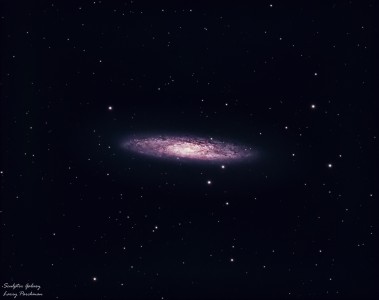
Image of the day

Captured by
Lawrence Parchman

Sculptor Galaxy (NGC 253)

My Account

New to Astromart?

Register an account...

Need Help?

Posts Made By: Dennis Persyk

September 17, 2006 11:49 PM Forum: CCD Imaging and Processing/Deep Sky

Sharpless 2-50 Fairly Faint Emission Nebula

Posted By Dennis Persyk

SkyMap Pro calls this a 2 where the brightness classification extends from 1=faintest to 3=brightest. I have learned the hard way that 2 is really very faint. And brightness classification 1 is nearly invisible to my scope/camera in a two hour imaging session!

I do mainly H-a imaging now because my 6 nm FWHM AstroDon is the world’s best light pollution filter. And of course, it works well with moonlight.

Image (2 hours at f/3.3) and matching SkyMap Pro 10 screen shot at
http://home.att.net/~dpersyk/new.htm

I’ve not seen any amateur images of this nebula. If you have a link to one I’d like to get it – thanks.

Clear skies,

Dennis Persyk Supercharged LX200GPS 14”
Igloo Observatory Home Page http://dpersyk.home.att.net
Hampshire, IL

New Images http://home.att.net/~dpersyk/new.htm


September 26, 2006 03:41 AM Forum: CCD Imaging and Processing/Deep Sky

Comet 4P Faye

Posted By Dennis Persyk

I should have stayed up to 3:30 am to get the comet near transit but I was too tired . I managed to capture a 10 arc minute long tail 3 hours pre-transit. This is an interesting comet that is brightening steadily.

Images and supporting data at
http://home.att.net/~dpersyk/new.htm

Thank you for visiting my site.

Clear skies,

Dennis Persyk
Igloo Observatory Home Page http://dpersyk.home.att.net
Hampshire, IL

October 15, 2006 08:08 PM Forum: CCD Imaging and Processing/Deep Sky

Now Three Bright Comets to Image

Posted By Dennis Persyk

There are presently three bright comets to image:
C/2006 M4 (SWAN) magnitude 6.4 (7.9)
4P/Faye magnitude 9.4 (10.7)
P/2006 T1 (Levy) magnitude 9.6 (11.2)

Note: The above magnitudes are correct – they are the currently observed values. Your planetarium programs will indicate different calculated magnitudes, as indicated above in parentheses. The calculated magnitudes are usually greatly in error.

I imaged the brightest of the three because it was well positioned at sunset – the other two require staying up quite late to get them at transit.

Images and supporting data at
http://home.att.net/~dpersyk/new.htm

Thank you for visiting my site.

Clear skies,

Dennis Persyk
Igloo Observatory Home Page http://dpersyk.home.att.net
Hampshire, IL


October 24, 2006 05:42 PM Forum: CCD Imaging and Processing/Deep Sky

Comet Movie: C/2006 M4 (SWAN)

Posted By Dennis Persyk

Upon close inspection of a single subframe of my comet image from Oct 15 I noted a galaxy or two. I aligned the images on the stars and lo and behold, out popped a bunch of 14 to 17 mag galaxies!

I also made a small movie illustrating the very rapid (5.1 arc seconds per minute) motion of the comet for 60 minutes.

Images and supporting data at
http://home.att.net/~dpersyk/new.htm

Thank you for visiting my site.

Clear skies,

Dennis Persyk
Igloo Observatory Home Page http://dpersyk.home.att.net
Hampshire, IL


October 30, 2006 05:48 PM Forum: CCD Imaging and Processing/Deep Sky

SWAN: DSLR vs. Astrograph/Cooled CCD

Posted By Dennis Persyk

I imaged C/2006 M4 SWAN with my Canon 20D and EF 75-300 mm lens at f/8 and my E-160 f/3.3 6-inch astrograph with SXV-H9 for similar times. I was quite surprised at the results! The DSLR subs were 19 x 2 minutes while the cooled CCD’s were 19 x 1 minute – but the cooled CCD was binned 2x2.

I used simple JPGs rather than RAWs with the DSLR so my imaging technique is not optimal. I haven’t figured out how to use the Canon software to download RAWs yet.

Images and simulated refractor and binocular eyepiece views at
http://home.att.net/~dpersyk/new.htm

Thank you for visiting my site.

Clear skies,

Dennis Persyk
Igloo Observatory Home Page http://dpersyk.home.att.net
Hampshire, IL

New Images http://home.att.net/~dpersyk/new.htm


December 15, 2006 02:30 AM Forum: Solar System Observing

Aurora Northern Illinois

Posted By Dennis Persyk

The aurora over Northern Illinois was very intense at 0130 UT Dec 15th. It was changing rapidly. I have a couple of photos at
http://home.att.net/~dpersyk/new.htm

Clear skies,

Dennis Persyk
Igloo Observatory Home Page http://dpersyk.home.att.net
Hampshire, IL

New Images http://home.att.net/~dpersyk/new.htm

April 16, 2007 06:54 PM Forum: CCD Imaging and Processing/Solar System

C/2007 E1 (Garradd)

Posted By Dennis Persyk

This comet is ideally positioned for imaging from the Midwest USA as it high (57 degrees elevation) and transits at a “reasonable” hour – that is, at astronomical darkness. At magnitude 13.0 it is an easy target.

It has a relatively fast motion relative to the star field, 6.2 arc seconds per minute. I imaged it in one-minute frames with at 5.0 arc seconds per pixel.

The fast relative motion lends itself to a nice animated GIF. I have a small (422 kB) video of 1 hour of the comet traversing 6.2 arc minutes of Leo. Take a look. The comet is really racing along!

Images, associated data and imaging notes at
http://home.att.net/~dpersyk/new.htm

This is my first image of 2007. I’ve been spending time on another hobby – an indoor, non-weather-dependent hobby . See http://home.att.net/~dpersyk/horr.htm

Thank you for visiting my site.

Clear skies,

Dennis Persyk
Igloo Observatory Home Page http://dpersyk.home.att.net
Hampshire, IL


April 21, 2007 08:09 PM Forum: CCD Imaging and Processing/Solar System

Brightest Comet in the Sky – Don’t Miss It!

Posted By Dennis Persyk

C/2007 E2 (Lovejoy) is nearing its peak on light curve – see
http://www.aerith.net/comet/catalog/2007E2/2007E2.html

This is presently the brightest comet in the sky (save for a few lucky souls near the equator who might still be able to view 2P/Encke). Better grab a view or an image now, before it fades into oblivion.

It is racing though Aquila at 8.8 arc seconds per minute at magnitude ~ 7.6. I was limited to 30 second exposures when I imaged it to avoid blur.

I “think” I saw (using averted vision and averted imagination) the comet in my 4-inch refractor piggybacked on the 6-inch E-160 f/3.3 astrograph. I synthesized a simulated eyepiece view for my web page linked below.

I was baffled for quite a while looking for the “missing star”, V606 Aquilae, that was depicted prominently in my SkyMap Pro screen shot as being very bright but was missing in my image – even though all the other stars were right where they should be. How could I not image a bright star??? The mystery (for those that haven’t figured it out yet) is solved on the web page.

Let me know what you think of the movie. It really was hard for me to get the hour’s worth of frames to look about the same. The comet was rising in the sky (and thus getting brighter as the atmospheric extinction was decreasing); at the same time, the sun was rising, so the sky glow was increasing. Balancing the two effects to achieve consistent histograms drove me nuts! I’ve probably invested ten hours in image processing and composing the web page.

Images, associated data, eyepiece view, imaging notes and *movie* all at
http://home.att.net/~dpersyk/new.htm

Please take a look and give me some feedback. This was quite a processing challenge for me. Thank you for visiting my site.

Clear skies,

Dennis Persyk
Igloo Observatory Home Page http://dpersyk.home.att.net
Hampshire, IL


July 10, 2007 03:48 PM Forum: CCD Imaging and Processing/Deep Sky

Brightest (and Fastest!)Comet in the Sky

Posted By Dennis Persyk

C/200 VZ13 is nearing its peak on light curve – see
http://www.aerith.net/comet/catalog/2006VZ13/2006VZ13.html
This is presently the brightest comet in the sky. It will be fading in a week or so.

It is racing though Draco at 8.4 arc seconds per minute at magnitude ~ 8.4. I was limited to 45 second exposures when I imaged it to avoid blur.

Let me know what you think of the movie. Note that I have really squashed the file size to permit rapid down load. It is only 679 kB.

It was really hard for me to stretch all the frames the same because the high cirrus cloud layer was rapidly changing. I had to manually adjust each frame to match the previous one. I’ve probably invested six hours in image processing and composing the web page.

Images, associated data, eyepiece view, imaging notes and *movie* all at
http://home.att.net/~dpersyk/new.htm

Please take a look and give me some feedback. This was quite a processing challenge for me. Thank you for visiting my site.

Clear skies,

Dennis Persyk
Igloo Observatory Home Page http://dpersyk.home.att.net
Hampshire, IL


July 13, 2007 10:04 PM Forum: CCD Imaging and Processing/Solar System

C/2006 C/2006 MZ13 Complete with Ion Tail

Posted By Dennis Persyk

C/2006 VZ13 is about at its peak on the light curve. This is presently the brightest comet in the sky. It is fading now.

It is racing though Draco at 9.3 arc seconds per minute at magnitude ~ 8.4. I was limited to 60 second exposures when I imaged it to avoid blur.

The comet has an ion tail that I had difficulty bringing out in my processing. It is just barely apparent in my stack of 40 x 60s. However, I was able to bring out what appears to be a 15 arc minute tail using the Larson-Sekanina filter in AstroArt 3.0. I realize this is a somewhat “dangerous” filter since one can easily introduce no end of interesting artifacts. I would thus appreciate feedback from the comet cognoscenti (and everyone else) on whether my processing is legitimate.

Images, associated data, imaging notes and all at
http://home.att.net/~dpersyk/new.htm

Please take a look and give me some feedback. Thank you for visiting my site.

Clear skies,

Dennis Persyk
Igloo Observatory Home Page http://dpersyk.home.att.net
Hampshire, IL

Pier Design Paper: http://home.att.net/~dpersyk/Pier_Design.htm