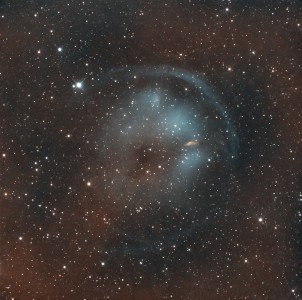
Image of the day

Captured by
Yue Ma

HFG-1

My Account

New to Astromart?

Register an account...

Need Help?

Posts Made By: Inge Skauvik

August 1, 2007 06:45 PM Forum: Deep Sky Observing

Your favourite low power view

Posted By Inge Skauvik

Following up my thread under the "equipment" forum I decided to ask for your favourites among deep sky views for wide-field telescopes or binoculars (Top 5 or top 10 list, or whatever you like). These may be defined objects like gaseous nebulae or clusters. Nice asterisms or glorious star fields and dark nebulae are also of interest. Additional comments and short observation reports are welcome.

You can consider me as a dummy when comes to this group of objects. I hardly owned a scope giving less than 50x magnification and fields much exceeding 1 degree since I learnt to use a scope.

Inge S

September 10, 2007 12:01 AM Forum: Deep Sky Observing

Astro trip to La Palma 2007

Posted By Inge Skauvik

Dmitri and I together with our Norwegian astro friends, Eckart and Tore write this post from the summit of Roque de los Muchacos on La Palma on the Canary Islands.
We already had a superb observing session. Those of you being interested can follow our blog: http://casacolmenero.blogspot.com/

The sky transparency and seeing are excellent. This is an experience for life.

Inge S


September 18, 2007 02:03 PM Forum: Deep Sky Observing

Some thoughts after trip to La Palma

Posted By Inge Skauvik

The summit of Roque de los Muchachos has been chosen as the site for several professional observatories because of stable weather conditions, generally good seeing and a darker sky than anywhere on the European mainland.

Our second visit to this site was a unique experience. Here we had the opportunity to really push both our equipment and observation skills to the limit.

Dmitri was able to view stars in the magnitude range 15.7 - 15.8 near the Ring Nebula through the 12.5-inch Portaball(While I had to be satisfied with 15.2 - 15.3). The corresponding naked eye limiting magnitude should be somewhere around 7. The zodiacal light was quite bright in the morning, and none of us had problems seeing the Counterglow or Gegenshein in the position opposite to the sun.

I gave Dmitri the task to make a drawing with the positions of as many of the galaxies in the Fornax group he could see. While I could make out 11 he correctly noted down the positions of 15, and even their orientations (except one) were correct. A few of these galaxies are fairly bright, and for NGC1365 the spiral pattern is easy to see with direct vision. However, quite a few of Dmitri's 15 are very faint, and can easily be taken as faint stars. I'm impressed.

Seeing was good already a short time after sunset, and in most cases excellent before dawn. Beta Delphini which is getting quite close now was notched in Dmitri's C8, and a clean split was obtained with the Portaball and a 3.5mm Nagler.

Eckart Fuchs brought along a super-portable 8-inch f/4 Newtonian. With growing experience this telescope also performed really well. With a 24mm Panoptic it gave beautiful widefield views (more than 2 degrees FOV), but it also gave images with good resolution and contrast of Jupiter. Not bad for a scope that can be collapsed to a package small enough to be carried as hand luggage with the airlines.

I plan to make some posts about some of the interesting objects we observed during our week down there.

My main conclusion from our trip is the following: In order to get the most out of visual observation the following factors must be optimal:

Sky darkness
Atmospheric transparency
Seeing
Equipment
Eyesight of observer(s)
Observational comfort

During our present trip all these factors were in place. We have already started discussing where and when to go for our next astro trip.

Inge S

September 19, 2007 11:58 AM Forum: Deep Sky Observing

The Sculptor galaxies

Posted By Inge Skauvik

Sculptor contains some of the most beautiful galaxies in the sky. Unfortunately navigation in this region in the sky is rather difficult (not a problem for high-tech astronomers, though). We observed the most famous of the galaxies in this region from La Palma. The highlights were NGC253 and NGC55, but also NGC300, NGC134 and NGC247 (In Cetus) are worth mentioning. This post contains my impressions - but I'm sure that Dmitri can add interesting information.

NGC253 is an extremely beautiful object. Its outline is a nearly perfect ellipse, and the surface brightness is relatively high, but varies a lot over the area. This is a huge galaxy which extends outside the field of view even with moderate magnification. Obscuring nebulae are obvious at first glance. With higher power high brightness patches appear - obviously starburst regions or emission nebulae. Hints of spiral structure can be made out. Particularly the arm along the south-western edge is easy to see. For me a dream came true as I allowed the galaxy to drift across the field of view at 115x magnification. No photo can justify the view seen directly through the eyepiece under such conditions.

The second brightest and largest Sculptor galaxy is NGC55. This is also a galaxy with a huge apparent size, and although it is a bit fainter than 253 it is still an impressive object. It resembles NGC253, but is even more elongated and a bit irregular. The brighter parts are asymmetrically placed - the north-western part being the brightest. Also NGC55 contains obscuring patches and lanes. A superb galaxy.

NGC300 is a moderately large spiral galaxy with some foreground stars making observation of its details a bit difficult. It appears as a slightly smaller and fainter edition of NGC2403 in Camelopardalis.

NGC134 is another fine object. It is a tilted spiral. At first glance its light appears to fall off abruptly along one of its edges. With more attention is becomes obvious that the reason for this is an absorbing lane.

Finally, NGC247 in Cetus should be mentioned. This galaxy can possibly be seen even from Norway, but it is much better from a location further south. It appears as an elongated ellipse oriented almost north - south with a star at one of the ends. A pretty large object with a rather low surface brightness. An interesting galaxy with an appearance through the eyepiece that can't be confused with any other galaxy in the sky.

Inge S

September 20, 2007 11:03 AM Forum: Deep Sky Observing

Globulars of all sizes

Posted By Inge Skauvik

We observed many globular clusters during our expedition to La Palma. Some of them even outside our galaxy (More about this in a coming post about the Andromeda galaxy).
Among the clusters belonging to our own galaxy, the most distant one observed by us was NGC7006 in Delphinus. We tried very hard to see signs of resolution, and we had the impression that it had a granular appearance at high power. In Sagittarius, Scorpius and Ophiuchus we saw globulars everywhere. Most of them were at least partially resolved, and the larger and brighter ones appeared as swarms of stars. The globulars closest to our solar system, M4 and M22 were superb sights. In both clusters individual stars were bright enough to reveal their colour, and - as should be expected for ancient stellar associations - the brightest stars were orange or red giants. This was very obvious in M22. Some 20 red stars stood clearly out against the swarm of countless fainter yellow-white stars. It is much more difficult to see colour e.g. in M13 - maybe it is possible with more aperture. In M4 a wide double of orange stars is obvious at first glance. Then there is a chain of stars across the centre of the cluster. M4 appears quite sparse compared to M22 which is a superb object. Omega Centauri was out of range at this time of the year - unfortunately.

Inge S

September 21, 2007 12:44 PM Forum: Deep Sky Observing

The glorious diffuse nebulae of the summer sky

Posted By Inge Skauvik

From Scandinavia the diffuse nebulae of the Sagittarius region are always very low in the sky and hard to observe due to interfering sunlight. With some luck M16 and M17 can be seen from Norway, but the views from here are dim and blurry compared to what could be achieved from La Palma.

We observed M17 through the Portaball. Starting at low magnification and trying with and without O-III we soon realised that there was potential to see more. I think we went up to 300x before Dmitri was satisfied. This nebula contains an enormous amount of delicate detail. It is possible to see the same through the eyepiece as in many photos, but while many photos overexpose the brightest parts the human eye is capable of seeing structure in both the bright and faint parts of the nebula at the same time. Also for M17 it is a good idea to allow it drift across the field of view.

It is difficult to tell which is more beautiful, M17 or M8. Possibly the nebulosity of M17 is a shade brighter, but the form of M8 competes with any artist's painting. Also M8 benefits from the use of an O-III filter. It is huge, and fills a one-degree field of view if the faint outer whisps are included. Although M42 is even larger and brighter and (as I'm told by people who have seen it) the Eta Carinae nebula is still more impressive, my opinion is that M8 is the most beautiful of the diffuse nebulae - with or without a filter.

M20 is another superb object. Its dark lanes became immediately obvious also in the 8-inch f/4. It is enhanced by filters, but its enigmatic glow appears nicer to me without. Observing it from La Palma was a particularly great experience since the multiple star at the centre (as well as all other stars) appeared as needle-points although it wasn't very high in the sky.

M16 is also worth mentioning. The dark obscuring clounds were glimpsed without a filter, but were enhanced by O-III. If M16 was placed 10 degrees further north, we would have spent quite a lot of time with it from our latitudes. The only easily acessible diffuse nebula from Scandinavia that competes with it is M42.

We observed many other diffuse nebulae (In Cassiopeia/Cepheus and the winter sky). In order to avoid too long posts I'll return to them later.

Inge S

Inge S

September 23, 2007 03:11 PM Forum: Deep Sky Observing

An open cluster expedition along the milky way

Posted By Inge Skauvik

At this time of the year a normal observing night starts with summer objects, and for very persistent observers ends with some objects of the winter sky. That was also the case for us observing from La Palma. However I invite you to an expedition for open clusters in Canis Major and ending in Scorpius based on our observations. Many clusters will be skipped, but hopefully some of you will enjoy my writing about some highlights.

The cluster around Tau Canis Majoris cannot be seen from Norway, therefore the La Palma observation was my first sighting of this facinating object. It reminds me of a swarm of bees around a jar with honey, Tau representing the jar, since it is much brighter than the other cluster members. A very cool sight. What would be very enjoyable (unfortunately impossible) was to see an animation of this cluster over an interval of 100.000 to 200.000 years.

The M35/NGC2158 combo was also great. It was possible to count at least 20 - 30 stars in the small cluster, but the unresolved haze in the background revealed the presence of even more. M35 intself with its beautiful chains of stars with all colours from yellow through white to bluish white was a great sight in itself, but best at low magnification, of course.

M37 in Auriga is one of the objects I observe most frequently. From La Palma it appeared extremely rich and bright with several stars in addition to the bright central one having a clear orange colour.

The double cluster was glorious as seen through all scopes. Maybe best with the wide field of the 8-inch f/4. Through the other scopes it fills the field ov view with beautiful star patterns.

NGC7789 in Cassiopeia was another highlight. I always get an impression of concentric rings or a spiral pattern when viewing this cluster. Dmitri commented that it looked like a "Superman logo", and actually this description really suited this cluster as we saw it from La Palma.

M103 was a real jewel box with coloured stars. Maybe a christmas tree...

The grand but distant cluster, NGC6791 in Lyra needs very dark skies to be detected, even with a 12.5-inch telescope. This time, however, it was immediately obvious as a nebulous glow behind the rich star field near Theta Lyrae. With some magnification we suspected some resolution, but it is difficult to tell which of the stars actually belong to the cluster. NGC6791 is unusually rich for an open cluster, and it is one of the oldest open clusters known, somehow resembling a globular in age and element composition.

In the sparse constellation of Scutum we find what I consider to be the most beautiful of all open clusters in the sky, M11. This cluster displays very little colour as seen through the eyepiece (surely in contains lots of fainter members of class K and M), but it is extremely rich condensed, and looks imressive in almost any telescope. Through the 8-inch f/4 it was like "a city seen from a plane at night". In the 12.5-inch it is beautiful beyond words.

M11 is located in the Scutum star cloud. Further south we have the small star cloud of Sagittarius (M24). This is not an open cluster by definition, but it contains at least one fine open cluster, NGC6603. This one is also quite rich and compressed. I always get the impression that this cluster is placed in a small void in the star cloud. The cluster stars are fainter than the prominent stars of the cloud, and I see none of the typical bright M24-stars near or in the cluster.

The grand finale of this little tour along the milky way is NGC6231. The cluster is visible to the naked eye as a part of the "false comet" in southern Scorpius. At first glance the cluster's bright stars catch the attention. Most of them are bluish white, forming an asterism making me think about the Pleiades. With more attention (and magnification) countless fainter stars appear. Many stars are arranged in short chains. Near the centre series of chains appear to be arranged perpendicular to each other. The cluster contains many supergiant stars. I recommend everybody to read about this facinating cluster (e.g. in Burnhan's Celestial Handbook).

Inge S


September 24, 2007 06:17 AM Forum: Deep Sky Observing

Diffuse nebulae of the northern sky and one SNR

Posted By Inge Skauvik

Compared with the treasures of Sagittarius and Orion (and of course Carina - Yes I know it is there) the northern sky seems to lack bright and impressive diffuse nebulae. However, there are many fainter ones, and some of them are even quite interesting with sufficient aperture combined with a dark sky.

Some of the northern nebulae we observed from La Palma were what we should call "challenges" rather than "great sights". Particularly this is true for the "Bubble Nebula" near the Cassiopeia/Cepheus border. I have tried to view it from home on many occasions - without success. Under the extremely dark skies at the mountain top we could, indeed, see it - extremely faint, but with some hint of detail. Still not the beautiful "bubble" visible in photos. Another nebula of the same class is the "Cocoon Nebula" in Cygnus. I had to use the adjacent dark nebula to locate it, and saw it as a coarse cluster with very faint nebulosity involved. Here we obviously have two objects we can leave for those making images.

The "Crescent Nebula", NGC6888 in Cygnus, was in another league. It appeared enormously large and bright with the Portaball and an O-III filter. The crescent is only the brightest a glowing ellipse covering a large part of a 1-degree field of view. I have earlier seen a number "6" in it, but never something like this.

The "Pacman" in Cassiopeia, NGC281, it perhaps the best of the northern gaseous nebulae, at least when a filter is applied. Its present is obvious without a filter, but it appears quite ill-defined, particularly at high power which is used to resolve all components of the central star, Burnham 1. With a filter it has an interesting shape with obscuring nebulosity cutting out its outline.

The small, but bright nebula, NGC1931 in Auriga should also be mentioned. It glows quite brightly when seen with low power on the route between M36 and M38. Higher magnification reveals some stars involved in it, and at 167x or more a faint triple star appears. In fact this triple forms an almost equilateral triangle. Two of the stars are almost equally bright, the third is about 1 magnitude fainter. The distance between the stars must be around 10 - 15". If these stars had been 2 - 3 magnitudes brighter, they would have made up the "perfect" triple star.

As northerners we are a bit envious since all the bright diffuse nebulae are located in the southern sky. But we have one object that perhaps is granted us by the Creator as a compensation....
The Veil nebula is a superb object. Under dark skies quite a lot of detail is seen even without a filter. A bright band with hints of filamentary structure is seen north of 52 Cygni and some nebulosity also south of it. The eastern segment of the nebula is still brighter. The O-III filter has a tremendous effect on the Veil. The view through the eyepiece under dark conditions contains an amount of detail not much inferior to good photos of the nebula. In addition to the bright eastern and western segment, a lot of nebulosity is seen between them, all with the same beautiful structure. I think Dmitri was rather impressed by the view of it with the 12.5-inch and the O-III filter.

I even observed another SNR the day after Dmitri left. IC443 near Eta Geminorum is extremely faint. From home I can see a very short segment of it, but from La Palma a larger part of its crescent could be seen. In no way impressive like the Veil.

Inge S

September 25, 2007 05:49 AM Forum: Deep Sky Observing

Winter sky nebulae

Posted By Inge Skauvik

The nebulae of the winter sky were morning objects for us observing from La Palma. We got Orion and Canis Major and most of Monoceros well above the horizon before the onset of morning twilight.

There were many highlights among the gaseous nebulae in this region too. I saw the California nebula for the first time in my life. With the 8-inch f/4 , 32x magnification and a H-beta filter. With this combo this faint and ill-defined object looked surprisingly bright, and its shape left no doubt why it got its popular name.

Another object looking great through the wide-field scope was the Rosette complex. Once again, a filter helped enhancing the view. I'm always amazed by the views of the Rosette nebula with an O-III filter. Even from home a lot of detail can be made out, including obscuring bok globules. From La Palma the amount of detail in the 8-inch was about the same as with the 12.5-inch from home. Without a filter, the nebula is almost invisible. A large, faint patch is seen with some effort north-west of the central cluster.

M42 was beautiful beyond words from this dark site. It could be traced further than from home, of course. But still more important was that the stars involved were sharp needle points and not blurry patches as those we see with the nebula low in the sky and Norwegian seeing conditions. The Trapezium, of course, caught a lot of attention. All 6 stars were seen with ease with all our telescopes. Even some hint of colour in the nebulosity could be seen, the brighter parts appearing green, while some of the fainter whisps looked violet. These colours are very subtle, and nobody should expect colours like those on photos seen through the eyepiece. But once again, I prefer the soft glow seen visually.

Even M43 had an interesting appearance. I always considered M43 to be a featureless nebulosity surrounding its central star. With the Orion nebula complex, however, we played around with magnification, and I was very surprised to find that M43 also was framed by dark nebulosity giving it a quite complex outline. I suppose I'm going to see some of this from home too - time will show.

The nebulosity near Zeta Orionis is not impressive from light polluted sites. With the dark southern skies, the faint patches turned out to be quite bright and crisscrossed by dark lanes. The sight of it with a 13mm Nagler and Zeta just outside the field of view was just unforgettable. It reminded me of a nicely structured maple leaf. I prefer viewing this nebula without a filter. At least I don't find the O-III to be beneficial - possibly the UHC is.

Then, the great challenge - the Horsehead nebula. Yes, we all saw it through the Portaball with 24mm Panoptic and H-beta. The background nebulosity appeared quite bright with this filter, and the obscuring nebula was apparent as a dark gulf. I couldn't make out the horsehead shape - didn't even expect it. My younger, more sharp-sighted friends, however, claimed to glimpse it. Dmitri could even see the Horsehead nebula without the filter. Unfiltered I had difficulties even seeing the faint background nebulosity.

Inge S

October 2, 2007 06:39 AM Forum: Deep Sky Observing

Planetary nebulae seen from La Palma

Posted By Inge Skauvik

I love observing planetary nebulae. They come in so many different shapes, sizes and brightness levels, and some are quite vividly coloured. We observed many of these nebulae from La Palma, most of them old friends from the northern skies, but also a couple of new ones. Once again I only mention the highlights in this post - we observed many more planetary nebulae.

I find the three planetaries, NGC246 in Cetus, NGC1514 near the Taurus/Perseus border and NGC1501 in Camelopardalis to resemble each other. All of them have relatively bright central stars, and the nebulae have very delicate features like small condensations and dark areas. Almost like thin glass spheres floating in space. I was never able to see these details as well as under the dark and calm skies of La Palma. NGC246 is rather low as seen from Norway, and appeared surprisingly bright and nice. NGC1514 is one of my favourites. Without a filter 1514 appears as an ordinary star surrounded by some haze. The O-III filter reveals all its beauty, and it bears magnification very well. The bright and dark features of this planetary really came to their right from La Palma.

NGC40 in Cepheus appears as a smaller version of the three above.

Then we have the small, bright and strongly coloured planetaries where the "Cat's eye", NGC6543 in Draco could be considered the prototype. Of course, we observed both NGC6543 and NGC7662 in Andromeda. These nebulae, however, are both well placed for observation from the north, and are so bright that the amount of additional detail wasn't so great from the south. Both nebulae appeared extremely bright, though. The Saturn nebula, NGC7009 in Aquarius also belongs to this class. For the first time I was able to glimpse the extensions giving the popular name to this nebula.
We didn't observe the Eskimo nebula this time. However, we observed NGC1535 in Eridanus which resembles the eskimo quite a lot. It has a bright inner zone, slightly annular with a central star. Then there is a delicate outer halo, and the nebula has a nice green colour.

Of course we observed both M27 and M57. We spent quite some time with M57. We couldn't see its central star, but we were able to make out field stars in the 15.2 - 15.8 magnitude range. In order to accomplish this we had to go up to magnifications 167 - 214x. M27 was splendid floating in a rich star field.

Then we, of course, observed the oddest of the planetaires, the "Bug nebula" in Scorpius. It was a bit low in the sky a short time after evening twilight, but was still a very nice object to observe.

During this Canary Islands stay I observed two planetaries I never have seen before. NGC1360 in Fornax was a nice surprise. Without a filter it appeared as a moderately bright star surrounded by faint nebulosity. The O-III filter made it appear in its full glory - a large, oval nebula, not completely homogeneous in brightness. We called it the Rugbyball nebula - probably Americans would disagree in this name - in Europe we play soccer and don't actually know how a rugbyball looks like.

The last object I'll mention in this post is the Helix nebula. I have seen hundreds of photos of this planetary throughout the years, but I have also read observation guides stating that it is a large, very faint and ill-defined object. Therefore, when I got the Helix into the field of view I was astonished. Indeed, this is a beauty! Large and bright with much of the detail shown in photographs. The central star is easily seen along with many foreground (or background?) stars. The central hollow was obvious at first glance, and so also the outer extensions giving the nebula its popular name. With O-III the nebula appeared extremely bright, but in fact I find the unfiltered view to be more appealing. The dark centre was more obvious without the filter. It was large enough with a 24mm Panoptic, but we also studied it with higher magnification. The view of this nebula through the eyepiece was nearly worth the whole trip.

Inge S