Image of the day

Captured by
Yue Ma

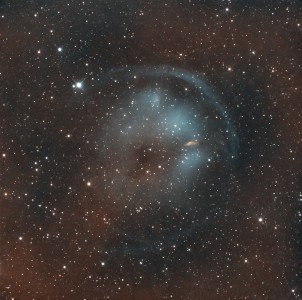
HFG-1

My Account

New to Astromart?

Register an account...

Need Help?

Posts Made By: Inge Skauvik

October 4, 2007 06:13 AM Forum: Deep Sky Observing

Galaxy clusters and groups

Posted By Inge Skauvik

The Sculptor group of galaxies contains many showpieces and cover a large part of the sky. In this post, however, I'll comment on some more distant galaxy groups where several galaxies could be observed in the same field of view.

The Fornax galaxy cluster was a nice surprice. I could count 11 galaxies within a field slightly larger than the 1 degree field of my 24mm Panoptic. Dmitri made a drawing of the same region and spotted 14. Only one of these galaxies could be considered a showpiece object. NGC1365 is a very beautiful barred spiral, and its arms could be plainly seen in the 12.5-inch.

Maybe the least impressive of the galaxy groups observed was the Pegasus-1 galaxy cluster. This group is very distant, about 200 million light years away. The group is dominated by two 11th magnitude galaxies, and a closer look reveals several fainter ones. As always, Dmitri could see more than I could - he indicated the presence of a faint smudge at the position of UGC12535. According to the information we could find about this galaxy its magnitude is 16.1. According to our experience the limiting magnitude with the 12.5-inch was a bit lower, but possibly the listed value for this galaxy was too high....

Before going south, I decided to have a look at the NGC5371 group in the north-eastern corner of Canes Venatici. From home I see four galaxies there (5371, 5350, 5353 and 5354). From La Palma I could add NGC5355 (magnitude 13.1). Dmitri also identified 5358 without seeing any map or photo in advance. I confused this 13.6th magnitude galaxy with a star - even when knowing almost exactly where it should be.

We also observed Stephans Quintet. From home we can get a hint of these objects under the best conditions, but from La Palma they were obvious at first glance. It was not difficult to split the pair NGC7318 A and B, both 13.4 magnitude galaxies. (I should mention that these galaxies were high in the sky while the NGC5371 group was low in the western sky.) The object I had most problem with was NGC5358. I saw it as a star first time, but with sufficient magnification it revealed its true nature.

Just a pity that the Coma galaxy cluster was out of range. I really hope to observe these objects together with Dmitri on some occasion.

Inge S

October 5, 2007 06:09 AM Forum: Deep Sky Observing

M31 and M33

Posted By Inge Skauvik

These two great galaxies were both very well placed for observation during our stay at the Canary Islands, and we observed both of them several times.
The impression through the 12.5-inch was quite similar to what we achieve with 18 inches of aperture under dark conditions from home.

The great Andromeda galaxy was glorious. Along the side opposite to M32 two conspicuous dust bands run. Superimposed on the large, bright central area is the core - clearly non-stellar, looking like a tailless comet. We found two of its globular clusters, G76 and G244. G76 is the brightest one and we chose G244 because it was not too difficult to locate using my "memorisation technique".
The globulars themselves appeared like faint stars, and were not really interesting as visual targets. The process of locating them, however, had a valuable spin-off. Particularly, G76 is located near the end of the galaxy, a zone which until now has not been subject to much attention by me. During the search, however, I noticed the spiral arm making its turn around the end of the galactic ellipse. Looking closer considerable detail could be seen there. Many condensations and star clouds could be seen, not only the large, bright emission region, NGC205.
All these fine details would have been overlooked unless we decided to find G76.
Of course, we also observed the satellite galaxies, M32 and NGC205 (in addition to the distant ones, 147 and 185).

M33 looked like a real spiral galaxy through the eyepiece. Its size made the 13mm Nagler optimal for studying it (115x). The observable detail approached what can be seen in photos. The spiral arms were decorated with bright emission regions. The rather well known, NGC604 is near the end of an arm containing several smaller condensations, IC143, IC132 and NGC595. At the opposite side of the galaxy NGC588, NGC592 and A128 makes a triangle. An eastern "3rd" spiral arm is marked by A100 and A101, both quite bright. One of the great advantages with the superb observing conditions down there is that it is no problem discriminating between small nebulous patches and foreground stars. M33 was definitely one of the highlights of our trip. With sufficient aperture this is one of the best DSO's in the sky.

Inge S

October 8, 2007 06:30 AM Forum: Deep Sky Observing

Galactic detail

Posted By Inge Skauvik

This will be my last post under this forum with La Palma highlights.

I have already written about the great Sculptor galaxies as well as M31 and M33. Also there has been a post about galaxy groups. Here I'm going to tell about our observations of other galaxies (possibly also touch objects already mentioned).

Already the first evening we observed NGC891 in Andromeda. Normally we find it necessary to use high magnification in order to see its equatorial dust band. From La Palma it was very easy to see with direct vision at 63x magnification. This was another object where the view through the eyepiece was very similar to photos.

We also saw obscuring bands in M31 and several of the Sculptor galaxies - most notable perhaps in NGC55.

Spiral structure was detectable in quite a few galaxies. We have already mentioned the greatest of them, M33.

Early in the evening we had access to both M51 and M101. Even though they were low in the sky, they appeared at least as detailed as we see them from home.

We have also already mentioned NGC1365 in Sculptor. This is one of the finest spirals in the sky within range for amateur telescopes. Those who have seen photos of it may be surprised by its small size. It is comparable in size with M61 and M99 in the Virgo cluster, but its central bar and spiral arms are easier to see.

Further north, in Eridanus is another barred spiral where we could see its arms. NGC1300 is just slightly smaller than 1365, but a bit fainter. Still its structure is well enough defined to be seen under superb conditions like those we experienced. A third barred spiral, NGC7479 in Pegasus also showed its structure quite well. This galaxy is less symmetrical as the previous two, but is still a facinating view through the telescope.

During our previous trip to La Palma I suspected that I could see the spiral arms of NGC6946 in Cepheus. This time (observing under less hostile conditions) we could confirm that this was the case. With some attention three spiral arms could be made out. I found 115x to be optimal for viewing the details of the galaxy.

NGC2403 in Camelopardalis is a much neglected object in spite of the fact that it is one of the brightest galaxies of the northern sky. This is another galaxy with spiral structure detectable in amateur telescopes. I find it a bit difficult due to some rather bright foreground stars. However, it was much easier from La Palma even though we didn't get it very high in the sky during our stay.

We observed a second galaxy in Camelopardalis, IC342. From home it is hardly possible to see more than the core of it, but now we could make out a large round halo. Dmitri claimed to see at least one spiral arm there. Looking at photos afterwards I can confirm that one of its arms are more prominent than the others. The visual detection of spiral structure in IC342 was quite surprising - it is after all considered to be a rather challenging object to see - almost regardless of aperture.

I may have skipped some of the galaxies with interesting features in this post. Maybe Dmitri has something to add.

In solidarity to observers who never have the chance to observe under conditions like those we had down there I took out my scope under very lousy suburban conditions the other day. During an hour or so of observation the sky got more and more overcast. There was a lot of disturbing light around, and the humidity was so high that the Telrad became useless almost at once. Two local astromomy novices joined me during the observation where we had a look at objects like M13, M57, M27, M31 and the double cluster. The enthusiasm of the two guys, however, approached the level we had under the dark, clear La Palma skies.

Inge S

October 12, 2007 05:52 AM Forum: Deep Sky Observing

NGC7027

Posted By Inge Skauvik

I very often observe the small planetary, NGC7027 in Cygnus. Located just a short distance east of the North America neubla, it is easy to find - unless you take it as a star.

Monday night I re-observed the planetary. I had a couple of visitors with me, and they couldn't see that it was a nebula at 63x. Even at 115x they had problems, and I therefore increased the magnification to 167x. Then I noticed something that I hadn't been aware of earlier. This nebula isn't round (like I always believed), but elongated, and obviously bi-polar. I somehow feel a bit embarassed that I didn't notice this before, particularly when considering the number of times I have observed it.

I recommend everyone to have a look at NGC7027, and not be afraid of using high magnification.

Inge S

October 22, 2007 05:50 AM Forum: Deep Sky Observing

Best diffuse nebulae of the northern hemisphere

Posted By Inge Skauvik

The sourthern celestial hemisphere has all the show objects among the diffuse nebulae (excluding planetaries and SNRs). This includes M42 in Orion which is located south of the celestial equator.

I would like to hear your opinion about the diffuse nebulae FOR VISUAL OBSERVATION (with or without popular filters) on the northern hemisphere. Please, list your 3 - 5 favourites.

M1 and the Veil nebula are SNRs and should not be counted. Planetary nebulae are also to be excluded. This leaves... any objects at all???

Inge S

November 16, 2007 06:50 AM Forum: Deep Sky Observing

In memoriam

Posted By Inge Skauvik

It was with great sorrow I received the message that my astronomical friend and travel mate, Eckart Fuchs, died in a car crash at Dovrefjell November 2nd at an age of 52. Our astronomy club has lost a great resource and a good friend.

The night before his funeral three of us gathered at our observing site. The sky was clear and we made it a memorial observing session, reviewing many of Eckart's favourite objects.

We shall return to this place many times in the future. It is hard to imagine that Eckart no longer will be with us. We are going to miss his enthusiasm about equipment and telescope construction and joy of observing the beautiful universe.

Inge S

December 6, 2007 01:18 PM Forum: Deep Sky Observing

Best spiral galaxies in the sky - revised list

Posted By Inge Skauvik

I have to face the realities. My perception of which objects are the most appealing and interesting in the sky changes over time. Of course it also depends on the telescope I'm using.

Even though I still have not observed thevery southern part of the sky I believe that I have seen all the best spiral galaxies in the sky. Here is a list of my present favourites. Any comments and second opinions are welcome. And those of you who are new to galaxy observing may find it interesting to observe some of these objects. Observing reports are also welcome, of course.

Note that this list only contain face-on or nearly face-on spirals. Highly tilted systems like M31 and NGC253 are not included. I presently use a 12.5-inch Portaball for my observations.

1: M51 - Easiest spiral in the sky
2: M33 - Awsome under dark skies
3: M83 - Large with plain spiral arms
4: M101 - Most beautiful of the bright spirals
5: NGC1365 - Small, but incredibly detailed barred spiral
6: M61 - Small with peculiar arms
7: M99 - Another small spiral
8: NGC6946 - Rather large, elusive in rich star field
9: NGC7479 - Strange barred spiral
10: NGC2403 - Spiral arms difficult due to foreground stars
11: NGC1300 - Small, very beautiful shape

Inge S

December 7, 2007 12:48 PM Forum: Deep Sky Observing

The M82 class of irregular galaxies

Posted By Inge Skauvik

The first time I saw M82 through the telescope (one of my greatest astronomical memories) I thought it was a typical example of an edge-on spiral. Later I have realised that this actually is a peculiar galaxy with absorbing dust bands crisscrossing its surface in a more random way. These bands can be seen visually in a small or moderately sized amateur telescope. A good 8-inch scope with a magnification of 150 - 200x gives a good view if the sky is dark and clear.

M82 is not the only example of this galaxy class. I recommend a look at the following objects.

NGC3556 (in the same field as the Owl nebula). This galaxy is smaller and fainter than M82, but the general appearance is quite similar. The dust bands are obvious in a 12.5-inch scope.

NGC55 in Sculptor is the best of all galaxies of this class. It puts M82 to shame, being brighter and considerably larger. The drawback is its location far to the south. At La Palma I used the northern stars of Phoenix to help me locate this awesome galaxy.

Then there are two galaxies where I have to admit that I'm a bit uncertain about the classification.

NGC253 in Sculptor also has some resemblance with the M82 class. It could easily win a contest as the best galaxy in the sky viewed through a telescope (M31 being too large). The galaxy definitely contains an irregular pattern of obscuring clouds, but it is far more regular in shape than both M82 and NGC55.

NGC4631 near the Coma Berenices /Canes Venatici border also appears to contain irregularly arranged dust clouds when viewed through a telescope. I even believe I have seen photos revealing such clouds.

Anyhow, all the galaxies listed hare are very good objects for telescopes in the amateur range. Any comments and observing reports are welcome.

Inge S

December 14, 2007 03:05 PM Forum: Deep Sky Observing

NGC1275

Posted By Inge Skauvik

Friday night I had a nice observing session. The seeing was less than perfect, so I spent most of the time with deep-sky objects. One of the targets of the night was to observe some galaxies in Perseus. The only good one in the constellation is NGC1023. This galaxy reminds me a bit of NGC7331 in Pegasus in size and brightness - and some foreground stars decorate the view.
A bit further north is NGC1003. A faint fuzzy even in the 12.5-inch - I was a bit disappointed.
For a long time I have tried to locate the great and distant galaxy NGC1275. This is not a show object, but belongs to the "nice to have seen" category. On Tuesday night I finally succeeded. I realise that I have been searching a bit too far to the north, and since this is close to the milky way, the star field is rich, and makes it difficult to spot the galaxy. At 63x magnification NGC1275 only was visible. At 115x, however, at least three more galaxies could be seen. The negative photo in the NSOG is a bit difficult to use for identification, therefore I would be grateful if anyone could give me a reference to a better photo of this galaxy cluster.
It would have been very interesting to have a person like Dmitri around. He would probably have seen quite a few galaxies in the field.

Inge S

December 19, 2007 02:53 PM Forum: Deep Sky Observing

Re: Nominations for Top 10 All Time!!

Posted By Inge Skauvik

I suggest that this thread - relevant as it is - is moved to the general astronomy forum.

Inge S