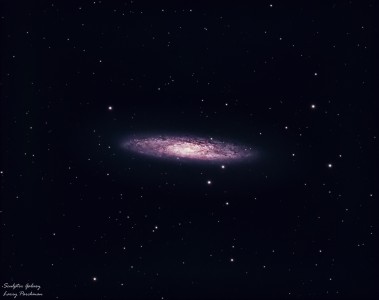
Image of the day

Captured by
Lawrence Parchman

Sculptor Galaxy (NGC 253)

My Account

New to Astromart?

Register an account...

Need Help?

Posts Made By: Dennis Persyk

November 11, 2009 10:45 PM Forum: CCD Imaging and Processing/Deep Sky

Why I Love H-a Imaging –Brief Tutorial

Posted By Dennis Persyk

Our skies are filled with nebulae. The nebulae of interest in this tutorial are huge regions of gas – gas clouds. The nebulae I’ll discuss here are called emission nebulae. We image emission nebulae by means of the light from the surrounding gas cloud which is ionized by radiation from one or more nearby stars.

The most common emission nebulae are of the hydrogen emission type. They emit a very narrow band of red light, and with the appropriate filter (Hydrogen alpha, or H-a), the camera sees essentially only the nebula light, and moon light and terrestrial light pollution is nearly completely eliminated.

Imaging with H-a levels the imaging playing field. No matter where you are imaging from, with an H-a filter you have the equivalent of magnitude 8 super dark skies! Honest!

Pros of H-a Imaging
• Eliminates light pollution
• Background is now inky black – backgrounds have a zero or nearly zero black point
• Stars are much dimmer, minimizing star bloat, chromatic aberration and “fat” stars.

Cons of H-a Imaging
• Very little signal is passed by the filter, so imaging times have to be fairly long – five minute subs are possible if your camera has very low readout noise
• Autoguiding is probably required
• DLSRs without mods don’t have much sensitivity to the H-a light

Here’s an example of 2 hours and 15 minutes in nine 15-minute subframes
http://home.att.net/~dpersyk/new.htm

The target is NGC 281, a/k/a the “Pac Man” nebula and Sharpless 2-184. I used a Takahashi astrograph, f/3.3 and Starlight Xpress SXV-H9 camera. The filter was a 6 nm FWHM H-a. Most processing was done with ImagesPlus. The false color was added in Photoshop with Noel Carboni’s actions. The Hubble employes false color, so I don’t feel like I cheated.

I recommend H-a imaging to everyone who is plagued by sky pollution. No longer will you have to journey to a dark site to get good images.

Clear skies,

Dennis Persyk
Igloo (Now Roll-Off) Observatory Home Page http://dpersyk.home.att.net
Hampshire, IL



March 14, 2010 10:42 PM Forum: CCD Imaging and Processing/Deep Sky

The Flame Nebula

Posted By Dennis Persyk

This is a very bright emission nebula but challenging to image due to the proximity of magnitude 1.7 Alnitak. Alnitak really tests the scope's optics in the areas of scatter and veiling glare.

I do mainly H-a imaging now because my 6 nm FWHM AstroDon is the world’s best light pollution filter. And of course, it works well with moonlight.

Image (1.3 hours at f/3.3) and matching SkyMap Pro 10 screen shot at
http://users.FoxValley.net/~dpersyk/new.htm

Clear skies,

Dennis Persyk

Igloo Observatory (now actually a roll-off) Home Page http://users.FoxValley.net/~dpersyk
Hampshire, IL
New Images http:/usersFoxValley.net/~dpersyk/new.htm
Pier Design Paper http://users.FoxValley.net/~dpersyk/Pier_Design.htm


December 15, 2003 04:33 PM Forum: CCD Imaging and Processing/Solar System

Collimation with a webcam??

Posted By Dennis Persyk

Hi Gianluca,

Collimating with a webcam is an excellent method. Prior to getting my ToUcam, I always collimated my C-11 with a video camera. Now that I have a webcam it is easier because the laptop is always present for imaging and I don’t have to set up the TV monitor.

I use a 2X Barlow when the seeing permits (not very often) to get a larger presentation, but it is not necessary.

I have never seen an Airy disc with either my LX-90 or my C-11, so I cannot speak to the efficacy of the webcam collimation for the final, final stages of collimation – my SCT's optics and seeing don’t allow me to get that far.

Clear skies and easy collimating,

Dennis Persyk
Igloo Observatory Home Page http://dpersyk.home.att.net
Hampshire, IL

T7 comet image and movie http://home.att.net/~dpersyk/new.htm

December 21, 2003 10:27 PM Forum: CCD Imaging and Processing/Solar System

MX716 vs ST7ME comparison

Posted By Dennis Persyk

Hi Kwang,

Thanks for sharing the A/B comparison data. I have an MX716 and at times consider buying an SBIG camera. I was shocked the first time I saw a dark frame from an SBIG camera. Many times I never even bother subtracting a dark frame with the MX716 because the dark noise is so low. Another feature of the MX716 is the very low read noise. This is important if you take short, unguided exposures, as I usually do.

I find the amp glow from the STAR 2000 objectionable, as I do the loss of 50% of the imaging time due to guide frame swapping. That is the greatest driver in my consideration of the two-chip cameras. So far the large price differential has kept me in the Starlight Xpress camp.

Clear skies,

Dennis Persyk
Igloo Observatory Home Page http://dpersyk.home.att.net
Hampshire, IL

T7 Comet Images: http://home.att.net/~dpersyk/new.htm

March 14, 2004 07:20 PM Forum: CCD Imaging and Processing/Solar System

Field rotation??

Posted By Dennis Persyk

Hi Ryan,

Your image displays both star trailing and field rotation. Thirty seconds is about the limit for alt-az for field rotation. And 30 seconds or less will take care of the trailing as well.

Of course you can then stack hundreds of 30 second frames to get a very good signal to noise ratio. Your aligning software must then both rotate and translate, but most astro image processing aps do this, some automatically.

Here are some 30 second stacks to give you a feel for what can be done.
http://home.att.net/~dpersyk/dso.ht
I used a wedge but my LX-90 tracking was only good for 30 seconds so I might as well have been in alt-az!

Clear skies,

Dennis Persyk
Igloo Observatory Home Page http://dpersyk.home.att.net
Hampshire, IL

New Comet Images http://home.att.net/~dpersyk/new.htm

May 9, 2004 11:41 PM Forum: CCD Imaging and Processing/Solar System

Noise Reduction: Is it worth It?

Posted By Dennis Persyk

Hi Vishnu,

I downloaded the compressed image and processed it in ImagesPlus. I could not do as well as NEAT. The question is, could I have done as well with the uncompressed RAW image?

If you could contact me off-list I’d like to discuss processing options with you. I do note that many experienced imagers are using NEAT for DSOs along with MaximDL, AstroArt and other powerful processing aps. Maybe there is something to it!

Clear skies,

Dennis Persyk
Igloo Observatory Home Page http://dpersyk.home.att.net
Hampshire, IL

New Images http://home.att.net/~dpersyk/new.htm

August 1, 2004 05:07 PM Forum: CCD Imaging and Processing/Solar System

How often does SCT Mirror Flop

Posted By Dennis Persyk

Hi Alex,

I do mostly unguided imaging and seldom exceed 6 minutes per frame so I am somewhat isolated from mirror flop issues. I previously had an LX-90 and now a C-11. However, it is apparent from what I’ve read in the various imaging groups that the extent of the problem varies greatly among scopes of even the same manufacturer and model.

On both my SCTs I could twirl the focus knob 20 turns (as with removing a diagonal) and not have the image move more than an arc minute or two. Others report large shifts between different eyepieces, requiring only minor focus knob rotations. This may offer a clue as to the extreme variability.

I’d suggest you image with what you’ve got and see how your individual scope works out. Once you acquire an image long enough to swamp out the readout noise, there is little gained from acquiring longer. Stacking lots of short exposures works quite well. So far all my imaging has been in that mode.

Clear skies,

Dennis Persyk
Igloo Observatory Home Page http://dpersyk.home.att.net
Hampshire, IL

New Images http://home.att.net/~dpersyk/new.htm

October 8, 2004 03:10 AM Forum: CCD Imaging and Processing/Solar System

Comet C/2001 Q4 NEAT

Posted By Dennis Persyk

Correction: My web page images were labeled 6 Sept and should have been labeled 6 Oct. I apologize for any possible confusion. I have corrected the errors.

Clear skies,

Dennis

November 8, 2004 03:00 AM Forum: CCD Imaging and Processing/Solar System

Aurora Tonight!

Posted By Dennis Persyk

Hi Tyler,

It sure was a beautiful display tonight. And your image is outstanding! That has to go to Sky and Telescope.

Clear skies,

Dennis Persyk
Igloo Observatory Home Page http://dpersyk.home.att.net
Hampshire, IL

Aurora Images http://home.att.net/~dpersyk/new.htm


January 15, 2005 06:27 PM Forum: CCD Imaging and Processing/Solar System

Machholz nucleus alignment ..Images Plus

Posted By Dennis Persyk

That’s a very nice image, Tom. If you do a 0.5 log stretch on it you can bring out a bit more of the tail structure. If you really want to see the tail detail, convert to luminance, convert to negative, and move the black point over a bit. The result is not as pretty but gives a few more arc minutes of tail detail.

Clear skies,

Dennis Persyk
Igloo Observatory Home Page http://dpersyk.home.att.net
Hampshire, IL

Latest Machholz Stuff http://home.att.net/~dpersyk/new.htm