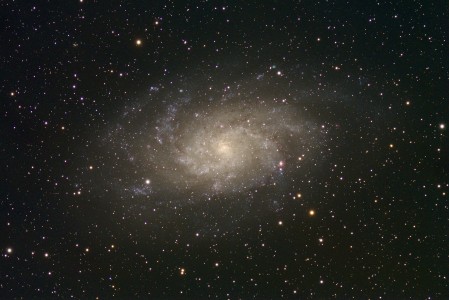
Image of the day

Captured by
Erwin Forbragd

M33 in Triangulum

My Account

New to Astromart?

Register an account...

Need Help?

Posts Made By: Andrew Riehl

February 6, 2003 10:58 PM Forum: CCD Imaging and Processing/Solar System

weird issue with green filter in CFW8A

Posted By Andrew Riehl

Brian, like ron said, that is kind of odd. Best thing I could suggest is to look at the 'seemingly too simple to look at' things. have you imaged successfully with this setup before? what order did you shoot your colors (possibly temporary very thin cloud?)? reversed blue/green filter settings in Maxim? perhaps a fogged filter? Did you try to refine focus manually with the handbox control? how light polluted are you; most light pollution shows in green images, maybe it was fooling Maxim into thinking the stars were bigger than they were. I dunno, never heard of an issue like this before (in green that is).

February 8, 2003 05:38 PM Forum: Equipment Talk

G-11 vs CI-700

Posted By Andrew Riehl

a good comparison on the two can be found on cloudy nights at:
http://www.cloudynights.com/reviews/cm1100.htm

February 8, 2003 05:48 PM Forum: Equipment Talk

Lumicon Halpha any good?

Posted By Andrew Riehl

The lumicon h-alpha is a prominence viewer. The bandpass is somewhere along the line of 1.5 angstroms. A wide bandpass will be good at showing prominences, but not surface detail. The lower the bandpass, the higher the detail that can be seen. To see surface detail, <1 angstrom is pretty much the limit. If you really want a premium solar filter that will knock your socks off, Pass on the lumicon and save up for something under 1 angstrom (a coronado 40mm solarmax is a great deal IMHO). You won't be dissapointed.

February 11, 2003 09:57 PM Forum: Equipment Talk

Meade standard coatings

Posted By Andrew Riehl

Mirror reflectence and throughput are different things. Reflectence (of say 94% for example) is totally dependent on the mirror coatings; i.e., of all the light hitting the mirror, 94% gets reflected. Now this light has to go through the corrector plate first; 94% of the light coming through the corrector plate gets reflected. If only (for expample, not an actual figure) 90% of the light is getting to the mirror (10% reflected back into space by the corrector plate), 94% of 94% (some light loss at each the primary and secondary mirror) of 90% would yield 79% of the total photons hitting the corrector plate actually making it 'through' to the eyepiece. These numbers are purely made up, just used to illustrate the surfaces involved. That's how you can have a reflectence of 94%, but a much smaller throughput. Please anybody correct me if my theories are in error.

February 14, 2003 02:49 AM Forum: Off Topic Discussions

Battle gear time....

Posted By Andrew Riehl

well, I guess I'm dragging myself back in here for a bit...Just have a few things to say, then will most likely excuse myself as most of us have hammered through this before.
I beleive the UN will definately agree to authorizing the use of force. To not do so would pretty much be the end of the UN. If there are no consequences to breaking their rules, what point is there to follow them? Many keep saying 'let the inspectors have time to work'; they've had over a decade. These aren't new rules here. what good are rules if they are not enforced? Making new rules won't help as the violator has already established their intent to not follow them. The UN has to show their seriousness; what will happen if they are ignored? Allowing Iraq to go on ignoring them will just make matters worse. If nothing is done to Iraq, what will the North Koreans think? They'll just keep demanding things from us to keep them happy; although they never will be. Once we start giving in to their demands, what would make them stop asking for more? If these countries know nothing will ever happen to them, they can do, take, and demand anything they want. 'they won't hurt us as long as we leave them alone'. Gosh, I'd love to know how these appeasing people feel about my right to bear arms...
The problem here is that our current administration is in a series of liberal catch 22's. If they up the terrorist threat warning and nothing happens, the libs will say it was only upped to gain support for the 'oil war'; if something does happen and americans die, then the administration knew it would happen and let it to once again gain support for the war. Same thing with Iraq; if they use Weapons of Mass Distruction (the ones they don't have), we let them do it so we look good. If we take them out before they use them, then obviously they never had them to begin with and it was just cover for us to get oil. These same types of paradoxes will be used against the administration for everything from the economy to what meal is served at a state dinner. No matter what the end result is, good or bad, the Bush administration will always be wrong to these people (yes, the same people who didn't want a homeland security department as it was a waste of taxpayer money, but are now bashing the administration because it is not letting this same department have enough money in their eyes. It's all window dressing, these people will always gripe about something, no matter how hippocritical it makes them look. They say we can't touch Iraq because we don't have UN support. What happens when we do have UN support? They will come up with some other little reason why we are wrong. Then it will be that Iraq and North Korea are OK, it's the rest of the world that's crazy or something like that.

February 15, 2003 10:08 PM Forum: Off Topic Discussions

Coffers of Saudia

Posted By Andrew Riehl

Interesting indeed...thanks for the info Barry

February 19, 2003 12:18 AM Forum: CCD Imaging and Processing/Solar System

Help needed

Posted By Andrew Riehl

Well Luca, A nexstar 11GPS is one of the scopes I own. I will say going to ccd imaging is a huge leap; there is very very much you will have to learn. Believe me, it is not easy. The suggestion for you to get the book 'the new ccd astronomy' is a very very good one and reading the book will do you well indeed. One-shot color cameras just aren't that great. The are much less sensitive; the best way to go is a monochrome ccd with a color filter wheel. There are many pro's and con's to the equipment you will choose, including your budget. What tradeoffs you decide to make is best left a personal decission once you have weighed the facts. The book mentioned before will help you make an informed decision, as well as help you get the most out of your equipment when you do buy it. These are decissions not to be rushed into, you will thank yourself later. For some CCD images through a nexstar 11GPS, goto my site at:
http://home.sprynet.com/~inbred/andys.htm

February 19, 2003 12:42 AM Forum: CCD Imaging and Processing/Solar System

New ST2000xm or used ST8E

Posted By Andrew Riehl

Well tom, I have no personal experience with an st-8E, but as you probably know, I seem to be one of the main st-2000 guys out here right now. I'm assuming you're looking for an abg (antiblooming) camera? The st-8e is available as either abg or non-abg, whereas the st-2k is only an abg camera. Basically, the bottom line is that the st-8e is just more sensitive (requires shorter exposures) than the st-2000, due to a combination of pixel size and quantum efficiency in the red (the st-2k is actually the better in green and blue). Translated into lay terms, imagine pixel size equalling aperture; the bigger pixel size has more light grabbing area than the smaller one. I personally see the QE's averaging out to be about the same (this is when comparing only the anti-blooming version of the st-8 to the ST-2k), since each is better than the other at opposite ends of the color spectrum, although the st-8 would have the edge as we all know many nebulae are predominately red. The smaller pixels of the st-2k will give you a higher resolution on a small scope; while the added resolution will be usually useless on larger scopes due to seeing conditions. But with the huge image size, binning still gives you a decent sized image. If I had to pick between the two as a gift, I'd pick the st-8e. If I had to buy one, I'd pick the st-2k (which I did). The price difference is mainly due to ccd chip design differences. I couldn't see paying the extra price for a little more sensitivity. I never would've been able to buy an st-8. As far as use goes, the cameras work exactly the same. If you do decide on an st-8E, I would definately not settle for anything besides USB connections. If you get a parallel cheap, I'd get it upgraded. Oh, one last note; the st-2k is capable of 0.01 second exposures where I believe the st-8 is limited to 0.11 seconds? Definately a lot nicer for lunar/planetary imaging. Ok, I've rambled on enough. If you haven't checked it out, sbig explains the differences pretty well at:
http://www.sbig.com/sbwhtmls/st2000xm.htm

February 19, 2003 10:40 PM Forum: CCD Imaging and Processing/Solar System

Re: COAA telescope controller opinions??

Posted By Andrew Riehl

Judging by what I've read there, don't forget to add over $200 for a pair of vixen mt-1 drive motors, or subtract a suitable amount from the price of an ss2k unit if you already have the motors (new ones are included with the ss2k). I would say that if you had the optional dedicated hand guider, it may be very possible to adapt it to take autoguider relays, but it would depend on this 'hand box's electronic interface to the system.

February 23, 2003 05:36 PM Forum: Off Topic Discussions

U.S. Secret Weapon REVEALED....

Posted By Andrew Riehl

come on, haven't you heard what the actors are saying? Iraq doesn't have any guns and missles!?!?