Image of the day

Captured by
Erwin Forbragd

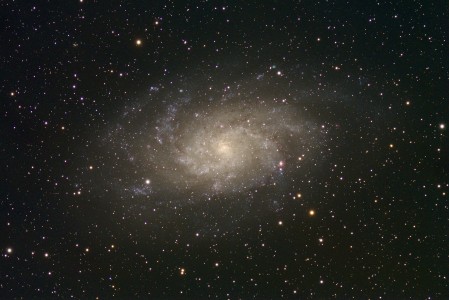
M33 in Triangulum

My Account

New to Astromart?

Register an account...

Need Help?

Posts Made By: Inge Skauvik

October 8, 2002 06:38 AM Forum: Off Topic Discussions

Any musical astronomers out there?

Posted By Inge Skauvik

In addition to being an amateur astronomer I'm an amateur pianist mainly playing classical music. The combination astronomy/music may seem weird, but e.g. W.Herschel both played the organ and composed some music.

There are a few pieces of music which gives me "astronomical" associations. Currently I'm working with Debussy's "Suite Bergamasque" and one of the movements is the famous "Clair de Lune" which makes me think not only about a moonlit landscape, but perhaps even more on the sight of the Veil nebula through the telescope.

Another "astronomical" piano piece is Chopin's Prelude, Op.45. To me this is a painting of a drifting star field with beautiful chains of stars, asterisms and clusters slowly pass through the field of view.

Any other suggestions to "astronomical" music? Of course I know about "The Planets" of Holst.

November 2, 2002 10:41 AM Forum: Deep Sky Observing

NGC7479 - at last

Posted By Inge Skauvik

During several observing sessions I have searched for NGC7479. According to the magnitude given in tables, it should not be difficult with an aperture of 8 inches. However, I have a problem with city glow in the low southern sky, and it there are not too many referance stars to help locating it. Yesterday evening, however, I finally spotted the galaxy. It was pretty large, but I was absolutely not impressed by its brightness.

In the near zenith region, however, I could go pretty deep yesterday. NGC185 and NGC147 were not very difficult. Not far from this group is a compact spiral, NGC278 which is a good object, and should be reachable with apertures of 4 inches or less.

I also had a look at a few diffuse nebulae. NGC1931 (between M36 and M38) was the brightest and smallest one. NGC1491 in Perseus is a bit larger, looking almost as a square with the O-III filter. After some sweeping, I also found NGC1333 (also Perseus). This turned out to be a pretty large, oval nebulosity. There was a star involved, clearly off-center. I didn't try a filter on this nebula since it shines by reflected star light. It was not extremely bright, but pretty obvious in the 8-inch. It was much easier to see than NGC7479 and NGC891 in Andromeda.

November 29, 2002 07:05 AM Forum: Equipment Talk

New toy

Posted By Inge Skauvik

I'm going to be a part owner of a new club telescope. We take advantage of a very good offer as well as a beneficial currency exchange rate. So, at last I will have the chance to look through something with more than 8 inches of aperture.

Our new "toy" is an NGT-12.5. I have heard quite a few critical comments about this scope. The main problem appears to be to keep collimation while rotating the upper tube assembly(UTA). I just wonder how serious this problem is, and would really like comments and advice from owners/users of NGT scopes. In principle the concept should work beautifully if the axes of the UTA, the diagonal mirror and the center axis of the primary mirror are perfectly aligned. In worst case, I suppose the rotation facility of the UTA can be left unused.

BTW: The 8-inch Portaball remains with Papa.

December 9, 2002 07:05 AM Forum: Deep Sky Observing

Where did the NTB go?

Posted By Inge Skauvik

Jupiter experts, what happened to the NTB? I made my first decent observations of Jupiter last year, and during the whole observing season the NTB was a conspicious feature. This morning I observed Jupiter for the second time this season. (Weather has been bad, so this was my first real opportunity) Seeing was moderate, but it should not be a problem to see the NTB if it were comparable to last year, but I could hardly make it out. The GRS was no problem to see, and there was quite some detail in the SEB. Following the GRS parts of the STB also was obvious.

Are changes in the main features of Jupiter common? Will the NTB reappear? I miss it.

December 9, 2002 09:22 AM Forum: Equipment Talk

Celestron Erfles

Posted By Inge Skauvik

Dedicated amateur astronomer Antony Allsobrook (NZ) kindly sent me a set of four Celestron Erfle eyepieces for testing and comparison with UO-eyepieces. I was a bit sceptic in advance, since the comments I've heard about Erfles mostly have been reluctant or negative. This weekend I had the opportunity to try the eyepieces, not from a very dark site, but from my driveway (suburban conditions). I use an 8-inch f/6 Portaball Newtonian with Zambuto optics, and have only UO orthos and one Konig in my personal set of eyepieces.

The Celestron Erfles are 1.25" barrel eyepieces, and available focal lengths are 16mm, 20mm, 24mm and 28mm. I don't know the nominal field of view, but it must be something near 70 degrees. The design is classic and functional.

I was quite surprised when comparing the 16mm Erfle with my 16mm Konig. The field of view is more or less the same for these two eyepieces, and both suffer from some edge coma. However, this was much less conspicuous for the Erfle than for the Konig. I also noticed that the image brightness was excellent in the Erfle. Possibly the sharphess near the centre of the field of the Konig was slightly better.

I tried all four eyepieces, and the general impression was the same. Images were crisp and sharp, and with normal use edge coma was not noticeable. I also found the eye relief to be comfortable. Perhaps the 28mm had a slightly longer eye-relief than what I'm used to, but it was much better than e.g. the 25mm UO ortho where I find field blackout to be annoying.

I used the 28mm with an O-III filter on extended nebulae like the Veil, the North America nebula and NGC281 in Cassiopeia, and I'm very pleased with what I saw. I have never before had such a good view of the North America nebula. With the wide field of view, much of the nebulosity could be viewed simultaneously, and the "Mexico" region was very conspicuous. The two main branches of the Veil were visible without a filter, and absolutely great with the O-III. I could even easily see the Crescent nebula in Cygnus (NGC 6888). I consider this to be pretty good with an 8-inch with such an amount of ambient light.

My general impression of the Celestron Erfles is that they are great eyepieces, and I will try to obtain at least one of them for myself. I can't give any statements about how they compare with e.g. Meade wide angle or UWA's, but I can definitely recommend them for persons who can't use 2" eyepieces.

Antony Allsobrook kindly allows me to keep the eyepieces for some time, and I will also test them with our new club scope, a 12.5" f/4.5 NGT Newtonian. I will report the results as soon as they are available.

December 12, 2002 06:53 AM Forum: Equipment Talk

Diffraction grating?

Posted By Inge Skauvik

Can anyone tell me where to find some not too expensive replica diffraction grating? I need it as an aid to locate small planetary nebulae, and perhaps even viewing some of the more prominent spectral features in stellar spectra. It could be useful for educational purposes as well.

Another question: Will it work if I mount the grating in an eyepiece filter, i.e. apply the grating before the light enters the eyepiece? This would be much more convenient than holding the grating between the eyepiece and the eyes.

I would like to experiment with this, trying different arrangements and, if possible, try grating with different grooves per mm values. Suggestions? Advice?

December 13, 2002 03:31 PM Forum: Equipment Talk

Siebert?

Posted By Inge Skauvik

There has been quite some discussion about wide-angle eyepieces lately. Do anyone know about the Sieberts in the f.l. range 20 - 30mm? How do they perform with short f.l. Newtonians?

Another question, maybe a bit off topic: What is the origin of the "Erfle" designation. How is it pronounced in English (or German or Russian if anyone knows)? If pronounced as written in Norwegian it sounds stupid.

January 10, 2003 10:17 AM Forum: Deep Sky Observing

What does it take to view the Veil nebula?

Posted By Inge Skauvik

The Veil nebula complex makes a wonderful sight even in a modest 8-inch Newtonian equipped with an O-III filter and an eyepiece with a decent field of view. However, a dark, transparent sky and absence of ambient light is important to enjoy the full splendour of the nebula.

On Wednesday evening I had my scope out just to check the seeing conditions. A friend of mine dropped by, and wanted to have a look at the Veil, and I decided to make a try in spite of interfering moonlight and snow on the ground reflecting all the high-pressure sodium lamps in the vicinity. Just a hint of the nebulocity could me made out without a filter, therefore I put on the O-III. Then the nebula was pretty easy to see in spite of the conditions. Just as my friend was to take over the scope, a #£€@#@ truck came down the road pointing its headlights directly towards us. And believe it or not, it was still possible to see the Veil with the truck parked at a distance of 30 metres.

This was not a great sight, but it just illustrates the fact that the Veil nebula isn't really a difficult object in a decent modern telescope. The O-III filter certainly helps a lot, but even without a filter quite a lot can be seen with 8-inches of aperture.

January 15, 2003 11:37 AM Forum: Equipment Talk

Low power eyepieces for new scope

Posted By Inge Skauvik

Sunday evening my astronomy club's new scope arrived, an NGT-12.5 (12.5-inch f/4.5 Newtonian). The scope lives with me, at least to begin with, and I can, of course, use my own set of eyepieces with the NGT (UO-orthos, 25mm, 12.5mm, 7mm and 5mm and a 16mm Konig, all 1.25" barrel).
Just recently I have tried some low power eyepieces (16mm, 20mm, 24mm and 28mm Celestron Erfles)with my personal 8-inch f/6, and I realise that these eyepieces provide nice views of extended objects, and work beautifully with narrowband filters. I will, however, soon have to return the Erfles to the owner, and therefore want to purchase at least one low-power wide-field eyepiece for use with the new scope. The NGT allows the use of both 1.25" and 2" eyepieces, BUT the filters I have are all 1.25". Any recommendations? I think that the focal length should be no longer than 30mm, perhaps 28mm (considering exit pupil). I would also prefer the price to be below 200$.


February 6, 2003 07:54 AM Forum: Deep Sky Observing

Field test of NGT-12.5 optics

Posted By Inge Skauvik

I'm a part owner of a 12.5-inch NGT recently purchased (second-hand) by the local astronomy club. The scope was picked up about a month ago, and we have had the scope out a few times to get acquainted with the set-up (mechanical and electronical issues). So far we have concluded that the potential of the scope is great, but we have to do some maintenance in order to have it working properly. During the first couple of observing sessions we have been 3 persons present, and checked out a few show objects. However, yesterday evening I had the opportunity to spend a couple of hours alone with the scope and used the chance to check the performance of the optics.

For some reason I could not find the power cable connecting the battery pack and the control unit of the scope. Therefore I had to move the scope manually. This was, of course, a drawback, but I was able to handle powers up to 280x without problems.

The sky was partially clouded (coverage varying from 40 - 70%) but seeing was excellent. The first test object was Struve 1126, a near equal 1" double in the same low power field as Procyon. This double was cleanly split at 280x.
Next target was Saturn. The image at 280x was sharp and contrast was great, showing much nice detail at the planet's surface, of course the Cassini division, the crepe-ring and a hint of Encke's division at the ends of the ellipsiodal image of the ring system.
Jupiter's surface was very bright at 280x, almost annoying, and it was necessary to spend some time to adapt the eyes in order to make out the fine detail at the planet's surface. Unfortunately there were no satelite transits taking place, but I followed a GRS passage during the observing session. This was my first chance to have a close look at Jupiter with 320mm aperture, and the amount of detail clearly exceeds what can be achieved with my 200mm Zambuto mirror (which is excellent, indeed).

The conditions were useless for observation of nebulae. Low clouds reflected a lot of high-pressure sodium light, so most of the time I spent observing doubles. Zeta Orionis was a great surprise. Normally it is very difficult to split it from my latitude, but this evening it was EASY. So were Theta Aurigae and Eta Geminorum, and for the first time in my life I could see 6 stars in the trapezium. A lot of other doubles in the 0.8" - 1.5" range were resolved with ease, e.g. 52 Orionis, 32 Orionis, Eta Orionis and Zeta Cancri which was a BEAUTIFUL triple system. The separation of the close pair is presently about 0.8". It was easy to see that the amount of dark space between the components is greater in the 12.5-inch than the 8-inch. I didn't challenge closer doubles this evening since I didn't have the RA-motor running.