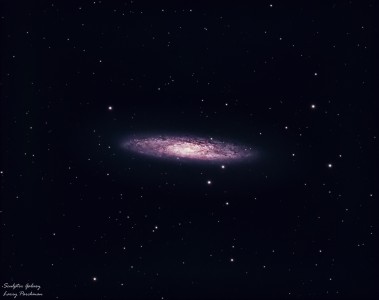
Image of the day

Captured by
Lawrence Parchman

Sculptor Galaxy (NGC 253)

My Account

New to Astromart?

Register an account...

Need Help?

Posts Made By: Dennis Persyk

December 20, 2003 05:11 PM Forum: CCD Imaging and Processing/Solar System

Comet T7 Images and Movie

Posted By Dennis Persyk

I imaged C/2002/T7 at 0130 UT Dec 20. 4-inch refractor and MX716 CCD. Images, “eyepiece” view and movie at
http://home.att.net/~dpersyk/new.htm

The tail is now 9 arc minutes long.

Please take a look.

Clear skies,

Dennis Persyk
Igloo Observatory Home Page http://dpersyk.home.att.net
Hampshire, IL


December 27, 2003 07:52 PM Forum: CCD Imaging and Processing/Solar System

C/2002 T7

Posted By Dennis Persyk

Single 3 minute, co-registered 21x 3 minute images and isophotes at
http://home.att.net/~dpersyk/new.htm

I also put up simulated “eyepiece views” comparing 11-inch SCT to 4-inch refractor. SCT won easily.

Comments and suggestions welcomed.

Clear skies,

Dennis Persyk
Igloo Observatory Home Page http://dpersyk.home.att.net
Hampshire, IL


January 2, 2004 02:26 AM Forum: CCD Imaging and Processing/Solar System

T7 Images: 4-inch refractor vs. 11-inch SCT

Posted By Dennis Persyk

I did the experiment comparing the two as I have both scopes on the same mount:
http://home.att.net/~dpersyk/new.htm

Due to the greatly differing focal lengths of the two scopes, I could not acquire the images under the same conditions. I hope to repeat the experiment again to acquire more data.

I invite comments on the comparison.

Clear skies,

Dennis Persyk
Igloo Observatory Home Page http://dpersyk.home.att.net
Hampshire, IL


January 13, 2004 02:58 PM Forum: CCD Imaging and Processing/Solar System

Comet T7’s Tail Getting Longer

Posted By Dennis Persyk

Images and simulated eyepiece views at
http://home.att.net/~dpersyk/new.htm

The tail has increased at least four-fold in length to 22 arc minutes by my images since January 1st.

Clear skies,

Dennis Persyk
Igloo Observatory Home Page http://dpersyk.home.att.net
Hampshire, IL


January 19, 2004 05:34 PM Forum: CCD Imaging and Processing/Solar System

Comet T7’s Tail Now 30 Arc Minutes Long

Posted By Dennis Persyk

Images
http://home.att.net/~dpersyk/new.htm

Clear skies,

Dennis Persyk
Igloo Observatory Home Page http://dpersyk.home.att.net
Hampshire, IL


January 24, 2004 07:24 PM Forum: CCD Imaging and Processing/Solar System

43P Wolf-Harrington

Posted By Dennis Persyk

I have imaged a much dimmer comet than the currently bright C/2002 T7 LINEAR. My images of 43P Wolf-Harrington are found at
http://home.att.net/~dpersyk/new.htm

Max Wolf (Königstuhl Observatory, Heidelberg, Germany) discovered this comet photographically in December, 1924. The P designates a periodic, or reoccurring, comet. It returns every 6.46 years. Comet 43P Wolf-Harrington is currently in Pegasus at magnitude 12.5

Clear skies,

Dennis Persyk
Igloo Observatory Home Page http://dpersyk.home.att.net
Hampshire, IL


January 30, 2004 05:07 PM Forum: CCD Imaging and Processing/Solar System

C/2002 T7 Comet Images

Posted By Dennis Persyk

I imaged T7 with a 57%-illuminated moon just 37 degrees away last night. Images at
http://home.att.net/~dpersyk/new.htm

Clear skies,

Dennis Persyk
Igloo Observatory Home Page http://dpersyk.home.att.net
Hampshire, IL


February 5, 2004 09:44 PM Forum: CCD Imaging and Processing/Solar System

Imaging: Hydrogen Alpha and Stacking

Posted By Dennis Persyk

When the moon is bright, most deep-sky observers and imagers give up because of moon light pollution. This need not be the case for imaging if one uses a narrow-band Hydrogen-alpha (H-a) filter and images emission nebulae.

Emission nebulae contain vast volumes of ionized hydrogen which emit a very narrow emission line in the red. If one utilizes a matching narrow-band filter, the camera sees predominantly just the red emission and the light pollution from the moon and everything else ceases to be a problem.

Hydrogen-alpha imaging does have some downsides:

Focusing is much more difficult because starlight contains little H-a light. I normally focus on a magnitude 8 star using 0.1 second exposures, giving me essentially real-time focusing. With the H-a filter, I need 10 second focusing exposures.

The exposure times have to be quite a bit longer due to the weak signal flux incident on the camera via the H-a filter.

Finally, stacking (co-registering) many images is a powerful tool to decrease noise. In my example below I show the effect of a single two-minute exposure versus a stack of 22 two-minute exposures.

Images at
http://home.att.net/~dpersyk/new.htm

Clear skies,

Dennis Persyk
Igloo Observatory Home Page http://dpersyk.home.att.net
Hampshire, IL


February 8, 2004 07:17 PM Forum: CCD Imaging and Processing/Solar System

C/2002 T7 Comet Images

Posted By Dennis Persyk

I imaged T7 between twilight and moonrise last night. Images at
http://home.att.net/~dpersyk/new.htm

Clear skies,

Dennis Persyk
Igloo Observatory Home Page http://dpersyk.home.att.net
Hampshire, IL


February 16, 2004 06:19 PM Forum: CCD Imaging and Processing/Solar System

C/2002 T7 Comet Images

Posted By Dennis Persyk

I imaged T7 last night. A simulated eyepiece view is included. The two-pronged tail is quite pronounced. The comet is sinking low in the west and my last image of the sequence was at an elevation of only 17.4 degrees!

Images at
http://home.att.net/~dpersyk/new.htm

Clear skies,

Dennis Persyk
Igloo Observatory Home Page http://dpersyk.home.att.net
Hampshire, IL