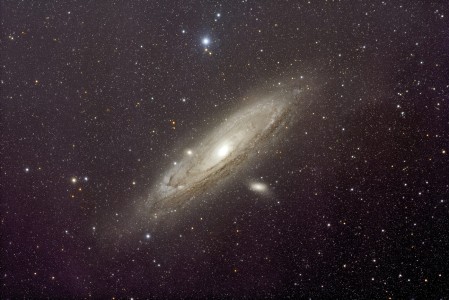
Image of the day

Captured by
Yue Ma

M16

My Account

New to Astromart?

Register an account...

Need Help?

Posts Made By: Barry Simon

November 13, 2002 02:33 AM Forum: Coronado-Lunt-DayStar Solar Filters

Eyepiece Question

Posted By Barry Simon

I knew I would have a problem and it was confirmed today. The older style Tak FS78 cannot be focused in far enough to work with most eyepieces that can be inserted in the Scopetronix afocal digital camera adapter. This adapter comes with a 25mm Plossl and I would estimate that I am about 1/2" shy of being able to focus in far enough. This is even doing a trick with the Tak adapters which gives me about another inch of in-focus. Orion Explorer orthoscopics also do not work, nor do any in an older set of Celestron erfles (16mm thru 32mm). I did find two eyepieces in my collection that do work. One is a Brandon (labeled 7/8" or about 22.5mm), the other is a Vernonscope 40mm Plossl. This one has a double cross-hair. (I can switch lower barrels with another eyepiece to take the cross-hair out of the equation.)

Anyway I would like to get more appropriate eyepieces for afocal projection. Can anyone recommend any eyepiece that focuses "out" more than most eyepieces do.

Barry Simon

December 8, 2002 04:31 PM Forum: Equipment Talk

Celestron Ultima 19 mm Wide Angle

Posted By Barry Simon

I acquired a Celestron 19 mm Ultima Wide Angle eyepiece recently. It is my understanding that the Ultima Wide Angles were only available for a short period of time and that there were only 3 eyepieces in this series, the 19 mm, I believe a 23 mm and maybe one about 16 mm, but I am not really sure. Can anyone provide more information about these eyepieces.

Barry Simon

December 27, 2002 02:37 PM Forum: Pictures of Me and My Telescope and........

The LightSpeed Wagon attracts a crowd

Posted By Barry Simon

Pictured is my LightSpeed Wagon alta-azimuth mount on a Losmandy G8 tripod with pier extension. The scope mounted on this rig is a Jaegers 6" f/5 refractor. This was taken at the 20th Annual Deep South Regional Stargaze this past November. I am the 4th from the left, just to the right of the telescope.

Barry Simon

April 15, 2003 01:00 PM Forum: Astro Binoculars

Maximum Star Counts for various binoculars

Posted By Barry Simon

Below is only a small part of the complete article found in the Files Section of the BinocularAstronomy Yahoo Group on potential star counts with binoculars based on field size and magnitude reach. Check out BinocularAstronomy for the full article.

(My apologies if the chart does not format correctly upon posting.)

Star Counts for Binoculars and Rich Field Telescopes

BINO MAG LMT STAR LMT(Total Sky) FIELD SQ.DEG/SKY(Averaged) STARS/FIELD

7X35 10.4 450,000 9.3 deg 68 742

8x42 10.8 600,000 8.2 deg 53 771

10x50 11.2 7 50,000 6.5 deg 33 600
10x50 11.2 750,000 5.0 deg 20 364

12x60 11.6 1,000,000 5.7 deg 25.5 618

16x60 11.6 1,000,000 2.8 deg 6.2 149

15x70 11.9 1,600,000 4.5 deg 15.9 616

16x70 11.9 1,600,000 4.0 deg 12.5 485

20x80 12.2 2,000,000 3.5 deg 9.6 465

20x100 12.7 3,000,000 3.0 deg 7.0 509

25x125 13.2 4,000,000 2.5 deg 4.9 475

30x150 13.6 6,000,000 2.2 deg 3.8 553

(It is interesting to note that star counts stay within a relatively narrow range with binoculars with maximum fields, typically between about 450 and 750 stars per field. As magnitude reach improves, field size decreases keeping the star counts close in spite of increasing aperture. The peak count was seen with a pair of wide angle 8x42 pair of binoculars; so I guess you could say it qualifies as the top "Rich Field" Binocular. Standard angle binoculars really suffer when it comes to star counts because of their dramatically small total field size area)

Some telescopes added to the mix -

SCOPE MAG LMT STARS Poss. FIELD Sq Degrees STAR CT

80mm f/6.25 12.2 2,000,000 4.8 deg 18.1 878
(35mm eyepiece and 14.3x mag)

152mm f/5 13.6 6,000,000 3.1 deg 7.6 1105
(35mm eyepiece and 21.7x mag)
(more than double the star count as compared to equivalent power binoculars)

Barry Simon

April 21, 2003 08:38 PM Forum: Astro Binoculars

Test Stars for Checking Limiting Magnitude

Posted By Barry Simon

A good grouping of stars for testing the limiting magnitude of binoculars and small telescopes up to about 80 mm aperture (from an urban or suburban location) can be found in Gemini just east of the bright star Pollux. At this time of year Pollux is between 50 and 60 degrees up at about 10 pm, so it is well placed for this test. The test group of stars is found by simply going "up" from Pollux approximately 2/3 degree in an easterly direction.

In binoculars you will note two stars in a line from Pollux that are approximately 7th magnitude. At the 2nd (brighter star) take a sharp turn to the left (south) and you will see two more stars in line with the brighter star where you turned. Note that in a refractor with a star diagonal the view will look a little different, just remember to turn your scope in the correct celestial directions.) These two are about 8th magnitude. Continuing on you will see another 7th magnitude star, about the same distance beyond the fainter 8th magnitude stars as is the other 7th magnitude star back to the north. Slighly east (up) between this last star and the last 8th magnitude star was a fainter 9th magnitude star. It was not initially noticed in the binoculars, but was eventually seen. It's visibility was not easy in the binoculars but was essentially constant. Subsequently another faint star was discovered "west" or below the imaginary line connecting the 7th magnitude star to the 8th magnitude stars in the middle. This one was a little fainter than the first 9th magnitude star. It's visibility was in and out in the binoculars.

From the city under 4.5 magnitude skies, these fainter 9th magnitude stars should be seen in 80 mm binoculars or telescopes and should be a challenge for 60 mm and 70 mm binoculars. From a dark rural location, these fainter stars should be easily seen in mounted 12x50 binoculars.


Barry Simon


May 1, 2003 11:38 PM Forum: Coronado-Lunt-DayStar Solar Filters

Coronado Solar Filter Adapter Opinion

Posted By Barry Simon

I just received another SolarMax 60 adapter cell from Coronado. This one was made so I could use the Coronado 60 with my Unitron 3" and University 80 mm scopes. In actuality it expands my use to 4 additional scopes, so 6 in all now, if you include some guidescopes with this lens cell and dewshield. The dewshields on these scopes are identical and screw on to the objective cell. The supplied adapter attaches by sliding over the end of the dewshield.

The adapter is heavily "felted" and the fit is tight. It has 4 nylon retaining screws which press firmly against the felt making the fit even more secure. I am thinking about modifying the adapter however. I have a short piece of old dewshield that has it's threads intact. It is possible for me to center this short piece within the new adapter and "J-B Weld" it in place. This would allow me to thread the adapter on in place of the dewshield. This is the way my other adapters attach (one screw on adapter for a Tak FS 78 and another one for my Tak FCT 76).

The advantages of screw-on adapters are:

1) An even more secure fit.

2) Shifts the balance point rearward, as the scope is somewhat less front heavy with the Coronado filter closer to the objective.

3) A bit more of the filter is utilized the closer you can get the filter to the objective. Not by much, but maybe a 2 mm gain.

My question to the group is: "Would you leave the adapter alone, or do the surgery?

Barry Simon


June 3, 2003 12:33 PM Forum: Coronado-Lunt-DayStar Solar Filters

Ok has anyone cleaned their Coronado yet?

Posted By Barry Simon

Has anyone had the courage or the need to clean the front surface of their Coronado SolarMax yet?

If so, how did you do it and what were the results?

Barry Simon

June 4, 2003 02:20 PM Forum: Solar System Observing

Digital Saturn using Registax

Posted By Barry Simon

I am attaching my first attempts using Registax with digital imaging. The Saturn image to the left was taken using a Takahashi CN212 and the image to the right was taken using an Intes MK67 Deluxe.

What the images show is the importance of multiple images - only 3 with the CN212, and 10 with the MK67. More is better. The camera used is an Olympus 3000 set to the iso 100 equivalent, at 3x optical zoom using a TV 32 plossl. The camera was set to the SHQ mode.

The image to the left was originally shot on 12-20-02 and the one to the right (MK67) on 12-29-02.

Barry Simon

June 19, 2003 12:24 AM Forum: Equipment Talk

Vehicle Recommendations

Posted By Barry Simon

It surprises me that this has not been discussed very much. Your vehicle is for many the largest and most important purchase related to the pursuit of this hobby. This is especially true if you have to travel to remote sites for observing and you have major equipment to haul.

A few years ago I had a Dodge Caravan as a company vehicle and it sure came in very handy for astronomy. While I am not a dobsonian owner, I do manage a large star party so once a year I have to haul tables and tents as well as door prizes, my own equipment and provisions for 4 days. The Caravan was great for that.

My next company car was a 2000 Toyota Camry. Not much capacity but great on gas mileage, comfortable and fine for my relatively small fast refractors. The daytime running lights were easy to disable with a one click pull on the emergency brake with the engine off first.

My new vehicle is a 2003 Jeep Liberty. It is still fine for my equipment but will not allow me to haul the star party tables as I have in past years. I have had the opportunity to sleep in it over two weekends. The rear seat does not lay completely flat but that is ok. Do have to sleep with knees bent as it does not have the room of a Suburban or an Expedition. It is not a vehicle for any of you with a large dob or long focal length refractor.

One additional problem that bears a warning is the susceptability to windshield cracks. I cracked one badly within the first 6 weeks, had it replaced and badly cracked the replacement 5 days later (both on Interstate 55). I had never replaced a windshield before over a 20 year history of company cars, 9 prior to this one. One possible contributing factor is the windshield angle. It is steep in the Liberty, about 43 degrees from the horizontal. (In my wife's Crysler Concord the windshield is only angled at 22 degrees from the horizontal.) Rocks have to be slamming into the Liberty windshield at a pretty steep angle causing all the damage. This may be a purchase consideration for some.

I am curious to hear from others that have good recommendations for vehicles specific to astronomy.

Barry Simon

June 22, 2003 07:02 PM Forum: Equipment Talk

Danger Will Robinson!

Posted By Barry Simon

I was photographing the Moon and Mars on the driveway last night and had the occasion to try a 2" extension tube that I bought from a well known vendor and E Bay'r about 2 years ago. (I actually got 2 of them on a Dutch Auction and sold one.) Anyway with my digital camera hooked up hovering about 4 feet in the air above the concrete, I noticed that the thing appeared loose. I removed the extension tube, adapter and camera assembly (Olympus C3000 hooked afocally to a TeleVue 9mm Type 6 Nagler) and brought it inside for an inspection. Imagine my shock when the lower chrome barrel pulled right out of the upper black barrel! It did not unscrew, it just pulled out!

The upper black barrel with brass clamp band has male threads and the lower chrome barrel has female threads. Unfortunately the threads do not match and once you line them up you can just push or pull them together or apart. This design blunder was partially solved by the manufacturer with some kind of adhesive loosely holding the two parts together until a mild force (my only time trying to use this part) pulled them apart.

Nothing that a little J-B Weld can't solve. Sure glad it did not result in an $800 accident!

Note that this adapter is as described. Additionally it has a chromed thumb screw and a black splatter finish paint job on the upper barrel. Very much like the black finish on some Intes scopes. It may be Intes, it may be Russian in origin, but I am not certain of that. Anyone with suspicions that they may have one of these should try unscrewing theirs. It may just break the glue seal. Better to have that happen then to have it fall apart with expensive equipment hanging off the end of it!

Barry Simon