I guess the "hand figured" optics claim by Celestron isn't a joke!
Star tested my 102 tonight on Sirius.
OTA was initially out of collimation, but a few tweaks on the mirror cell corrected that.
Waited about an hour for the tube to acclimate to the surrounding temperature, then did several inside and outside focus tests. Unfortunately, I have no way of recording what I saw visually, but will do my best to describe what I saw. Diagonal was a 1.25" Orion dielectric, EP was a "generic" 6mm plossl. A Baader fringe killer was used as well. Mount is an LXD75.
Inside focus: nice, concentric, well-defined discs
Outside focus: also very nice, well-defined discs
No obvious spherical aberration or over/undercorrection. No sign of astigmatism, or turned down edge. In fact, inside and outside star test patterns are essentially identical. If I could make an estimated guess, optics show at least 1/7 (maybe even 1/8) wavefront pte.
Confirming my visual test with images on Mark Ludes' website, the following pictures are the closest in representing what I see through the EP.
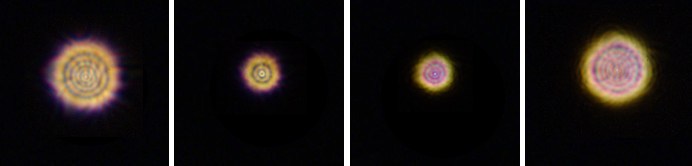
http://aberrator.astronomy.net/scopetest/html/refractor100_8.html

http://aberrator.astronomy.net/scopetest/html/refractor_100_5.html
Suffice it to say, I am VERY pleased with the optics in this refractor; with star test results(and I'm bound to irk some here with this) rivaling those refractors of much higher cost. Of course, there are some caveats; this is the second Omni OTA I've gotten from Celestron. The first was a 120mm with metal flakes between the doublet pair, and uneven coating. As I said before as well, collimation was way off out of the box. The fact that this is an achro also shows CA on bright objects, but a reasonable trade off considering the price paid for the OTA and mount together. All in all, I would highly recommend the Omni XLT refractors.
Regards,
James Sarte

