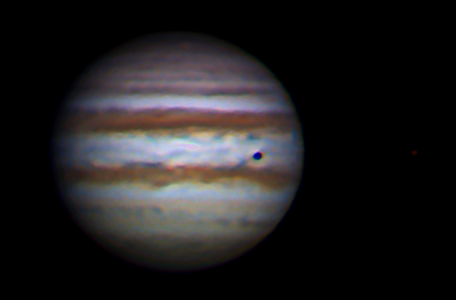
The color of SaturnPosted By Dan Newman |
In going up in aperture, this is not an uncommon observation: Saturn seeming whiter (and brighter).
In my cases, it was going from 4 - 6" refractors over to my 18" newt or between my 6.5" off axis newt
and my 18" newt. There's a big difference in light grasp and I've always figured that that was how my
eyes were responding to the significant change in brightness. The loss of some detail (brown bands)
could either be a collimation issue or too much light washing that detail out?
While the change may not seem too significant between a C14 and the 15" Obsession, my back of the
envelope calculations suggest a 1.24x increase at the focuser going from the C14 to the 15" Obsession.
(C14: 14.25" primary, 4.5" obstruction, one additional mirror [diagonal] that I'll assume to be giving 0.96
transmission; 15" Obsession: 15" primary, 2.6" obstruction; assume similar reflectivity of remaining two
mirrors in both scopes; ignore corrector plate.) So lets call it 20% more light grasp. [Of course, your
primary and secondary mirrors are likely cleaner and hence more reflective than those on a newt.] Question
is, is that enough to explain the difference? Searching around on the web, I've found reports of Saturn
appearing whiter going from 5 to 6 inch refractors (40% increase). Also ran across a review by Ed Ting
where he mentioned this as just a matter of fact consequence of going up in aperture (7" MakCass vs.
a FS102). Both of those cases are much more than 20% (or even 24%). So, while my knee jerk reaction
is that it's the light grasp, I have to wonder if there may not be some secondary effect also.
However, this doesn't explain why it seems more pronounced to you from your C14 to the 15" newt
vs. from the FS128 to your C14. Would be interesting for you to try it with the FS128 and C14
on the same night. Or, to go from your C14 to a smaller newt (e.g., 12.5, 10, 8 ) and see if your
C14 now seems whiter.
Dan

