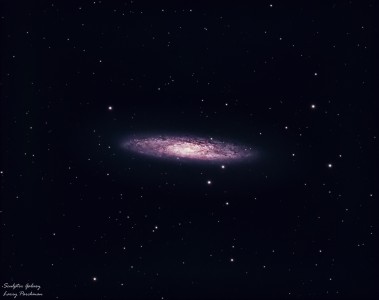
Image of the day

Captured by
Lawrence Parchman

Sculptor Galaxy (NGC 253)

My Account

New to Astromart?

Register an account...

Need Help?

Posts Made By: Lorne Johnson

August 6, 2007 07:02 PM Forum: Refractors

Re: Refractory history question

Posted By Lorne Johnson

There are plenty of uncoated refractors around today. My experience has been with an 1890 5 inch Alan Clarke, and a D & G 5 inch (both f 15). I don't believe that a visual observer will could see the difference in throughput between those and coated optics. Reflections, certainly but not throughput. (When comparing a a different coated D&G and my MN56 Maksutov Newtonian, we could tell a throughput difference on faint objects on those scopes.)

Greg Nowell said:

When Lord Rosse started his 72 inch Newt in 1840, I'd like to know what the competition was in the refractor domain. With speculum coatings he was going to get only .4 x .4 or 16% light throughput, and that was when the mirror was "fresh." So he was basically getting the equivalent of a modern 20 inch.

But refractors such as they were then didn't have modern coatings, so they probably lost a lot of light too. So here are my questions:

1. Light throughput of an 1840s era achromat doublet?
2. Maximum refractor aperture achieved in 1840?

thanks
Greg N

November 26, 2009 02:04 PM Forum: Beginning Astronomy?

Re: helical focusers

Posted By Lorne Johnson

david goldman said:

HELP! someone recently put a "wanted" ad in the focuser classified section for a particular helical focuser.the company is in the state of Washington.i don't remember the full companies name,.....optics.
the only thing they make related to telescopes is this helical focuser.does anyone know this company?,thanx, Dave.

Is it Kinesoptics?

November 30, 2002 02:13 AM Forum: Deep Sky Observing

Was this the North America Nebula?

Posted By Lorne Johnson

It certianly sounds like the N.A. nebula, which is certainly over 3 degrees across. The veil is just about 1.5 degrees across (also in Cygnus). I find both to be fairly awe inspiring, and worth the cost of a 2 inch UHC filter.

December 5, 2002 02:07 PM Forum: Equipment Talk

When is the mirror in need of a bath?

Posted By Lorne Johnson

Cleaning mirrors is when they tend to get scratched, though it is not a hard job. One should neither be terrified of the task, nor compulsive about it. It also takes a fair amount of dust to become noticeable in the image, especially as it happens gradually over time. I believe that the first effect is typically a loss in contrast and a lowering of the strehl ration.

December 13, 2002 12:26 AM Forum: Equipment Talk

Newbie question

Posted By Lorne Johnson

8" f/6 and 6" f/8 are both good choices. And a specific good deal is a good deal.

If the optics are of similar the light gathering power of the 8" is almost double. My school has three fine U Optics based 6" f/8s, and my 8" beats the stuffings out of them on deep sky (okay, the mirror is a really good one by Michael Spooner).

Focal lengths are identical, which means compactness is not much of an issue.

Weight of the 8" on off the shelf manufactured Dob's is probably more. But! You want a good plywood rocker box not that partical board stuff (it's going to be on the ground). My 8" weighs two pounds more than the school's 6" f/8 and I can comfortably carry it out of the house in one piece.

Collimation should be less critical on any f/8, and a 6" will cool down quicker. But a well ventilated mirror cell is more important than simply mirror size.

A two inch eyepiece is a real plus on these focal lengths--especially for a beginner. A 1.5" inch secondary will make for a very versatile 8" scope. Attention to detail, flocking, darkening, an astrozap type dew shield (read tube extension) can help ensure that either scope performs up to its full potential.

December 13, 2002 09:17 PM Forum: Equipment Talk

Good refractor for under $2000.00

Posted By Lorne Johnson

The jump from 11" to 4" is a big step, especially for deep sky. I would at least consider something like the D&G achromats. The views that I have seen through a 5" f/12 are impressive. You do need a hefty mount though. If you are sure to keep the C 11 then it's hard to go wrong with a smaller APO.

December 16, 2002 02:53 PM Forum: Equipment Talk

Siebert?

Posted By Lorne Johnson

I have two Siebert 21mm, the standard and the premium deep sky. I've been using them in f/6 scopes, faster scopes may not work as well. I also have a standard 12.5.

The premium deep sky's "flaws" show up most at the edges when used as a 21 mm. I used it quite a lot as a finding eyepiece in at Tak 130 epsilon. The edge is not as sharp as say a 22 panoptic, but some of that is wide angle in newtonians. It is better in my MN 56. I had less trouble with ghosting than Chris, though it is certainly there on Jupiter or saturn (and probably Sirius). The on axis sharpness is better than the 22 Panoptic I use now. The panoptic is emotionally a better view. But, when I have alternated the eyepieces, it's been very hard to say why. In the MN 56, the Panoptic maintains a flatter field and possibly better contrast. For some reason everthing looks bigger (though it isn't). So you get something for the extra $200.00.

Barlowed, the 21 mm just gets better. Edge sharpness is very good as is throughput. I've been using it with The Siebert variable barlow (which is optically excellent, though it requires a considerable range of focus to be fully utilized). It works very well in my 8" f/6 Dob, and those two pieces, 21 mm and barlow, could be used as my only eyepieces (but I'm too greedy for that). The problem is more the inconvienence of of switching to the Barlow and then pulling it out to adjust the mangification and then extensively refocusing. The rest of the Premium deep sky line is simply a barlowed 21 mm.

The Standard 21 mm does not have the Ghosting problem. Harry says that the edge is not as well corrected, but I haven't been able to observe that.

The 12.5 mm is a damn good eyepiece. It's in the same league as the TV plossls (I have a 15 and a 10.5), at least out to 50 degrees, and barlows very well. I would give an edge to the TV plossls, but I suspect that it comes from the flocking in the eyepiece barrel.

Finally, Harry Siebert is very honest and fair about his eyepieces. He will take it back if you don't like it (up to 30 days, which ought to be enough).

January 7, 2003 01:28 AM Forum: Deep Sky Observing

Handy website with seeing info, etc.

Posted By Lorne Johnson

It's certainly a good sight, and old news to the clubs and observatories that have a clock for their sight. In my experience their ratings of transparancy and turbulence are very conservative (at least by Vermont standards). Therefore, it's worth reading their explanations carefully.

January 7, 2003 01:48 AM Forum: Equipment Talk

Choose !

Posted By Lorne Johnson

Do not under any circumstances go to the eyepiece forum and read the string on Siebert's 32 mm 2 inch.

January 22, 2003 02:21 PM Forum: Deep Sky Observing

Re: How am I doing?

Posted By Lorne Johnson

Daryl, my experience pretty well mirrors yours. I did some astronomy in high school and started back in last March with a borrowed 5" Newtonian. I now use an 8 inch dob with a fine mirror and a 5 inch Mak Newt. I think that I may be one Messier object ahead of you, and you are almost certainly several galaxies ahead of me. I am sure that I am (and you are) a much better observer for finding all those objects. I agree with you that it is fun. One of the best things was finding the Helix nebula, and discovering that my friend (who has done a lot more of this than I have) had never even looked for it. I haven't read the Caldwell Objects, but there is a valuable passage in the Messier Objects where O'Meara talks about not racking up numbers of objects but observing one object for an entire night, and really learning it, finding as much as possible of what one can see in it.

The most important thing is that you enjoy what you are doing, not what anyone else thinks. I predict marital tension and a larger scope in your future, which will enable you to see more in those objects you have found as well as more objects.

Lorne Johnson