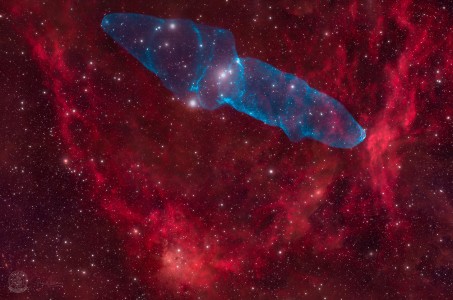
Image of the day

Captured by
Bruce Karbal

Bat and Squid

My Account

New to Astromart?

Register an account...

Need Help?

Posts Made By: Inge Skauvik

January 27, 2011 07:22 AM Forum: Deep Sky Observing

Object of January 27th: IC342

Posted By Inge Skauvik

From a real show object, we turn to a more challenging target. IC342 is a galaxy in Camelopardalis. For an observer without GoTo or setting circles it may be difficult to locate. I usually use stars in Cassiopeia as a guide to the location of IC342. From its magnitude (about 9th) one could expect that it was easy to see even in a small telescope. However, it is large and ill-defined, and may be overlooked even when located within the field of view in a telescope of considerable aperture.
The key to successful observation of IC342 is a dark and clear sky. If conditions are good enough it can be seen with 8 inches of aperture or even less. If the sky is hazy or light pollution is a problem, just forget IC342! Together with Dmitri Kulginov I observed IC342 from La Palma (Canary islands) with my 12.5-inch. Under the superb conditions at 2400m altitude it was possible to detect the elusive spiral pattern of this face-on galaxy.
IC342 is probably a relatively near neighbour to our own galaxy. Since it is at short distance from the galactic plane, it is obscured by dust clouds in the milky way. Located in a more favourable position it would have been a much brighter and more striking object.

January 28, 2011 01:41 PM Forum: Deep Sky Observing

Object of January 28th - NGC281

Posted By Inge Skauvik

For the amateur astronomer, NGC281 in Cassiopeia is an interesting combination of a diffuse nebula and a multiple star, Burnham 1. I split this posting in two, and describe the nebula here and the multiple star under the double star forum.

NGC281 is quite large and faint, and is hardly visible without a filter. In order to locate it, I prefer spotting the central multiple star which appears as a small triangle at low magnification. Having found Burnham 1, I usually see a weak brightening of the sky background in the field. Application of the O-III filter turns this featureless glow into a circular cloud with a well defined bay. The overall appearance becomes like the Packman from which the nebula got its popular name. It is a good object for apertures above 8 inches, but like all extended nebulae a dark, clear sky is needed to see it well. I have been using 63x and 115x magnification on NGC281. The higher magnification makes the sky background darker and brings out some more detail in the nebula.

January 31, 2011 01:53 PM Forum: Deep Sky Observing

Object of January 31st: NGC2420

Posted By Inge Skauvik

NGC2420 is an open cluster in Gemini. It is not among the most popular targets since it is neither particularly impressive nor really challenging. However, I find it one of the better clusters in Gemini, and well worth a look. It is located just a few degrees east and slightly north of the Eskimo nebula, and I usually visit the cluster every time I observe the famous planetary.

I usually observe this cluster at low magnification. It appears moderately compressed and rich at 30 - 50x power with 6 - 8 inches of aperture. It is the first entry in Herchels catalogue #6.

February 3, 2011 02:13 PM Forum: Deep Sky Observing

Object of February 3rd: NGC1931

Posted By Inge Skauvik

NGC1931 is a small, but very bright diffuse nebula in Auriga. Anyone making a spacewalk between the three great Messier clusters in Auriga (M37, M36 and M38) may detect it as a glowing cloud, not very far from M38. I have sometimes overlooked it, not due to faintness, but because it is so small. It is bright enough to be seen in a very small telescope. According to my sources it si a combination between an emission and a reflection nebula. I don't find it useful to apply a filter on this nebula, but it is a good idea to play around with different magnification. In the centre of NGC1931 is a triple star with 9th magnitude components.

February 7, 2011 01:00 PM Forum: Deep Sky Observing

Object of February 7th: M42

Posted By Inge Skauvik

Much has been written about the great Orion nebula, but still I would like to give my own impression of this great object. Very easy to locate in the telescope this was my favourite when I made my first attempts with a 30mm scope with fixed magnification of 20x. I was always very pleased with the greenish glow among the small glittering stars in the field. When, at an age of 15, I could trade the small telescope with a HUGE 60mm, I could, of course, see more of the nebula, and I also noticed that the sentral star was not single, but appeared to me as a triplet. Very few astronomy books were translated to Norwegian at that time, and I didn't even think about getting observation guides in English (due to limited budget), so I didn't know about the existense of the "Trapezium". If I had, I would probably seen the fourth star already then.
With my present equipment the Orion nebula is a glorious object. The visual extent is similar to what can be seen in many photos, but I find the images more delicate through the eyepiece than in photos. The colour, of course, is mostly green through the eyepiece, but under the best conditions I have an impression of seeing pink in parts of the nebula. Maybe it is just a shade of gray appearing pinkish due to contrast. Under the best seeing conditions the amount of detail in M42 is virtually endless, and even M43 becomes interesting at high magnification. From the Canary Islands I see six stars in the trapezium, while I usually can only pick out four (sometimes five) from home. I consider M42 to be the best object of all to view from home, and also the best to show occasional guests. A real beauty.

February 8, 2011 09:30 AM Forum: Deep Sky Observing

Object of February 8th - NGC2174/2175

Posted By Inge Skauvik

NGC2174/2175 is a much neglected open cluster/emission nebula combo. It belongs to the Orion constellation, but is actually so far to the north, that without a map giving the constellation boundaries most of us would believe it was located in Gemini or Taurus. In order to locate it I usually start with Eta Geminorum and point the scope to a position 2 - 3 degrees south and slightly west.
The open cluster is rather coarse, but not difficult to spot. Traces of nebulosity may be seen without a filter in a moderate telescope. With the O-III filter the nebula appears as an oval, pretty well-defined patch surrounding the cluster.

February 14, 2011 01:47 PM Forum: Deep Sky Observing

Object of February 14th: NGC2392

Posted By Inge Skauvik

There are not meny deep-sky objects suited for observation near full moon. However, some of the planetaries are bright enough to be seen quite well under moonlit conditions. The Eskimo nebula, NGC2392, is a good example. The brighter parts are visible even in small telescopes at full moon. The neubla bears magnification well, and 200 - 300x is at least needed to make out the more subtle details in it.
The best view ever I had of this planetary was with an 18-inch Dob. That time the sky was really dark, making the outer parts of the nebula much more conspicuous than I ever saw it before. The seeing was also very good that night, and I think this is essential to capture the finest details in the nebula.

To me NGC2392 appears green. Other people think it is bluish, and still others see hardly any colour at all. What is your opinion?

April 29, 2011 12:07 PM Forum: Deep Sky Observing

NGC4236 (Draco)

Posted By Inge Skauvik

I had a nice observing session the other night. This was the last chance before summer to view reasonably dark skies from my latitude. One of the objects I observed was the large and very elusive galaxy, NGC4236 in Draco. I was a bit pessimistic, since the nothern sky was pretty bright, but the great advantage for me was that the galaxy was very near zenith.

I see it very elongated and not too hard to spot with 12.5 inches of aperture. Certainly it can be seen with smaller telescopes, but I have heard about observers who missed it with much bigger scopes. An interesting challenge.

May 2, 2011 09:51 PM Forum: Deep Sky Observing

NCC4631 and NGC4656

Posted By Inge Skauvik

I should perhaps also mention this great pair of galaxies belonging to Canes Venatici but very close to the Coma Berenices border. I observed these galaxies the other night, and I was, indeed, thrilled by the sight of NGC4631 at a magnification of 167x. The galaxy is highly elongated and large and extended across almost the whole field of my Nagler eyepiece. Hints of obscuring dust clouds could be seen, and the small neighbour, NGC4627, also appeared pretty bright and clear.

NGC4656 is visible in the same low power field as 4631. It is much fainter, but still very obvious. In order to see the "hockeystick" appearance I had to use the 167x (9mm) eyepiece.

These are all "must see" objects for the observer of the spring galaxies of the northern hemisphere.

February 15, 2012 01:40 PM Forum: Deep Sky Observing

Is the visual deep-sky observer an endangered spec

Posted By Inge Skauvik

Some years ago there was a lot of activity on this forum. During the last years the activity has dropped to near zero. I sometimes wonder what the reason for this can be.
Have the active people found other, more interesting forums or blogs?
Have people started doing imaging instead of observing through the eyepiece?

Some time ago I tried to make some posts about previous observations of various objects (some showpieces and some less known objects), but the response was very low and few people read the posts.

Do anyone have any good ideas what can be done to get some more activity here?