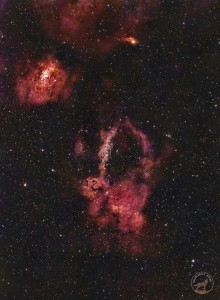
Image of the day

Captured by
Douglas Rollain

SH2-157_Seestar_S30_Pro

My Account

New to Astromart?

Register an account...

Need Help?

Posts Made By: Inge Skauvik

February 23, 2012 10:27 AM Forum: Deep Sky Observing

Do you see colour in any non-stellar object?

Posted By Inge Skauvik

Looking through magazines and internet sites it is easy to get an impression that galaxtic nebulae and even galaxies are very colourful objects. Looking through the telescope the universe appears differently. Certainly some stars (and star clusters) are coloured, but most nebulae appear pale greenish or neutral.

What is your experience? Do you seen any colour in deep-sky objects? Does large aperture help?

Inge S

March 8, 2012 09:26 AM Forum: Deep Sky Observing

Coloured stars in globular clusters?

Posted By Inge Skauvik

Another thread about viewing colour.

One of the first globulars I resolved was M3. This was 40 years ago and I used an 8,5-inch Newtonian and 100x magnification. This was really a memorable sight. To me all stars of the cluster appeared golden, and although nearby M13 is brighter and larger the sighting of M3 stands to me as the most memorable experience.
I never appreciated any colour difference between globular cluster members until I made my first observation of M4 with my 12.5-inch. The first impression of this cluster was that it was rather loose and I also noticed a wide double of brightly orange stars. The other cluster members appeared pale yellow to me.
Some time later I observed M22. In this cluster I noticed that several (20 - 30?) of the brighter stars were clearly orange and contrasting with the other stars. I also got a strange impression that these stars were located slightly in front of the cluster. This was definitely an illusion. It is easy to get a feeling that the stars of a globular are so densely packed that they would block out the light from stars inside. This is not true, of course, but can give the observing the feeling that the bright K-type stars are located in the front. To me this impression is most obvious in M22, but I also see some of it im M13 and M3.

The much brigher and larger Omega Centauri gives a different impression. I can't recollect seeing any colour there.

Do anyone else see coloured stars in the globulars?

Inge S

March 12, 2012 12:54 PM Forum: Deep Sky Observing

Structure in gaseous nebulae - what do you see?

Posted By Inge Skauvik

Of course everybody see structure in the great Orion nebula and objects like M17 and M8. But in addition to these there are numerous fainter nebulae, many of which appear like round or oval fuzzyballs.
In my experience many of these nebulae become more interesting when using narrowband filters, but even without filters some detail can often be made out with some patience.
I have a lot of favourites myself, but it would be interesting to hear about your favourite diffuse nebulae.
Let us keep the planetary nebulae and galaxies out for this discussion. We may return to them later.

Inge S

August 9, 2002 06:00 PM Forum: Equipment Talk

Night vision scope for telescope viewing

Posted By Inge Skauvik

I don't think this will work. I think that the cheaper night vision devices use infrared detectors, and I doubt that the amount of IR radiation from the stars most likely will drown in background radiation.

August 20, 2002 05:28 AM Forum: Deep Sky Observing

Albireo with an UHC filter

Posted By Inge Skauvik

Any colour filter (wideband or narrowband) will let parts of the colour spectrum through while reducing other parts. A blue filter will strongly reduce yellow colour, most probably also red and green, while blue passes more or less unfiltered. Assume you have two light sources appearing equally bright to your eye, one yellow and one blue. If you look at these light sources through a blue filter, the light from the blue light source will be much less reduced than that from the yellow light source. In many cases a narrowband filter will make a virtually invisible object stand out while pretty bright stars are strongly reduced in brightness.

I don't have a UHC filter, but an O-III. It is not suited for viewing bright objects (tends to produce double images), but it performs wonders on planetary nebulae and particularly the Veil nebula.

September 13, 2002 02:24 PM Forum: Deep Sky Observing

spokes

Posted By Inge Skauvik

Kim,

If you look for close double stars, I suggest 7 Taurii a couple of degrees east of the Pleiades. The present separation is about 0"7. In the evening you may try Eta Coronae Borealis and Beta Delphini. Both are 0"6 or slightly below. Beta Delphini is most difficult to split cleanly doe to its brightness.

One problem with sub-arcsec doubles is that their real separation also is small in most cases. Many of them are late main sequence or dwarf stars, and relatively close to the solar system. As a result of the small separation, the orbital period is low, and therefore they change separation and position angle quite rapidly. This makes double star interesting, but it is very difficult to find a relatively fixed pair below 1".

September 23, 2002 02:54 PM Forum: Deep Sky Observing

TV-102 Hot Brew: Nova Sgr 2002

Posted By Inge Skauvik

Ron,

According to theory classical novae result from some kind of mass exchange in close binary systems. You will, however, never be able to recognise them as doubles visually. As such they are out of range even for the most powerful scopes. A very high number of binary stars belong to the class "spectroscopic binaries". Due to the orbital motion in the system, the the spectral lines make periodic shifts in their position, in some cases where both stars are equally bright the spectral lines sometimes appear single, sometimes double. Therefore the spectroscope enables very presice determination of their orbital period. All three components of Castor are such spectroscopic doubles. In most cases, however, even spectroscopic doubles have too large separation for mass exchange to occur, and for potential novae both the separation and the orbital period is very low, perhaps a few hours or days.

So, missing the duplicity of Nova Sgr 2002 is no indication of poor optics of your Light Cup.

September 27, 2002 07:57 PM Forum: Deep Sky Observing

"Top ten" list of open clusters

Posted By Inge Skauvik

Clearly I'm located on the wrong place on the earth. For me it is very difficult to observe anything below - 15 degrees. In fact M46 is very near my practical limit of observation - when the sky is clear I see the foreground planetary though. M7 does not rise above the horizon, not to speak about clusters in Carina and Crux. Nevertheless, the clusters on "my" list are very pleasing to observe. BTW we have a couple of objects the southerners may envy us. The Veil nebula complex, and some very fine galaxies (M81, M82, NGC2403) and a few pretty planetaries. I suppose the Veil is visible from Australia, but it will definitely not get high in the sky.

I can't help having a dream of taking my Portaball for a week's trip to some southern location. But perhaps I'll get spoiled.

October 1, 2002 05:58 AM Forum: Deep Sky Observing

Top 10 galaxies

Posted By Inge Skauvik

Once again my favourite choices reflect the size of my telescope as well as my observing location. With an 8-inch just hints of spiral structure can be perceived in some of the larger and brighter face-on spirals whereas more detail can be seen in galaxies with large amount of dust. So here is my list:

1: M31 Dust lanes visible under excellent conditions
2: M82 The galaxy showing most detail in my scope
3: M51 Patience can reveal spiral structure
4: M33 Clearly mottled structure, hint of spiral
5: M81 Extremely bright. Nice doubles in field
6: M94 Incredible bright. Visible at full moon
7: NGC4631 Grand edge-on, nicely grouped with faint stars
8: M108 Obscuring dust visible
9: NGC2403 Major omission from Messier list (Cam)
10: NGC4889 Most distant galaxy visible in 8-inch (?)

The Sombrero galaxy can be seen from here, but it is very low. Probably it would be one the greatest favourites if I were located 10 degrees further south. There is a very high number of bright galaxies in the region Vir - Leo - CBr - CVn - UMa - Dra, many of which really would deserve a place on the list. Highly neglected is NGC4258 which is one of the brightest.

October 7, 2002 07:13 AM Forum: Deep Sky Observing

observing nebula

Posted By Inge Skauvik

Mary,

The crab nebula is small and has a relatively high surface brightness. Unless your observing conditions are very poor, you should be able to see it in your 8-inch Dob. I would recommend a power of 40 - 80x. Look for a relatively small, elongated patch of light, and don't expect to see anything resembling photographs of the nebula. The filaments easily seen in photos require a very powerful telescope.

The North America nebula is a very difficult object to observe. I have a high-class 8-inch Dob myself, and sometimes observing conditions are excellent. Even with an O-III filter, the nebula is not directly easy to see. it is very large, and you can not bring the whole nebula into the field of view - the nebula is simply too large.

The famous Veil nebula in Cygnus, also considered to be a difficult object is much easier to see in an 8-inch. But for the sake of training, I would recommend you to practice on some of the planetary nebulae first. M27 in Vulpecula is a good object, large and bright. The ring nebula in Lyra (M57) is smaller, but easy to locate, and its light output is comparable with the Crab nebula. M57 is smaller, though.

There are many gaseous nebulae within the range of an 8-inch scope, but most of them require much practice and good observing conditions. If your sky background is light or you are distrubed by ambient light, objects like the North America nebula are virtually impossible to see, and filters don't help much.