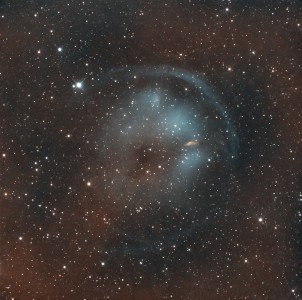
Image of the day

Captured by
Yue Ma

HFG-1

My Account

New to Astromart?

Register an account...

Need Help?

Posts Made By: Inge Skauvik

October 8, 2002 06:20 AM Forum: Deep Sky Observing

Q: best 5 objects to view right now?

Posted By Inge Skauvik

Five double stars, in order of difficulty (very easy -> moderate)

Beta Cygni (Albireo)
Gamma Arietis
Alpha Herculis (Rasalgethi)
70 Ophiuchi
Zeta Aquarii

I could have added Epsilon Lyrae, the double-double where both pairs are comparable in difficulty to 70 Ophiuchi. If your 8-inch has good optics, this list is just the beginning. You can split considerably closer pairs than Zeta Aquarii, but this will require high power, good seeing and probably some training and PATIENCE.



October 19, 2002 08:53 AM Forum: Deep Sky Observing

How to see the GRS?

Posted By Inge Skauvik

The GRS should be well within the capability of an 8-inch Newtonian with decent optics. And remember the following:

* The optics should be thermally stabilised
* Seeing must be good
* The planet should preferably be well above the horizon
* Use sufficient magnification. Possibly you will find 150 - 200x to be best
* Allow some time for your eyes to get used to the planets brightness
* The GRS should not be too far from the central meridian

The last point is important. More than two hours before or after meridian passage the GRS is difficult to see. For the first-time observer it may also be an advantage to know where the GRS is located. Scrutinise the southern edge of the southern equatorial belt. Good luck!

November 2, 2002 09:53 AM Forum: Deep Sky Observing

Polaris always visible?

Posted By Inge Skauvik

Polaris is always visible from any location on the northern hemisphere (almost, some practical and theoretical issues apply for locations near the equator).


December 15, 2002 09:47 AM Forum: Deep Sky Observing

Things that aren't there......

Posted By Inge Skauvik

What about your observing conditions? In order to see objects like the Rosette nebula, the Zeta Orionis nebulosity and NGC7000 the sky must be completely dark and transparent. Your chances of seeing anything is strongly reduced by
- scattered light from nearby populated areas
- ambient light
- thin cloud layer
- auroras

And very important: Your eyes must be dark-adapted. I always start my observing sessions with observation of planets and double stars and perhaps bright planetaries. After 20 - 45 minutes it's time to start looking for faint nebulae
If conditions are less than perfect, I often detect extended nebulosity by gently rocking my telescope (10 - 20' movements). This is a trick to enhance the small light gradients present.

December 15, 2002 10:02 AM Forum: Deep Sky Observing

What's your favorite double?

Posted By Inge Skauvik

Veyr difficult to say. I have observed some 200 - 300 doubles the last two years, and I tend to prefer close, challenging pairs, but of course I also love coloured doubles in rich star fields.

Among the brighter, coloured doules I have a special preference for Alpha Herculis. It is closer than Beta Cygni and Gamma Andromedae, and to my eyes the primary star appears deeper orange.

My personal favourite, however, is triple star Zeta Cancri. This system consists of three almost equally bright yellow stars arranged as a close pair with a more distant companion. It is a good double for small scopes at low power. But it is also a challenge for an 8-inch scope at higher power, looking very beautiful under good conditions. And it is one of the binary systems where movement is easiest to detect visually within a few years since the distant component is a good position angle reference.

January 3, 2003 06:30 AM Forum: Equipment Talk

Celestron Erfles revisited

Posted By Inge Skauvik

Interesting, and a bit strange to me, since I didn't notice any such effect in any of the four eyepieces I checked. Whenever the sky clears up (3 days or 3 months???) I will re-check the eyepieces, and look specificly for vigneting effects.

January 17, 2003 02:55 PM Forum: Equipment Talk

Low power eyepieces for new scope

Posted By Inge Skauvik

Thank you guys for your useful comments. I will probably go for a single high-end eyepiece rather than 2 - 3 cheaper ones. Perhaps a 26mm Nagler or the 31mm (have to check if I can utilise the exit pupil). Time will show.

January 17, 2003 08:08 PM Forum: Deep Sky Observing

Deep-sky observing under full moon

Posted By Inge Skauvik

Difficult question. I wouldn't be too optimistic about the effect of narrowband filters during full moon since ambient light will disturb too much. Rather try some double stars, and find out for yourself which scope is best for the purpose.

February 11, 2003 02:14 PM Forum: Equipment Talk

Vixen VC200L and VMC200L?

Posted By Inge Skauvik

Maybe the statement about 4 - 5" aperture being the maximum is true for planetary observers at very unfavourable locations. My experience is, however, quite different. I have just made the step from 8" to 12.5" aperture, and I admit I was a bit concerned about high power work since the focal ratio of the 12.5" is 1/4.5. In practice, however, the 12.5-inch proves to work beautifully both for planetary observation and close double stars. The last year I have been observing with an 8-inch f/6 Newtonian with a Zambuto mirror which delivers just great images of Jupiter under good seeing conditions. However, the contrast is almost as good in the 12.5-inch and the resolution is greater. The 12.5-inch also proves to be a powerful double star splitter, and I expect to be able to reach Dawes' limit (about 0.4") when it stops raining. And for observation of clusters and nebulae there is no question. The number of objects within reach increases with aperture, and the amount of detail also increases.

Concerning Vixen scopes: I think they generally are high quality instruments. However, If I was to purchase a new Vixen today, it would definitely be a Newtonian.

March 6, 2003 02:34 PM Forum: Equipment Talk

The Fateful Star Party

Posted By Inge Skauvik

Interesting!
Still I think you should keep in mind that some time is usually needed to get used to a different scope. I have just got hand of a 12.5-inch NGT in addition to my good old Portaball. The first evening I was out with this scope I was really put off. I had trouble with the focuser, pointing the scope to the desired target was difficult (Portaball users get spoiled), and after getting used to the 1x finder I had terrible problems with a usual finderscope.

The objects appeared brighter in the NGT than in the Portaball - no great surprise, theoretically the step in aperture should give a gain of one step on the magnitude scale. But I wasn't really able to see fainter objects in the big scope, and no additional detail on the planets could be made out.

However, after some tweaking with the mechanics of the scope, and after getting familiar with the equatorial mount and the 50mm finder, I start getting the benefit out of the aperture increase. With 12 inches of aperture the sprial structure of M51 is evident, and generally more detail can be made out on galaxies and other nebulae. Under good seeing conditions the NGT also performs beautifully on double stars and planets.
If somebody showed me the NGT at a star party I would probably conclude that this was not for me. But after 3 - 4 observing sessions I start feeling comfortable with it.

Don't misunderstand. I think it is a very good idea to try a scope under the stars before buying. But I have experienced several times that some time is needed with a scope to get the full potential out of it. It is almost like buying a new pair of glasses - you may feel a bit dizzy in the beginning.