Image of the day

Captured by
Bruce Karbal

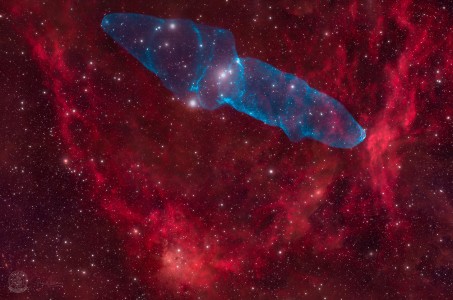
Bat and Squid

My Account

New to Astromart?

Register an account...

Need Help?

Posts Made By: Rod Kaufman

November 3, 2013 11:14 PM Forum: Deep Sky Observing

NGC 185: A Gem

Posted By Rod Kaufman

One of the few observable galaxies in Cassiopeia is a 9.2 galaxy with the designation NGC 185 or U396. I was impressed with the visual appearance of it Saturday evening in front of my home in my 16" f4.5 dob. With relatively good transparency and seeing, I was able to penetrate down to about 13 magnitude despite the ambient light pollution. I found the galaxy responds quite well to viewing with it in my 10mm Ethos eyepiece combined with a astro-tech broad band filter. The object initially appears like a large planetary nebula but inspection reveals a stellar core.
There's a link in imbedded in the following link that shows what I'm talking about:
http://cosmoquest.org/forum/showthread.php?121367-NGC-185-Ellipitcal-galaxy-with-a-blue-core-and-dust-clouds
The outskirts of the galaxy appears nebulous but the central region is star studded.
I was thrilled to see this object and I'd encourage observers with relatively large scopes to view it under dark skies and report their impressions...


December 29, 2013 06:58 PM Forum: Deep Sky Observing

First Object Photographed By 200" Hale Scope

Posted By Rod Kaufman

Discovered by William Herschel in 1783 and the variability of the associated star detected by Schmidt in 1861 with the variability of the nebula uncovered by Hubble in 1916.
Yeah, all the big names were in on this one.
I can't figure out why Floyd hasn't gunned this one yet. (Hint hint) grin

December 28, 2013 03:20 AM Forum: Deep Sky Observing

First Object Photographed By 200" Hale Scope

Posted By Rod Kaufman

In 1949, NGC 2261, Hubble's Variable Nebula, was the first object photographed by the 200" Hale Telescope atop Mt Palomar. In 1916, Edwin Hubble discovered that not only a known variable star produced a variation in this object but the nebulosity itself was also a variable source of illumination.
Although this object is described as comet-shaped, I liken it to having the appearance of a sail of a boat. I observed it Thursday evening (12-26) from my home under conditions of excellent transparency produced by very low humidity accompanying a high pressure system entrenched over California. I suspect 6.5 to 7 magnitude visual skies were likely visible from Mt Pinos during this time.
http://casjobs.sdss.org/ImgCutoutDR7/getjpeg.aspx?ra=99.78936154118313&dec=8.757267313333333&scale=0.39612&opt=&width=512&height=512
and:
http://observing.skyhound.com/archives/jan/NGC_2261.html

October 27, 2014 05:08 AM Forum: Deep Sky Observing

NGC 7094: A Challenge Object

Posted By Rod Kaufman

Described in the Observer's Guide as a "very faint" planetary in Pegasus, it's satisfying when you do see it. I observed it in my 16" while in Lockwood Valley and detected it only with the aid of an 0111 filter. It appears as a round Jupiter-sized ball with moderate to higher powers. You can try to pick it out without an 0111 but good luck on that one. The Observer's Guide says nothing about using an 0111 but it ought to so you can actually see it. I had a hunch an 0111 might do the trick and sure enough...
Mean surface brightness of 23 plus, and a total mag of about 14, you're pushing the envelope on this one!:
http://observing.skyhound.com/archives/sep/NGC_7094.html

November 21, 2014 04:21 AM Forum: Deep Sky Observing

In The Camel: NGC 1501

Posted By Rod Kaufman

Camelopardalis is a larger constellation than you might realize and it offers some impressive objects primed for winter viewing. I enjoyed viewing one of them from the front of my home on Wednesday evening, November 19.
NGC 1501, listed in the Observer's Guide as having a magnitude of 11.5, seems much brighter than it's apparent magnitude, which seems to differ depending upon the source. I found it, big and bright in my 16" dob, with a 9mm es ocular, without a filter, despite high ambient light pollution. Using a broadband filter enhances the view, and the Observer's Guide notes this planetary resembles the Eskimo Nebula in Gemini. Here's Skyhound's take on it:
http://observing.skyhound.com/archives/dec/NGC_1501.html
This object takes high power quite well so don't be afraid to crank it up!
Clear, dark and steady skies to you...

November 27, 2014 04:52 AM Forum: Deep Sky Observing

November/December Planetary Picks

Posted By Rod Kaufman

Tuesday evening, 11-25, brought high transparency and reasonable seeing in front of my home, so I rolled out the 16" dob for a tour of some winter delights. First up: IC 2126, currently well placed for observation in Auriga. While appearing stellar in the scope, it's blue color catches the eye and distinguishes it from nearby stars.
Check out Skyhound's description:
http://observing.skyhound.com/archives/jan/IC_2149.html
Next, try NGC 1514 in Taurus. Skyhound calls it the "crystal ball":
http://observing.skyhound.com/archives/dec/NGC_1514.html
I observed both planetaries with a broadband filter and a 14mm ES 100 AFOV eyepiece. Well worth the cost of admission...

January 18, 2015 05:32 AM Forum: Deep Sky Observing

January Planetary Picks

Posted By Rod Kaufman

I had hoped to do some viewing from the LAAS site in Lockwood Valley on Saturday evening, January 17, but the clear sky clock showed cloudy conditions later in the evening. The clock fared better near my home but I got clouded-out after a few hours of viewing. Nevertheless, I got some decent views of some lesser known but very interesting planetary nebula gracing our January skies.
First up, a fine double-lobed planetary in Gemini, NGC 2371-2:
http://www.skyhound.com/observing/archives/feb/NGC_2371.html
Although skyhound pegs it at magnitude 13, The Observer's Guide logs it at 11.3 and I feel the latter is more accurate as I picked it up fairly easily in my 16" with a CLS filter and a 14mm ES eyepiece, despite high ambient light pollution. It looks like a micro-version of M76, the little dumbbell, in my rig.
Swing over to Orion and check-out NGC 2022, and at 12 magnitude, it still appears bright and, to me, looks like an egg:
http://observing.skyhound.com/archives/jan/NGC_2022.html
and:
http://www.noao.edu/outreach/nop/advanced/observers/n2022.html
I hope to see them under a dark sky soon...


February 12, 2015 04:58 AM Forum: Deep Sky Observing

Best Galaxy Pick: February Skies

Posted By Rod Kaufman

I was observing in front of my home on Tuesday evening, 2-10, and although springtime and the realm of the galaxies hasn't arrived yet, one constellation riding high in the nighttime sky beckons for exploration.
The constellation is Lynx and the galaxy is NGC 2683. At magnitude 9.8, my guess is that Messier missed it, and at a 9' x 1.5' image in a 16" scope, details including mottling and bright knots are readily visible even in a light polluted sky with a broadband filter. Simply put, this is a real gem that might otherwise be overlooked when other fine winter constellations offer nebula, open clusters, and planetaries. More info:
http://en.wikipedia.org/wiki/NGC_2683
Lynx offers other interesting galaxies and I picked off a few more, including NGC 2537, the bearpaw galaxy, aptly named, and NGC 2782, visible only with the aid of a broadband filter from my location. I could also detect a few of the brighter members of the Abel 779 galaxy cluster and I hope to view them from a dark sky soon...

July 18, 2015 04:06 AM Forum: Deep Sky Observing

The Bug Nebula: NGC 6302

Posted By Rod Kaufman

Big and bright, it reminds me of a termite. The Bug nebula, now crawling at the bottom of Scorpio...
After spending two nights during the new moon week in July at the LAAS site in Lockwood valley, I observed some interesting objects. With SQM readings varying from 21.15 to 21.40 and seeing rated at 3-4/5 and transparency 4-5/5, the summer sky was good enough to offer some fine views of deep sky splendors.
While bottom fishing in Scorpio, don't forget to check-out another fine planetary nebula, NGC 6337, 40" in diameter and appearing pale blue in the eyepiece, it appears brighter than its listed 12.3 magnitude. Pop in an 0111 filter to discern NGC 6357, a large emission nebula embedded in an open cluster. Leave the 0111 filter in place and observe NGC 6334, a large and complex emission nebula with four large components. I used a 31mm ES 2" 82 AFOV eyepiece with my 16" f4.5 dob to see it. With the 0111 filter still in place, IC 4628 arcs across the field, reminding a bit of the cap of Thor's Helmet.
While observing in Ophiuchus, don't forget to observe NGC 6369, the little ghost nebula, reminiscent of the ring nebula in Lyra. A notable galaxy in the same constellation is NGC 6384, appearing big and bright in my scope.
Suffice it to say that I hit just about any globular cluster visible from my latitude along with planetaries in Cygnus and Aquila. I started the evening with views of galaxies in CV until the other constellations rode a bit higher in the summer skies.
Wishing you clear, dark and steady summer skies...

August 19, 2015 03:26 AM Forum: Deep Sky Observing

August Nights At The LAAS Site

Posted By Rod Kaufman

Saturday evening at the LAAS site in Lockwood Valley was splendid with the milky way arching overhead and seeing and transparency were quite good especially after midnight.
After touring numerous planetaries in Aquila, Cygnus and a bevy of nebulous objects throughout the milky way, a couple of objects stuck in my mind as pleasant surprises. First up, a nice 11.2 galaxy in Aquila, NGC 6814, appears rather large in a 10mm Ethos eyepiece in my 16" dob. In a constellation doted with planetaries, it beckons close attention:
http://dso-browser.com/dso/info/NGC/6814
Speaking of planetary nebula, check out NGC 6742 in Draco, a faint but rewarding planetary nebulae:
http://dso-browser.com/dso/info/NGC/6742/planetary-nebula
While in Darco, pay a visit to NGC 5866, a galaxy thought to represent the missing m object in the messier catalog known as m102:
http://apod.nasa.gov/apod/ap060612.html
I saw a wealth of dso objects on a fine night but I closed out the evening checking out the extensions on the Saturn nebula in Aquarius followed by nice views of Uranus and Neptune. A super summer night!