Image of the day

Captured by
Yue Ma

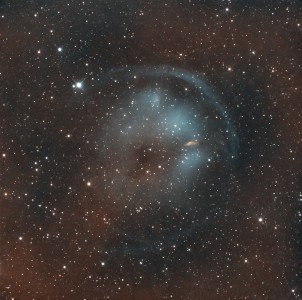
HFG-1

My Account

New to Astromart?

Register an account...

Need Help?

Posts Made By: Inge Skauvik

March 21, 2003 11:53 AM Forum: Solar System Observing

Io Does Its Thing, 2003/3/19 UT

Posted By Inge Skauvik

I also followed an Io transit a couple of weeks ago with my 8-inch Portaball. Both seeing and transparency were excellent, only occasionally the images trembled slightly. I didn't know which moon was transiting, but just accidentally turned my scope towards Jupiter just before second contact. Looking for a bright satelite disc towards Jupiter's surface I failed to see the moon itself in the beginning. However after a while I saw the small, dark spot moving along the equator, and then I realised that it was Io. The last minutes before the end of the transit Io appeared as a bright spot (not dark any more) against the darker limb of the planet. The shadow, of course, appeared as a punched hole in the planet all the time. The contrast of the features of Jupiter's atomsphere was excellent this evening. During the last part of the transit the GRS appeared, and a lot of smaller features were visible in Jupiter's belts. I used a 5mm ortho for the observation, giving 240x power.

April 7, 2003 05:06 AM Forum: Equipment Talk

Split-tube Dobs?

Posted By Inge Skauvik

On the European web-site of Markus Ludes there used to be some information about a Japanese split-tube Dob called Ninja. I haven't visited the site for some time, and can therefore, not tell if it is still there. Personally, I decided to go for the Portaball 8-inch, and I think this will be my choice whenever I upgrade to the 12 - 14-inch size. The Ninja could be transported by a standard (Japanese) car, but the larger models would be quite cumbersome to transport manually.

April 15, 2003 05:32 AM Forum: Deep Sky Observing

Viewing the Red Spot

Posted By Inge Skauvik

I fully agree that the timing is important for viewing the GRS. It is MUCH easier to see during the two hours around meridian passage than at other times (while still theoretically visible).

Another issue when looking for detail on Jupiter: Spend suficcient TIME to adapt your eyes to the elusive colour contrast on the planet's surface. I have very often experienced to see almost nothing on Jupiter to begin with, but after some minutes detail starts appearing. During a longer observing session it is also wise to re-observe Jupiter several times. Seeing often improves during the first hours after sunset, and the rapid rotation of Jupiter brings in new features all the time, even when the GRS is absent. Good luck!

April 17, 2003 05:44 PM Forum: Deep Sky Observing

OT: Whirlpools in Space?

Posted By Inge Skauvik

Clockwise????
As seen from which direction?

April 25, 2003 12:01 PM Forum: Deep Sky Observing

Spring the Season of galaxies. Boring...

Posted By Inge Skauvik

Vladimir,
With an aperture of 10 inches you should be able to see some variation among the galaxies, even with some light pollution present. I generally enjoy galaxy observation, and find it rewarding even with small aperture. Maybe it isn't interesting to you, but I will briefly describe my personal approach to galaxy observation.

1: I always identify the galaxy I look for (Normally I decide beforehand which objects I want to observe and locate it by star hopping or triangulisation.)
2: I gather as much information about the galaxy as possible before observing (distance, type, absolute and apparent magnitude etc.)
3: I note down the details I can see through the scope. Apparent size (e.g. 5' by 15'), brightness (subjective), presence of particular features (bright core, obscuring clouds, any sign of spiral pattern)
4: Any near neighbours/satelite galaxies present?
5: Foreground stars?

I see less variation among the globular clusters than among galaxies. But still they are great to view. And whenever I want to relax from the galaxies, there are always some double stars around.

April 27, 2003 10:46 AM Forum: Deep Sky Observing

Re: intersection of solstice and galactic equator

Posted By Inge Skauvik

Sorry, it was a bit early in the morning. However, the 6 and 18 hour point follow from the definition mentioned in my previous post, and the fact that we have the intersections at those points is time dependent and a matter of chance. In 6000 years or so both the ecliptic, the galactic equator and the earth's equator will intersect at the same point, since the vernal equinox (and the 0 hrs RA) then will be located near the Taurus/Gemini border.

May 5, 2003 06:04 PM Forum: Equipment Talk

Which is the best scope?

Posted By Inge Skauvik

I would like to emphasise, though, that the NGT is not a bad scope either. I use to keep it at outside temperature, therefore temperature equalisation is no issue (but I have to switch the heat off when driving to the observation site). And with some assistance, set-up is done in less than 10 minutes. Therefore it is a good club scope, and just fine for demo purposes when tracking is an advantage. I try to keep the balance between deep-sky, planetary and double star observation. And I can go very deep with the 8-inch Portaball under the best conditions with tremendous detail in hte Veil nebula. The 8-inch also shows absorbing clouds in some galaxies very well - I would say better than the 12.5-inch. For spirals, however, the structure is muche more easily seen with the larger aperture.

One curiosity: When I got the Portaball I was used to finderscopes with some aperture and magnification, and I struggled for a few hours getting used to the 1x QuickFinder. Within a few weeks, however, I changed my approach for locating tings, switching to triangulisation rather than star-hopping. The NGT is equipped with a 9x50 finderscope. When I started using it I felt completely lost due to the reversed image and the number of stars visible. Such a finder is definitely not suited for triangulisation. Fortunately, there is a guy in our astronomy club who loves to operate the digital setting circles.

The NGT/Portaball combo is great as long as I have somebody to observe together with. And some club members may be interested in imaging. But as a single-user general purpose visual scope, the Portaball is hard to beat. Due to the central obstruction it can not stop the mouth of the APO community, but personally I never miss a refractor.

May 7, 2003 05:55 AM Forum: Deep Sky Observing

It isn't fair....

Posted By Inge Skauvik

Mosquitoes and astronomy - a very interesting combination...
I hardly thought it was possible. The idea about going somewhere is, of course, great. Florida is a bit far away but interesting. Slovenia sounds nice, and is not too far away. Russia is an option for me, but I hesitate taking my Portaball there.

A dark site with a view of Scorpius and Sagittarius and 0.6" seeing would be my dream. This would keep me busy for a week or two. The option of observing under mosquito temperatures also sounds appealing. However, I don't need the mosquitoes.

The limitations are time and economy. With four weeks of summer vacation and a passion for fly fishing (which normally is limited to June - August here) it isn't easy to make the right priorities.

I have sometimes considered travelling to the US to pick up a scope. The freight cost for a 2000$ scope is probably more than the cost of the round trip by air. When I decide to go for a 12.5-inch Portaball... Maybe...

May 12, 2003 06:45 AM Forum: Equipment Talk

Seeing structure cheap

Posted By Inge Skauvik

When coming to structure in the galaxies, my experience is that going from 8 to 12 inches of aperture helps a lot. However, I find the dark features of some galaxies, e.g. M82 and M108 relatively easy to capture in the 8-inch Portaball. It is also possible to make out the spiral structure of M33 and M51, but this requires great sky transparency as well as some patience. The importance of magnification should also be emphasised. With the 8-inch I see most detail in galaxies with a magnification in the range 100 - 170x.
With an aperture of 12.5 inches, the spiral structure of M51 in obvious at first glance under dark skies. M101 is more difficult, but with some attention the structure can be made out. The spiral arms of M81 are also possible to see with direct vision in the 12.5-inch. In fact, this surprised me a bit, since it is far more difficult to see any structure in M99 and M100. This may, of course, partly be due to the location of my observing site. There is some city light interfering.

The objects showing the greatest amount of structure in the scopes I have used are still the great Orion nebula and the Veil which shows a tremendous amount of detail even in the 8-inch using an O-III filter.

May 14, 2003 12:58 PM Forum: Deep Sky Observing

Full Moon

Posted By Inge Skauvik

Try some double stars! Except for Orion, the highest concentration of appealing, easy-to-locate doubles is in the Bootes/Draco/CBr/Hercules region.