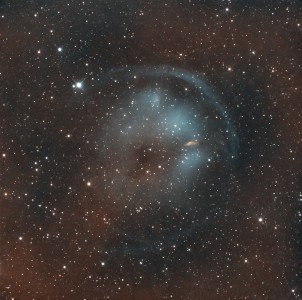
Image of the day

Captured by
Yue Ma

HFG-1

My Account

New to Astromart?

Register an account...

Need Help?

Posts Made By: Inge Skauvik

November 10, 2004 08:26 AM Forum: Deep Sky Observing

Triangulum Galaxy (M33)

Posted By Inge Skauvik

Under dark conditions and transparent skies hints of the spiral structure of M33 can be med out with an 8-inch scope. Increasing the aperture form 8 to 12.5 inches makes a great difference. Several of the galaxy's emission regions become visible, and the spiral structure becomes much more obvious.

I have observed M33 with different magnifications, and it seems to me that with a 12.5-inch scope 100 - 120x gives the best views.

Most observers agree that M33 is more elusive than would be expected from its integrated magnitude. I recommend novice galaxy observers to try M81 and M82. They are both well defined, and have a high surface brightness. And they are so close to each other that they can be viewed together in a low power field.

Inge S

November 12, 2004 02:32 PM Forum: Deep Sky Observing

Apparent Size

Posted By Inge Skauvik

When speaking about apparent size of small objects, we normally express the size as an angle. The moon's apparent diameter is about 0.5 degree, corresponding to 30' (arcminutes) or 1800" (arcseconds).
Jupiter, which appears as a sizable disc in the telescope has an apparent diameter of about 40".

Generally the apparent diameter of the stars is extremely small. Due to the undulatory nature of light, they appear as discs when looking through the telescope. The size of this disc depends on the aperture of the telescope. In a 5-inch telescope the diameter of this diffraction disc is about 1" (arcsecond).

If we move the sun 10 light years away, its apparent diameter would be approximately 0.003". Most stars are much further off, and if their diameters are comparable of that of the sun, they will appear even smaller. There are a few very rare giant stars whose diameter are maybe 100 - 200x that of the sun. If such a star was 10 light years off, it would be possible to see its apparent disc in a big amateur telescope. Unfortunately (or perhaps fortunately) we have no such supergiant stars in our near neighbourhood. Betelgeuse is several light years away, therefore its diameter is about 0.05". Therefore we see the diffraction image of the stars in our telescopes, only the
greatest telescopes being able to make out the diameter (and surface features if present) of the nearest supergiant stars.

Inge S


November 15, 2004 09:00 AM Forum: Deep Sky Observing

TMB80 first light

Posted By Inge Skauvik

Great report, Anthony!
As always I get envious reading about all the nice southern objects.

But it must be strange to view the Pleiades and Hyades upside down....

Inge S

December 9, 2004 01:27 PM Forum: Deep Sky Observing

Open clusters and nebulae

Posted By Inge Skauvik

I really hope for a clear night soon. Always look forward to the time when the nebulosity of Orion and Monoceros gets favourably placed for observation.

With a small scope I would go for Hubble's variable nebula (NGC2261). Monoceros contains other interesting nebulae too. Most famous, but probably least interesting viusally is the nebulosity involved in NGC2264 (Christmas Tree) with the Cone Nebula. The reflection nebulae NGC2245 and 2247 are far more interesting objects, although they are probably best suited for 10-inch scopes or larger. For observers equipped with the O-III filter and sufficient aperture I also recommend looking for detail in the Rosette nebula. Failing to spot the Horsehead in Orion, it is always a good comfort to see the bok globules of the Rosette with direct vision.

Inge S

December 14, 2004 07:07 AM Forum: Deep Sky Observing

NGC6939/6946 in small aperture

Posted By Inge Skauvik

Dmitri,
I don't have a small scope, but I have observed the objects many times. Generally it is a bad idea to start the session with such faint objects - they require good observing conditions and dark-adapted eyes. Under suburban skies the galaxy, NGC6946, is a difficult object in an 8-inch in my experience. Good conditions, however, work wonders. The cluster is one of the best open clusters in the northern sky.
With 12.5-inches of aperture, dark conditions and transparent atmosphere this cluster/galaxy combo is a great view at low magnification. I have, however, never been able to make out the spiral structure of the galaxy.

Inge S

December 20, 2004 02:47 PM Forum: Deep Sky Observing

Observation of small DSO's

Posted By Inge Skauvik

Since visual observation of extremely subtle features like the M87 jet is possible, I would also expect that some detail should be possible to make out in some of the planetaries. What can be seen in NGC6543(Cat's eye) or 7662 in Andromeda? I'm highly interested in observation reports of the brighter planetary nebulae with telescopes in the aperture range 10 - 15 inches.

Inge S

February 7, 2005 09:28 AM Forum: Deep Sky Observing

Colors in M42

Posted By Inge Skauvik

Russ,
Vam obyazatel'no k vrachu! (Joke)

I have never used a scope bigger than my 12.5-inch, and can't claim to have any experience seeing colours in M42. I just wonder if some of the impression of seeing colour is a result of the fact that green and pink are complementary colours. At least, this would enhance the colour difference.
I have a feeling of seing elusive colours in M57. I suppose that most observers would call M57 grey in my telescope, the outer part of the ring being significantly brighter than the inner part. Possibly, what I'm seeing is a greenish blue inner part and since the outer part is more neutral, I get the impression that this part has a faint red colour.
Still, I have read many reports from people claiming to see pink whisps in the Orion nebula using large aperture scopes, and I wouldn't call this nonsense. Dmitri's comment about surface brightness, is, of course, correct, but people's colour vision varies a lot. And I have a secret dream of seing the colours of the Orion nebula with my own eyes.

Inge S

March 3, 2005 03:10 PM Forum: Deep Sky Observing

First dark, clear night in three months

Posted By Inge Skauvik

One of the objects observed 2nd of March was M101. This is one of my favourite objects, but that evening I wasn't able to make out much of the elusive detail of the galaxy.

I realise that I made a couple of great mistakes. With my aperture, the eyes have to be fully dark-adapted in order to see the emission regions in the spiral arms of M101. During the previous session, I observed the galaxy about 5 minutes after switching off the lights of my car.
The second mistake was spending too little time on the object. For elusive spirals I often find it useful to observe for 10 - 15 minutes to capture the faintest features.
Finally, I used too little magnification (63x). It would probably be beneficial to be in the 80 - 100x range. At low power the sky background becomes pretty bright in the 12.5-inch, and higher magnification helps making out detail.
Therefore, last session's observation of M101 was rather disappointing. I could see the spiral pattern and some foreground stars, but I know from previous experience that it is possible to see much more on M101. Just a reminder to myself and whoever reads this post: The judgement of a scope's performance should not be based on a single observation. Conditions most be ideal (dark adaptation, transparency, ambient light, magnification, cleanness of optics, use of light shroud) in order to push a scope to its limit, and the way from success to failure is very short for features near the limit of detectability.

Inge S

March 15, 2005 06:37 AM Forum: Deep Sky Observing

Dust lane in bridge of M51/a line from Coleridge

Posted By Inge Skauvik

Impressed!
Both the Coma Cluster and M51 must be awesome sights in the 40-inch. What about M101? I assume that the emission regions and spiral structure stand out well with that aperture.

Inge S

March 16, 2005 08:29 PM Forum: Deep Sky Observing

Different galaxies - different magnification

Posted By Inge Skauvik

A friend of mine referred from a star party in Germany that the experienced guys played around with different eyepieces for different galaxies. He told me that just changing from a 13mm to a 17mm eyepiece made a lot of difference, and in some cases the 13mm was best, in other cases the 17mm.

My set of eyepieces is small right now, and I have a gap between 63x and 167x magnification(exit pupil 5mm and 1.9 respectively). For M33 63x is too little, but 167x is definitely too much. For M82, on the other hand, 167x seems to be a very good choice. For M51 I suspect that a magnification in the 120 - 140x range would give the best views.

I had a very strange experience with NGC891 last autumn. I wanted to check it with my 9mm Nagler (167x), but put in the 4mm Radian (375x) by mistake. To my surprise the equatorial dust band beautifully appeared - in fact it was better at the high magnification than with the 9mm.

Inge S