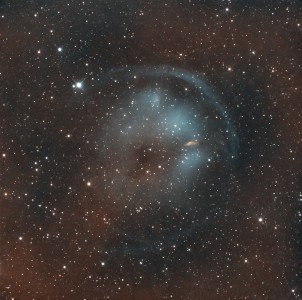
Image of the day

Captured by
Yue Ma

HFG-1

My Account

New to Astromart?

Register an account...

Need Help?

Posts Made By: Inge Skauvik

March 18, 2005 01:54 PM Forum: Deep Sky Observing

Campbell's Hydrogen Star

Posted By Inge Skauvik

Kim,
I have also tried to find this one without success (and considerably smaller aperture). I tried to spot it by its colour, but there are so many stars in the field and I didn't figure out any smart star hops.

Inge S

March 31, 2005 11:05 AM Forum: Deep Sky Observing

Spoiled

Posted By Inge Skauvik

Last night we made a second session with the 18-inch. The optics (f/5 Swayze mirror) were carefully collimated. Observing conditions were considerably better than the previous night, and around midnight seeing was superb.

We trained the telescope on many different types of objects. Among the galaxies were both bright ones with much detail (M51, M61, M64, M65, M66, M104 and M100) and faint smudges (Copelands septet). M104 is very low in our skies, but it was awesome in this scope, and one of the objects making the strongest impression on me this night. Also the black eye was a grand sight.

The Eskimo nebula in Gemini with a 9mm Nagler and an O-III filter was another highly impressive sight. Now, at last the real "Eskimo shape" was plainly visible, with much of the fine structure in the nebula very sharp and clear.

For me as an avid double star observer, Zeta Cancri, represented the ultimate moment of truth. At a magnification of 380x (6mm Radian) the scope showed a perfectly sharp image. The gap between the stellar discs was wide enough for another disc in between, indicating that this scope would happily handle a 0.4" double at these seeing conditions.

The scope also proved superb on Jupiter and Saturn. Images were sharp with great contrast on both planets, and intricate detail could be seen in the bands of Jupiter.

I do not plan to acquire a big Dob for myself after this. The drawback of such a scope is, of course, size and weight, and even though it was home made, it is a considerable investment. But this experience may influence my future way of practicing amateur astronomy. Fortunately the owner of the 18-inch is a member of our local astronomy club, and I look forward to many sessions where we cooperate. Travelling and trying other people's scopes is another option. And I'm still the happy owner of a grab-and-go 12.5-inch Portaball which is a winner when comes to efficiency and ease-of-use. But the images in the big scope are worth to die for....

Inge S


May 3, 2005 05:52 AM Forum: Deep Sky Observing

NGC 5248 Observation

Posted By Inge Skauvik

Superb drawing! This object must be attractive even with smaller telescopes, but I don't have it in my own records.

Inge S

May 5, 2005 06:55 AM Forum: Deep Sky Observing

NGC 5907 Observation

Posted By Inge Skauvik

Compare this one with NGC4244 in Canes Venatici. Which one is the best?

Inge S

May 10, 2005 02:24 PM Forum: Deep Sky Observing

A different kind of deep sky report

Posted By Inge Skauvik

Kim,
Surely awesome views. Also interesting to notice that a BIG SCOPE owner can appreciate the views through binoculars (King size, though).

Inge S

June 3, 2005 05:53 AM Forum: Deep Sky Observing

June DSO List

Posted By Inge Skauvik

I recommend NGC5466 - globular cluster in Bootes. It is not a show object, but rather a challenging target that is easy to miss in spite of being a 9th magnitude object. It is relatively large, and the average surface brightness, therefore, is low.
5466 reminds me of the "ghost of M53", NGC5053. Even though both are very faint, individual stars can be seen in these clusters with average sized scopes. I need 12.5 inches of aperture, but a keensighted observer under dark skies will need less.

Inge S

June 9, 2005 06:57 AM Forum: Deep Sky Observing

Last Messiers from Caribbean

Posted By Inge Skauvik

Hi Dmitri,
Which of the "Nordic" galaxies would you say is most similar to M83 in size and brightness?

Inge S

August 24, 2005 01:21 PM Forum: Deep Sky Observing

Galaxy Distribution by Type

Posted By Inge Skauvik

Interesting issue, but quite complicated.

One suggestion is to take distance into account as well as the distribution over the celestial sphere. For this, Burnham's probably does not provide sufficient information. Sky Catalogue 2000 (Vol.2) would probably be a better source. At least the radial velocities of the listed galaxies can be found there.
Also notice that considerable variation can be observed when small samples are taken from a random distribution. I sometimes have the feeling that statistics contradict common sense.

Inge S

September 1, 2005 05:45 AM Forum: Deep Sky Observing

One for Inge

Posted By Inge Skauvik

Dmitrij,

You are right, indeed. I love this object, and I often return to it. The Burnham multiple is so delicate, and the entire field of view is very pleasing. Not a challenge for those hunting for the faintest DSO or closest double, but recommended for everyone.

Inge S

September 16, 2005 05:58 AM Forum: Deep Sky Observing

Astro trip to the south

Posted By Inge Skauvik

Thank you, all!
Of course, I have access to information about this region of the sky through my observing guides (Burnham's, DSOG). Still I suppose that some of you who regularly observe beyond my horizons have your favourites (In practice I can't go much further south than the Sombrero galaxy). I know that there are some good doubles in Lupus and also assume that some of the nebulosity in Scorpius.
Naked eye and binocular observation is a good point. It's a pity that Alpha Crucis doesn't reach the horizon of the Canary Islands. But a first time view of Alpha and Beta Centauri would be a great experience, and since the air transparency is excellent at that site, I think chances are good for spotting them. I'm a bit less optimistic about Eta Carinae.
Still I'm sure that the "new" region accessible from the Canaries will keep me more than busy for one week. Next step will probably be to make a trip to the same latitude during autumn. Later, of course, I hope to travel still further south to get access to the rest of the sky, and get the southern constellations even higher up in the sky.

Inge S