Image of the day

Captured by
Erwin Forbragd

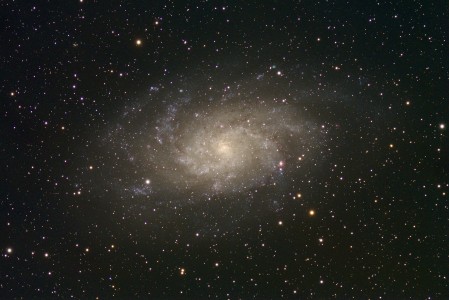
M33 in Triangulum

My Account

New to Astromart?

Register an account...

Need Help?

Posts Made By: Inge Skauvik

February 12, 2003 02:20 PM Forum: Equipment Talk

Use of Barlow to flatten field of fast scope?

Posted By Inge Skauvik

I am looking for a good low power wide-field eyepiece for an f/4.5 Newonian. Using wide-field eyepieces in the 20 - 24mm range gives some coma at the edges, and this makes me consider a combination of a 1.5x Barlow and a longer f.l. eyepiece as an alternative. Any recommendations?

Additional question: Has anyone tried the GTO Proxima 31mm/1.5x Barlow combo, and in case, how good is it?

March 7, 2003 09:54 AM Forum: Equipment Talk

Celestron Super Plossls - once more

Posted By Inge Skauvik

The Celestron Super Plossls are no longer manufactured. I was so lucky that I had the chance to borrow 4 of them from Antony Allsobrook, NZ for thesting them with two different Newtonian scopes. In a previous post I gave some preliminary statements based on the experience using an 8-inch f/6 Portaball. Now I also had the chance to try them with a 12.5-inch f/4.5 NGT.

The Celestron Erfles come with focal lengths 16, 20, 24, 28 and 32mm (all 1.25") and I tried all except the 32mm. In my opinion all are great eyepieces. The field of view is somewhere in the 65-70 degree range, and the image is bright and sharp. With the f/6 scope all eyepieces were sharp to the edge, and at 43x power double stars with 4" separation were split. Using an O-III filter the 28mm gave beautiful images of objects like the Veil and North America nabula.

With the f/4.5 images were still decent, but when focusing on an object near the centre, the edges became slightly unsharp. Once noticed, this was a bit annoying.

The eye relief of these eyepieces permits observation with glasses, but still I experienced no blackout problems. In my opinion they are GREAT eyepieces for low power use with scopes with f/6 focal ratio. With faster scopes, there may be a need for a coma corrector.

March 14, 2003 01:49 PM Forum: Equipment Talk

Comparison between two Newtonians

Posted By Inge Skauvik

Yesterday evening I put up two telescopes side by side, my own 8" Portaball and my club's 12.5" NGT. No night for deep-sky, but seeing turned out to be great. Setting up the Portaball took 2 minutes, while I needed 20 minutes with the NGT, and even after so much time I wasn't satisfied with the collimation. There was a satelite transit in progress on Jupiter, and after a short time the GRS emerged. The Portaball gave excellent images at 240x, the shadow looked as a neat punched hole in the planet's disc, and even the satelite (haven't identified it) was clearly visible against the planet's surface. The cloud belts showed a wealth of detail, and contrast was great. In comparison the images of the NGT were lousy. The shadow was hardly visible, and none of the intricate detail in the planet's belts could be seen. To be fair: Handling the NGT for a single person is rather tough, and I should probably have spent another 5 minutes with the collimation. And for deep-sky purposes the extra aperture definitely is an advantage. But 90% of the time yesterday night I spent with the Portaball.

April 24, 2003 01:15 PM Forum: Deep Sky Observing

Spirals!

Posted By Inge Skauvik

Being able to see the spiral structure in galaxies directly through the telescope, has always been a dream of mine. However, I have mostly been limited to small scopes, and the 8-inch Portaball which has been in my posession for nearly two years now only shows hints of spiral structure in M51 and with some patience, in M33. Lately, however, I had the opportunity to use a 12.5-inch NGT. With this aperture, the spiral structure of M51 is obvious, and it is also possible to glimpse the arms of M81. With some patience some structure is seen in M101. However, I have so far not been able to see any spiral pattern neither in M99 nor M100. (Light conditions have not been optimal. There has always been some scattered city light interfering, and at my latitude auroras can be quite annoying. This season we had some of them every night.)
It would be interesting to hear about other observers' experience with observation of spirals with apertures in the 10 - 14-inch range. What is possible to achieve? In which galaxies is the spiral pattern easiest to see visually? What magnification is best?

April 27, 2003 05:47 AM Forum: Deep Sky Observing

Re: intersection of solstice and galactic equator

Posted By Inge Skauvik

Just a small correction: The intersection points are at 0 hrs and 12 hrs RA. This is not a coincidence, but simply a matter of definition. The zero point of the Right Ascention scale had to be put somewhere, and the vernal equinox point was selected for this.
"Unfortunately" the equinox positions move slowly due to the earth's precession. Therefore, all star tables and maps have to be updated at intervals. I have a mess in my own bookshelf with a mixture of 1950.0 and 2000.0 coordinates.

April 30, 2003 05:46 AM Forum: Deep Sky Observing

Re: M94

Posted By Inge Skauvik

The core of M94 is bright, indeed! However, it has a rather extended faint halo which makes the galaxy's average surface brightness more moderate. Just a pity that the galaxy shows so little structure. I doubt that the tight spiral arms visible in photographs can be seen visually even in the greatest Dobs (Comments????)

While in Canes Venatici, look for the elegant galaxies NGC 4490/4485 very near Beta CVn. I associate this galaxy pair with two playing goldfish.

May 5, 2003 12:45 PM Forum: Equipment Talk

Which is the best scope?

Posted By Inge Skauvik

This spring I had two scopes for my disposal: an 8-inch Portaball and a 12.5-inch NGT. Both scopes are Newtonians, but they quite different when comes to ease of handling as well as optical performance. Since I never looked through a 12.5-inch before I was very keen, of course, to try the NGT, and during the first weeks this was my first choice whenever the sky was clear. The NGT is equatorially mounted with clock drive, hand control and digital setting circles. But it is a heavy beast and it quite difficult to handle without a second person helping. The Portaball has no drive option and has to be pointed manually, but it is extremely easy to transport and handle.

Optically the Portaball is the better scope, and for planetary detail and appealing views of double stars the NGT could not match it in spite of 50% larger aperture.
For deep-sky purposes the NGT was the clear winner. The extra step on the magnitude scale made all star clusters much more impressive, and more detail is within range in galaxies and nebulae than in the Portaball.

I can live without digital setting circles, but I admit that they are convenient wherever there are few reference stars available.

Weight is an important issue for me. In the long run I think the Portaball would see more use than the NGT. One-man set-up time is about 30 minutes for the NGT and 2 - 3 minutes with the Portaball.

If I owned both scopes (which I don't) I would trade them for a 12.5-inch Portaball.

May 6, 2003 01:59 PM Forum: Deep Sky Observing

It isn't fair....

Posted By Inge Skauvik

I probably complained about this a year ago, but when May comes I always get struck by envy against people living further to the south. At 59 degrees north there is nothing but disadvantages.

First of all, a significant part of the sky is never visible from here. Antares can just be glimpsed above the southern horizon, and telescopic observation further south than Sirius is out of question. For decent resolution we have to stick to the northern hemisphere.

This strongly limits our chances to observe the planets. Jupiter has been well placed the last few years, but as soon as it passes down to Virgo, it will be blurred by the atmosphere 99% of the time, and we will have to wait for 4 - 5 years until we can expect to see any amount of detail again. The coming Mars opposition will be a flop as seen from here.

But worst of all is the summer. Now we don't get dark skies until the end of August. And if we get clear skies, there is a great probability that either the moon or the aurora will interfere.

Any advantages? Ursa Major, Ursa Minor, Cepheus, Cassiopeia, Draco and much of Camelopardalis and Lynx are circumpolar. Who would really care for this?

May 14, 2003 10:16 AM Forum: Equipment Talk

Most beautiful scope - and the ugliest one

Posted By Inge Skauvik

When buying a telescope, I suppose most of us base our choice on price/performance. However, I admit that my choice also is partly influenced by the exterior look of the telescope. I'm not completely sure which external features appeal to me. However, if I was to choose a scope based on external looks only, my choice would be the 80 mm William Optics Megrez. This is, of course, my personal opinion, and others may have a different taste.

Ugliest commercial scope? Probably not well known in the US, but I vote for the AOK 110 mm Kutter Schiefspeigler (see attached image). This scope reminds me more of a moonshiner's outfit than an astronomical instrument. (AOK has a very interesting line of products, however. Both the Kutters and the AOK Newtonians are probably very good instruments).

May 20, 2003 12:23 PM Forum: Equipment Talk

UO High Definition orthoscopics

Posted By Inge Skauvik

A new line of orthos from University Optics is now available. This is said to be a supplement, and not a replacement of the old series. The new eyepeices are given the designation High Definition (HD) and they cost about 20$ more than the old ones.

Have anyone tried the new line? How do they compare to the old orthos?