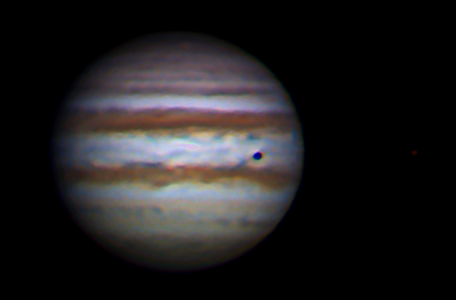
Image of the day

Captured by
John Roach

Jupiter IO Transit 12-10-26

My Account

New to Astromart?

Register an account...

Need Help?

Posts Made By: david roberts

June 6, 2003 02:24 PM Forum: Equipment Talk

Star Charting Software

Posted By david roberts

I'm looking for advice on selecting a star charting software. I plan to load the sofeware into a laptop for use in the field, not to guide a scope. I downloaded the trial version of MegaStar 5.0 but I guess as in all trials, I'm having problems. I'm also considering buying a used 4.0 version of Megastar and upgrading, but since I'm having some problems operating the trial version, I'm having doubts.

Is Megastar that buggy or is it just me. I've tried calling Willmann-Bell, the publisher, but the phone line is constantly busy. Any suggestions out there?

Thanks in advance

David Roberts

June 12, 2003 04:38 AM Forum: Deep Sky Observing

Planning your night

Posted By david roberts

I know posters have talked about this, but I think it deserves repeated attention. For me, a night unplanned is a night mostly wasted. I have gotten to the point that I now plan my nights around one constallation, and try to see everything of interest in that constallation. I use a variety of reference material and try to memorize as much as I can, or become very fimiliar with the objects before night comes. The reason is that I find myself slewing this way and that, back and forth, no rhyme or reason. Another problem is that I will see an object that is not a star and will then start searching the field references, wasting time and needing light (red) in the process to read by. I could just as easily wait until I get home to look it up, but I want to know.

Now I'm not just a stick in the mud. I save a portion of my night just for hopping around from one known object to the other, or to a special object I missed a few nights before. Anyone else use a system for observing?

regards

david roberts

April 25, 2004 04:52 AM Forum: Equipment Talk

Mirror Quality

Posted By david roberts

Over the past couple of months I've become interested in how to evaluate mirror test data such as strehl ratio, wavefront RMS, peak to valley wavefront, etc. Just what it all means. I read through a long thread (12.5 Mirror)posted here recently but realized I don't have a basic understanding on the subject. And really, a basic understanding is all I want at this time.

My key question - is there a certain point or level of quality above which really it makes no difference to the average amateur astromoner? Sometimes I read where the mirror is 1/8 or better wavelength. Then another mirror is 1/20 or better. Is the difference between 1/8 and 1/20 seen in actual use.

I own an old coulter 13.1 inch red tube which I am quite happy with. I have no test data on the primary but I believe its reasonable compared to the other scopes I've looked through at star parties. Someday I may want to upgrade to a larger truss mounted dob. I would like to specify a minimum quality or at least underastanding what is being offered for the price. I realize that it boils down to a cost relationship, and the cost would likely go up exponentially beyond a certain quality level.

Maybe I'm obsessing here but I just want to know what I'm paying for and don't what to buy a mirror that the last 10% of quality cost a bundle and I can't tell the difference anyways.

I do believe that seeing conditions, dark skys and collimation are as important to bringing out the most a mirror can offer.

Thanks in advance for your comments.

David

May 5, 2004 04:28 AM Forum: Telescope Making

What is a turned edge???

Posted By david roberts

I see the term often but have no idea what it means or how it applies to a mirror.

Thanks

david roberts

May 9, 2004 05:04 AM Forum: Equipment Talk

Question Regarding Two Products

Posted By david roberts

I'm interested in the Jack Schmidling Productions EASYTESTER I® RONCHI EYEPIECE and the EASYTESTER II "eyepiece like device" for collimation. I found them on the ADIRONDACK VIDEO ASTRONOMY site. The Ronchi tester is listed as a first pass to determine primary mirror quality. Is it more dangerous than useful? The collimation eyepiece works with a perforated mirror in the eyepiece. Seems easy enough. I use a cheshire and laser but always feel I could tweak collimation just a bit more. I have an old coulter 13.1 inch F4.5 mirror. It may be worth spending the $45 and send the mirror to Swazye for testing but I don't want the downtime. I'm happy with the mirror but have always wondered just how my mirror compares with the current 1/8 or better standard. The price seems to be right, each product around $25.

If anyone has used these products and care to share their experience, I'd appreciate it.

Sincerely

David Roberts

May 17, 2004 03:19 AM Forum: Equipment Talk

I'm Now Convinced...

Posted By david roberts

Last year I bought a Coulter 13.1 inch thin mirror model (early 90s ?) in good shape and at a good price. I've learned to collimate pretty well I believe and have some reasonable eps (wide angle meades), not naglers but still OK. I do have a 9mm Type 1 (or 2) nagler I bought from a fellow club member.

So with all of that my DSO, double star, planet, etc. views have been reasonable but not tack sharp. Of course its a fast scope and not an ultra quality mirror. I don't see the detail of Jupiter that some appear to see with smaller scopes. Stars do not resolve to a point, more like a small blur with points (but not caused by the spider vain). The stars at best focus look like a very small "V".

I tried to do a star test the other night with the 9mm and a 2x barlow. This is the highest magnification available to me at the moment. I could see the defraction rings (6 or 7) and the dark central obstruction when I racked in past focus, and just a blur of light (no defraction rings)when I racked out. I believe it was a fairly steady night for seeing.

The defraction rings bounced around and were very spikey.

From the above, and what I've read on the forum, I now believe that I'm seeing the effects of the boundary layer just above my primary and likely some tube currents.

I thought my mirror was cooled down and truth be told there was not a 10 degree change from day to night (Houston area). I don't think there was a cool down issue with the mirror but I still believe there is something going on with the air inside the tube (16-inch sonotube) that is causing some of the spikeyness I'm seeing in the focused stars and during star testing.

So I plan to install fans similar to what Mr. Sower installed. Hey what can it hurt.

I'll let you know it this helps. If so, it may encourage others it give it a try.

regards

david roberts

May 23, 2004 04:29 AM Forum: Telescope Making

Question about Mounting the Primary

Posted By david roberts

My primary mirror (13.1-inch) has come loose from the mirror cell. It was attached with a silicon-based product. The product looked like typical silicon caulk from a tube, but I'm not sure just what the product is. The mirror was already mounted when I bought the telescope used. My question - is there any difference from silicon caulk I can buy at Lowe's from the material used on an aquarium or do I need to order special material or find a fish store that has the material.

In other words, can I just use silicon caulk to reattach my mirror.

Thanks

david roberts

June 6, 2004 04:23 AM Forum: Equipment Talk

What is the Problem???

Posted By david roberts

I've attached a quick sketch I made of a slightly defocused star looking through my f4.5 reflector with a Meade 14mm swa ep. A focused star looks like a fuzzy dot, a blob actually. If I use a 2X barlow, I can see the defraction rings and the scope looks pretty well collimated, (the obstruction is pretty much dead center)however the image is jumpy and spikey due to poor seeing.

I reglued the mirror to the cell recently and this is the first attempt to collimate it.

I've been working on my collimation, but may be having a problem with the secondary alignment. I took the secondary off while working with the primary. It all looks pretty well collimated according to my laser and cheshire. Even the star test didn't look to bad. I don't think I can get it so much closer that would make a significant difference. I could be wrong though.

The seeing tonite was not very good, but I don't think I can blame this solely on the seeing. I probably have tube currents also as I don't have fans installed. I believe the scope was cooled down but it may have needed more time. The clouds rolled in pretty quick after I rolled the scope out of the garage to collimate it.

I believe I'm doing something wrong in my collimation attempt. The view has never looked quite this bad. But I've done a pretty good job a collimation before.

What's the problem - poor seeing, misalignment of secondary or primary, poor optics, a combination of things.

If one of the more knowledgable could give me some advice, I'd appreciate it.

Thanks for helping,

David Roberts

June 15, 2004 04:56 AM Forum: Equipment Talk

What the Problem Was...

Posted By david roberts

A coupe of weeks ago I posted about having what appeared to be a problem with collimation after regluing my primary. I think Pat Plunkett hit the nail when he posted he had a similar experience and thought the primary was pinched.

Well I used a thin-bladed saw with sharp teeth and basically pushed through the silicon glue. I had not used a support such as nails to keep the mirror off the mirror cell and I believe the mirror was resting on the top of the collimation screws, or just about. There was certainly way to much glue used. I went overboard shocked

For the second go around, I used three rather large nails - they cost about 9 cents a piece from Home Depot. They were about 6 inches long and maybe a 1/4 inch diameter. Beefy.

I used standard silicon caulk by GE and made three small mounds, taller than wide. I sat the mirror down and the mirror came to rest on the nails.

The mirror cell has three clips but they are more like posts that stick up about 1 inch perpendicular to the mirror cell. There was about 1/4 inch of space between the posts and the mirror. I filled those spaces with silicon.

After drying I noticed the mirror had just a slight bit of spring when I pushed down on it. I think this may compensate if the cell warps a little when tightening the collimation screws.

I reattached the mirror cell tonite and did a quick collimation and the difference was 100% better. Even with rough collimation, the stars were just about tack sharp. I've only seen it better once or twice and that was after some tweaking and good seeing. I'll get it on the money tomorrow nite.

So problem solved and lesson learned.

Thanks to all who contributed.

Sincerely,

David Roberts

June 19, 2004 10:37 PM Forum: Telescope Making

Homemade EQ Platform for Dob

Posted By david roberts

I've been considering building an Eq. platform for my dob, such as shown David Shouldice's webpage:

http://members.tripod.com/denverastro/dsdfile/dspfile.htm.

Basically I'm tired of bumping my dob for the image to stay centered, especially at higher power.

But upon further consideration, I don't want a motored version, which leads me to this point.

I want to build a platform that is a manual control for one axis. Maybe I'm thinking about a modified barndoor.

Any Thoughts ?

Sincerely

David Roberts
