Image of the day

Captured by
Erwin Forbragd

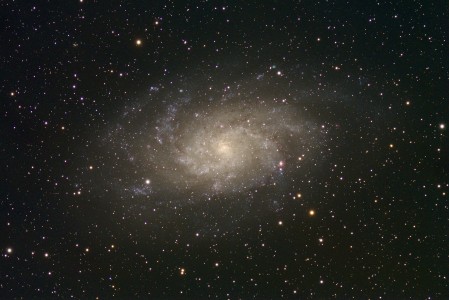
M33 in Triangulum

My Account

New to Astromart?

Register an account...

Need Help?

Posts Made By: Inge Skauvik

July 26, 2006 11:00 AM Forum: Deep Sky Observing

The best portable deep-sky scope is....

Posted By Inge Skauvik

At an age of 56, ease of handling, weight and ergonomics is important for me, and I have found what what I would consider the perfect solution for me - the Portaball. I started out some 5 years ago with the 8-inch. The scope has superb optics, is easy enough to be carried by one hand, and with the special "ball" concept it is always possible to get the eyepiece in a comfortable position while seated. Later I upgraded to the 12.5-inch which, of course, is a bigger and heavier scope. However, it is still very comfortable to use, although I normally stand while observing. It is no problem to transport it in a small car, and I brought it along to the Canary Islands this spring as checked luggage on the plane without serious problems. There is also a 10-inch version. Even the 8-inch performs well for deep-sky observation, although the larger models, of course, give even more. And still, the Portaballs are excellent scopes for double star and planet observation too.
Drawbacks? No GOTO or digital setting circles, and for tracking an eq. platform is required. The price is high for a Newtonian, but it is worth every cent, and it is probably better economy to buy a good scope and stick with it rather than purchasing a new one every time you get dissatisfied with what you have.

Inge S

August 8, 2006 06:37 AM Forum: Deep Sky Observing

A recent observing session, Walker Pass California

Posted By Inge Skauvik

Good report, Mike,

I fully agree that you easily get spoiled by dark skies. Observing under excellent conditions with a smaller scope gives a better feeling than observing under poor conditions with a bigger scope, even if you can see the same.

Nice that you mentioned M4. I observed this cluster for the first time this spring, and found it very beautiful (a bit surprising after reading some reports claiming that it was rather poor and dim). Although many clobulars are much richer, the stars of M4 are bright enough to show some colour with a scope with moderate aperture. I enjoyed it very much.

Inge S

August 14, 2006 02:09 PM Forum: Deep Sky Observing

What do I need for a limiting magnitude

Posted By Inge Skauvik

How far above the horizon are the objects you try to see? If the sky transparency is poor, objects near the horizon may be very difficult to spot, even while moderately faint stars near zenith are visible.

One of the easiest galaxies to spot under poor conditions is M94. Even at full moon it can be seen with very small telescopes, but, of course, it isn't an impressive sight.

Inge S

August 16, 2006 06:16 AM Forum: Deep Sky Observing

Is seeing important for the deep-sky observer?

Posted By Inge Skauvik

Hi all,

Many good points. Locating small planetary nebulae is very difficult when seeing is bad. I normally consider seeing as "bad" when the star images at my lowest magnification (63x) are clearly diffuse. Then the star images are cotton balls with 2 - 3" diameter, and as such all of them looking more or less like small planetaries. Blinking with an O-III filter may help finding the objects, though.

Extended diffuse nebulae like the Pelican Nebula or North America Nebula definitely suffer the least, but the aestethical impression is not the same since the stars look unsharp.

Many of the obscuring clouds and emission regions in distant galaxies are small in extent, and will definitely be washed out by poor seeing. One of my best sights ever of M82 was with the 8-inch Portaball under excellent seeing conditions and a magnification of 170x.
Another sight to remember was the Eskimo nebula with my friend's 18-inch and O-III filter, once again under superb seeing. At a magnification of around 250x we could enjoy the delicate features of the nebula. We have returned to this nebula later without being able to make out half as much detail.
I also think that seeing is very important for detecting the spiral structure of small face-on galaxies like M99 and M61. I find it very difficult to see much detail in these galaxies at 63x magnification. About 200x is much better, and the features of these objects are very delicate and need very stable seeing for a good view.

Inge S

August 20, 2006 08:10 AM Forum: Deep Sky Observing

8 inch SCT vs 12 inch SCT for galaxies

Posted By Inge Skauvik

I stepped up from 8 to as.5 inches of aperture a few years ago, and can confirm that this makes a significant difference on galaxy observation.

Under excellent skies, I could make out the spiral structure in M51, M33 and M101 with the 8-inch, but it required patience, and perhaps some imagination. With the 12.5-inch I actually see these features with direct vision under dark and transparent skies. With the 12.5-inch I also see the spiral arms of M99, M61 and NGC2907. I could never see the equatorial dust lane of NGC891 in Andromeda with the 8-inch, but it is rather obvious with the 12.5-inch. I also see the dust lane of the large elongated galaxy in the same field as M65/66 (I'm on vacation and don't have my maps at hand and don't remember its NGC-number).
Just remember to use sufficient magnification when observing galaxies. I use 115x for M33 and M101, and 167x for M51 and the smaller ones to make out most detail.

Inge S

August 24, 2006 06:19 AM Forum: Deep Sky Observing

No galaxies but one

Posted By Inge Skauvik

Dmitri,

Great report. I fully agree - the Milky Way seen from a southern location is the most impressive and beautiful of all deep sky objects - even without a telescope. I also found M7 to be the brightest knot in the star clouds in the central region.

Of course, I envy you the sights of the great doubles. In fact there are many doubles in the Centaurus and Lupus region remaining on my "to do" list of future expeditions to the south.

I don't remember the id of the multiple star at the centre of M20 - I think it is HN-something.

M83 and NGC5128 are great objects when favourably placed in the sky, but they don't compete with the great nebulae of Sagittarius. I just can't forget the sight of M8 in my 12.5-inch and O-III. It was absolutely superb.

Inge S

September 28, 2006 05:24 AM Forum: Deep Sky Observing

Footprint nebula

Posted By Inge Skauvik

Dmitri,

The "Footprint nebula" is unknown to me. Where is it located? Is there any reference to it in Kepple&Sanner?

Inge S

October 7, 2006 09:29 AM Forum: Deep Sky Observing

Cepheus spiral, NGC6946

Posted By Inge Skauvik

I agree that this galaxy is an overlooked object. It is pretty bright and large, and quite impressive in mid-sized scopes. I recommend everybody with scopes with aperture from 12.5-inches to look for the spiral arms.
I also like the nearby cluster, 6939. In my opinion it is the best open cluster in Cepheus.

Inge S

October 20, 2006 06:09 AM Forum: Eyepieces

Zoom eyepieces for high power - TeleVue?

Posted By Inge Skauvik

Thank you, everyone.
I have already put this eyepiece on my purchase plan. Of course, I'm a bit spoiled after having used Naglers, Panoptics and Radians the last year or two. But, after all, I was very happy with the 45 degree field of the orthoscopics before I acquired the TV eyepieces.
With my focal length, the 3-6mm zoom eyepiece will cover the magnification range between 250x and 500x. This may be high for nights with moderate seeing conditions. But I hope that I'll experience many nights when I can fully utilise the potential of this wonderful eyepiece.

Inge S

October 22, 2006 08:18 AM Forum: Deep Sky Observing

North America Nebula, hard to see?

Posted By Inge Skauvik

With a telescope where you can't go very low in magnification the nebula appears very large and ill-defined. However, it shouldn't be difficult to detect it with your telescope under dark skies.
I use a very simple trick to bring out very diffuse nebulosity. I gently swing the telescope from side to side (a movement of some 30 - 50% of the field of view). This makes large and diffuse objects more easy to spot, and as soon as your eyes have discovered the object, you can stop the movement, and it will still be visible.

Inge S