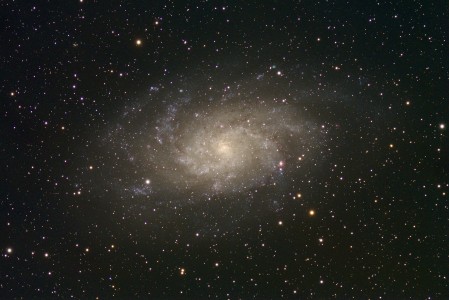
Image of the day

Captured by
Erwin Forbragd

M33 in Triangulum

My Account

New to Astromart?

Register an account...

Need Help?

Posts Made By: Inge Skauvik

January 25, 2007 07:21 AM Forum: Deep Sky Observing

Observing session January 22

Posted By Inge Skauvik

In his fine report Dmitri mentioned NGC1999. This nebulosity is pretty obvious with apertures of 8 inches and above, but it is surely a target even for smaller equipment.
It is a bit strange that is is so seldomely mentioned in observation report. It isn't a very structured and interesting object, but it is very easily found. Start at M42, move south past the triple star, Iota Orionis and slightly further, and there it is!

Inge S

February 12, 2007 06:48 AM Forum: Deep Sky Observing

Observing in Brazil, February 2-6

Posted By Inge Skauvik

Dmitri,

Great report! I really hope to have a chance one time to see with my own eyes some of the marvellous objects you observed down there.

The Barnard galaxy will be well placed for observation from La Palma in September. For the Coalsack you'll have to find another occasion.

Inge S

February 28, 2007 07:14 AM Forum: Deep Sky Observing

Features in some selected diffuse nebulae

Posted By Inge Skauvik

Obviously diffuse nebula don't appeal so much to the participants of this forum. I'll give my comments to the listed objects myself, and still encourage you to use the next opportunity to have a look at least some of them.

1: NGC2024. (Near Zeta Orionis). My score: 1.
The nebula can be overlooked unless the bright star is put outside the field of view.
2: NGC1579 in Perseus. My score: 1.
A pretty bright and large object showing some detail. A narrowband filter will kill it, since it is a reflection nebula.
3: IC410 in Auriga. My score: 3.
Maybe a hint of it can be detected without a filter, but the O-III makes an enormous difference. The nebula is large and is shaped as a letter "C". The cluster involved can hardly be considered a show object.
4: Dark lane in NGC2024. My score: 1.
Just keep Zeta Orionis outside the field. I prefer not using a filter for this nebula.
5: Dark channels in Rosette nebula. My score: 4.
To see these delicate features an O-III filter is neeeded and the sky must be very dark and clear. Still the bok globules of the Rosette are much easier to see than the Horsehead nebula.
6: NGC2174 in Orion. My score: 1.
For some strange reason this object is almost unknown to many observers. I have to admit that I observed it for the first time myself just a year or two ago. In fact it is one of the most interesting emission nebulae of the northern winter sky. Already without a filter it appears as an obvious aura around the coarse cluster, NGC2175. With the O-III it is bright, large and with an interesting shape. In my opinion it is superior to NGC281, the "Pacman" nebula in Cassiopeia.
7. Obscuring cloud in western part of NGC2174. My score: 3.
Although invisible without a filter it is pretty striking with the filter in place.
8: IC443 (SNR near Eta Geminorum). My score: 4.
This is a difficult object. It is completely invisible without a filter, and even with the filter only the brightest part of it can be seen - a rather small segment of the arc visible in photographs.
9: NGC1788 in Orion. My score: 1
Another pretty large and moderately bright nebula. In the same league as 1579 in Perseus.
10: NGC2245 in Ophiuchus. My score: 1.
This object resembles NGC2261, Hubble's variable nebula. It is a bit fainter and has a more delicate (silky) appearance than 2261.

There are many more diffuse nebulae along the milky way. Quite a few of them are small fuzzies best suited for big scopes, but there are some exceptions that are more likely to be detected with a small scope with a wide field of view than with a big one.

Inge S

March 23, 2007 10:08 AM Forum: Deep Sky Observing

Another hymn to 15x70

Posted By Inge Skauvik

Dmitri,
Thank you for your interesting report. I have hardly used binoculars for astronomy myself, and sometimes I miss the option to make observations of large fields at low power. I did, however, look through my friend's 20x80 binoculars at La Palma last year, and I was amazed by the view of the Veil nebula.
I have considered getting a pair of astro-binoculars for myself - time will show if I have to pay for the binoculars or the fine for not owning them.

Inge S

March 28, 2007 07:41 PM Forum: Deep Sky Observing

Full moon vs nebulas and star clusters

Posted By Inge Skauvik

With the moon present the fainter galaxies will disappear and most of the detail in the brighter ones will vanish. I don't observe galaxies or nebulae if the moon is above the horizon in the period between first and third quarter. However, I occasionally show one of the brighter globulars, opern clusters or even the Orion nebula to occasional visitors. It is possible to see individual stars in M13, M3 etc. even at full moon with a 12-inch, but the objects show very little of their true splendour under such conditions. If I observe with the moon present I concentrate double stars, planets or the moon itself.
If you really can't live without deep-sky objects during the full moon phase, you may observe some of the brighter planetaries. The Eskimo nebula, the ring nebula, M27, NGC7662 and NGC6543 all have a high surface brightness to be seen well under moonlit conditions. I don't have good experience with the O-III filter under such conditions, though. The filter dims the sky background considerably, but I find the ambient light very distrubing.

Inge S

April 10, 2007 08:59 AM Forum: Deep Sky Observing

Do any of these improve night vision?

Posted By Inge Skauvik

I don't think that carotenoids or Vitamin A (or any other nutrients or medications) will significantly improve night vision. However, regular intake of Vitamin A is definitely recommended to keep your eyes in shape. Quite a few people get a reduced ability to resolve detail when they get older. This is related to the retina, and can not be corrected by glasses or contact-lenses. Vitamin A is said to delay or even prevent this process.

Inge S

April 10, 2007 07:30 PM Forum: Reflectors

High performance visual viewing machine

Posted By Inge Skauvik

A few additional comments:

I never doubt that Starmaster and Obsession are excellent scopes. I also believe that adding tracking devices can make them even more comfortable to use. However, I'm worried about weight and ease of set-up. I normally have quite unstable observing conditions, and there is always a risk that clouds may come in while I'm busy setting up the scope. Therefore I prefer a scope that can be set up very fast and easy and/or be collapsed to a volume small enough to be brought along as checked luggage with the airlines. The 12.5-inch Portaball fulfills these requirements although it is on the large and heavy side for a travel scope.

Obsessions and Starmasters look a bit clumpsy and heavy. t-scopes on the other hand, offers a line called far-star telescopes which look extremely compact. Also the Plettstone scopes appear to be light for their aperture. These are my impression mainly from looking at photos and may be completely wrong. I therefore need comments from people who actually have used such telescopes.

Adding GOTO functionality seems to improve the ergonomic aspect of observing, at least the ability to maneuvre around the difficult spot at zenith. Once again I'm a bit sceptic. I fear that implementation of GOTO means additional wires, gears and stuff that will harm portability and ease of set-up. Any comments to this?

Inge S

April 13, 2007 05:52 AM Forum: Deep Sky Observing

What is the latest word on Galaxy Filters?

Posted By Inge Skauvik

My personal opinion: I don't believe that it is possible to make a galaxy filter with any significant efficiency today. Any filter works by blocking out part of the electromagnetic spectrum. The intensity of undesired light is strongly reduced while (almost) all the light of the celestial object is allowed to pass. If the desired and undesired light have strongly different spectral distribution, the filter will work. This is the case for emission nebulae, since they emit a very large amount of their visible light within a small wavelength band.

Galaxies have a more or less continuous spectrum, not very different from sunlight (emission and absorption lines are there, but they don't contribute significantly and are spread over the enitre spectrum). Undesired light may differ from place to place, but my impression is that high-pressure sodium lamps make the strongest contribution at most urban places in the western world. The spectrum of these lamps somewhat differs from galactic light, but they emit some radiation almost across the entire spectrum, making this light almost impossible to filter away.

I'm old enough to remember the time when low-pressure sodium lamps were used. This light would have been possible to block out since almost 100% of the radiation came from a double spectral line in the orange-yellow part of the spectrum.

Mercury lamps also emit almost all their light at a few wavelengths within the visual spectrum. Unfortunately they are spread over almost the whole spectrum, and an efficient mercury-lamp rejection filter would be very expensive to make.

I hate high-pressure sodium lamps.

Inge S

May 4, 2007 06:09 AM Forum: Deep Sky Observing

What do you observe?

Posted By Inge Skauvik

My statistics are not too different from Dmitri's. However, I spend more time observing planetary and diffuse nebulae. I have also included supernova remanents as a separate group even if I only observe three of them (M1, the Veil and IC443 in Gemini). I very often return to the Veil, and observe it more often than the moon.

I didn't make a pie chart, but give just the figures here (based on the number of records in my log, not the time spent).

Planets: 5%
Moon: 2%
Doubles: 36%
Galaxies: 27%
Open clusters: 6%
Globulars: 4%
Diffuse nebulae: 7%
Planetary nebulae: 10%
SNR: 3%

The sun and comets are not included even though I occasionally observe such objects. In periods with Jupiter present I spend more time on planets.

Inge S

June 4, 2007 06:04 AM Forum: Deep Sky Observing

question on old star charts

Posted By Inge Skauvik

There bookstore at the tehcnical university of Trondheim had a copy of such an atlas (probably the one you are talking about) when I was a student in the early 70ties. (A bit strange since there were no students of astronomy at the university). I didn't buy it for two reasons. It was too expensive for a poor student and I didn't find it very handy. As far as I can remember, there were no labels on the star, and it was really hard to figure out which part of the sky was shown on a randomly picked sheet. I still have some problems realising what such an atlas actually can be used for. I didn't find any DSO's on any of the (few) sheets I looked at.

Inge S