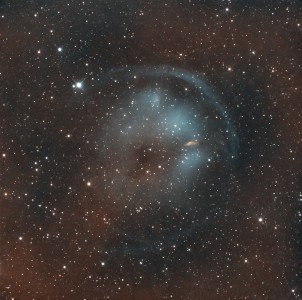
NGC7027Posted By Inge Skauvik |
Indeed, 7027 is bright. Even the slightest optical aid will make it visible, but like several other planetary nebulae, magnification is needed to appreciate them as nebulous objects.
For faint, small planetaries (9th magnitude or fainter) I often use the blinking technique with an O-III filter to identify them. The brighter ones, like NGC7027 reveal themselves by their colour. In a recent post I mentioned NGC6572 in Ophiuchus. This nebula is significantly brighter than 7027, and extremely vividly coloured.
The same night as I observed 7027 I also had a look at NGC7662, the "Blue Snowball". Once again I noticed a feature that I hadn't noticed before. 7662 is appears distinctly annular with sufficient aperture and magnification. I just find it strange that I have overlooked this earlier.
Inge S
