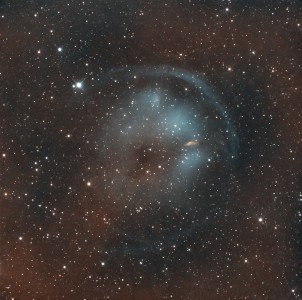
Image of the day

Captured by
Yue Ma

HFG-1

My Account

New to Astromart?

Register an account...

Need Help?

Posts Made By: Inge Skauvik

March 3, 2008 07:26 AM Forum: Deep Sky Observing

Opinions?

Posted By Inge Skauvik

As many other experts in the forum already have stated - the best magnification depends on which galaxy you observe.

Looking at photos of two different galaxies, e.g. M99 and M101 you could get the impression that they are similar in both size and appearance. However, M99 is tiny compared with M101. I would suggest a magnification around 100x for M101, but at least 170x for M99.

I don't say that M101 is an easy object to detect the spiral structure in. With my previous, high-end 8-inch Newtonian I could see the arms and the emission condensations in it only under very good sky conditions. Any scattered artificial light or auroral glow would make these details disappear. With 12.5 inches of aperture I observe them regularly. To me it is the most beautiful of the spirals.

Inge S

June 2, 2008 06:34 AM Forum: Deep Sky Observing

Two Superb Nights at Cherry Springs

Posted By Inge Skauvik

Dave,

Nice report!
Viewing the great galaxies through the 32-inch must have been a great experience.
BTW, At which latitude is Cherry Springs?

Inge S

July 21, 2008 05:16 AM Forum: Deep Sky Observing

book on double stars

Posted By Inge Skauvik

Tim,

You should also be aware of the double star forum under this site. There you will learn many interesting things from dedicated double star observers.

Inge S

August 1, 2008 05:41 PM Forum: ASTRONOMY

The 1st of August 2008 solar eclipse

Posted By Inge Skauvik

Writing from Novosibirsk, I would like to give a short report of the event. Some clouds around noon made us all worry a bit, but as the moon started to move in front of the solar disc, the sun only occasionally was covered by thin clouds, and it was completely clear during totality.
Unlike most visitors from abroard I decided to mingle with the Russians, and observed the eclipse from the eastern shore of river Ob. Local astronomers put up an enormous number of TAL-refractors there to show the public the partial phase of the eclipse. The number of people gathering was amazing, and as the "diamond ring" appeared just before totality, people shouted and screemed. I observed most of the totality through unfiltered binoculars. The corona showed the elongated structure as expected near sunspot minimum. The delicate structure of the magnetic field lines was very nice, also near the poles. One quite obvious prominence was visible on the right hand side some distance from the north pole. I didn't waiste any time looking for stars in the dark sky, but both Mercury and Venus were shining bright, and Mercury could be seen together with the moon's disc and the corona through the binoculars.
I made one observation that I actually didn't expect. As the totality approached the end, the red photosphere became very obvious along a quarter of the moon's diameter. A very beautiful sight!!! As the diamond appeared on the right hand side of the moon, people started shouting and applauding. After totality it was still interesting to observe the colour of the landscape and the sky.
This was an experience for life. Hopefully I'll have more chances to view this phenomenon. It is just incredible.

Inge S

August 5, 2008 09:00 AM Forum: ASTRONOMY

Siberian delights .... photos

Posted By Inge Skauvik

Anthony,

Excellent photos. Links like yours are the reason why I didn't even try to make photos myself. I can't say that I was able to capture all the details of the photos through the binoculars, but much of it was, indeed, visible.
I hope you too had the chance to enjoy the eclipse visually.

Inge S

September 2, 2008 05:31 AM Forum: Deep Sky Observing

stephan's and other faint fuzzies

Posted By Inge Skauvik

George,

Thanks for your report. We picked out all five Stephans from the summit of La Palma last year with my 12.5-inch. The darkness, tranpsarency and seeing were all excellent. From home it is often difficult to even spot Stephans quintet with the same scope. I regret that I'm not familiar with the other galaxy groups you mention. Are they located in the Pisces region?

Inge S

September 23, 2008 06:54 AM Forum: Deep Sky Observing

The benefits of aperture

Posted By Inge Skauvik

Rick,

I strongly recommend that you get yourself an O-III or UHC filter to use with the 8-inch. This will add another dimension to your observing. Personally I recommend the O-III. This filter works wonders on the Veil nebula, and objects like the Rosette nebula and Crescent nebula (NGC6888 in Cygnus) are difficult to detect without the filter, but stand out clearly with considerable detail when a filter is applied.

But be careful! I didn't use the 8-inch for many years before I just had to upgrade to a 12.5-inch scope.....

Inge S

November 3, 2008 06:09 AM Forum: Deep Sky Observing

Two amazing nights at Pettigrew, NC.

Posted By Inge Skauvik

Nice report, Andreas.

Let's have more of this. Partuicularly I liked your format with detailed comments about the highlights followed by the full list of observed objects.

Inge S

November 19, 2008 06:39 AM Forum: Deep Sky Observing

The Veil from an Urban Backyard

Posted By Inge Skauvik

Jon,
Thanks for the report. You are indeed right that some diffuse nebulae can be observed under less than perfect conditions. I once observed the Veil from my driveway when a truck stopped 20 metres away with the headlights directly pointing at me. I still could see the brighter filaments of the nebula, but I quickly closed my eyes to save my night vision.

As a next challenge you may try to see the Crescent nebula (NGC6888) in Cygnus. It is much smaller and fainter than the Veil, but with the O-III filter you should have a chance of detecting it. There are also some not so frequently observed diffuse nebulae in the winter Milky Way (Perseus, Auriga, Monoceros). Most of them are, however, rather featureless, but nebulae like NGC1931 (on the route between M36 and M38) and NGC2261 (Hubble's variable nebula) are bright enough, and may be visible even without a filter.

Inge S

December 31, 2008 10:24 AM Forum: Deep Sky Observing

How to observe

Posted By Inge Skauvik

Alex,

As a starting point, I'll tell you how I make my observations of one particular group of objects, open star clusters. These objects vary quite a lot in appearance, and are therefore among my favourite deep-sky targets.

After having located the object, try out different magnifications, and decide which one gives the best impression of the objects.

Give an estimate of the total number of stars you can see!
Which is the magnitude of the brightest stars and the majority of the stars?
What is the approximate visual diameter of the cluster?(Knowing the field diameter of your eyepieces in arc-minutes you may use this as a scale).
Which is the general shape of the cluster (round, elongated, irregular)?
Do you see any colour in the stars? If all stars are very faint this may be difficult to see, but many open clustars contain stars brighter than the 8th magnitude, and then it is usually easy to see some colour.
Is there any nebulosity associated with the cluster? Any dark voids?

Does the cluster contain any double stars? Some clusters, e.g. M34 contains very close doubles, requiring magnifications of 200x to split them.

Asking this kind of questions will normally make you spend more time with the object, and give you the chance to discover interesting features which otherwise would go undetected. Using enough time is very important.

I'll be back later with hints of observing other kinds of objects.

Good luck!

Inge S